


With its voluminous accommodation and secure cockpit, the Arion 29 is a low-draught Polish-built cruiser is ideal for family coastal cruising – and a bit of canal pottering…
Arion 29 used boat review: The Polish pocket cruiser built for the canals

In October 2019, my wife Anna and I decided to sell our Victoria 26. We loved the boat and had experienced some fun times with her, but she was just a bit too small for a family of four. Plus, she was a tad tippy. One of the people who viewed Ronja when she was for sale was Mike Hornsey, a friend of a friend.
Mike bought another boat in the end and, although he lived in Warwick, he based it in Devon. I was intrigued to see what he had bought instead, in the same way you might be curious to meet your sister’s ex’s new girlfriend. Not only that, but the boat was an Arion 29, built in Poland, which I knew nothing about. So when he suggested going out on Pelagia, I jumped at the chance.
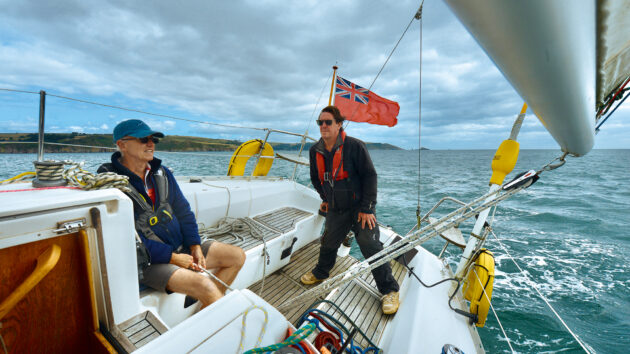
Mike decided to follow his dream of sailing to the Med via the French canals. Photo: Nic Compton
Less pretty, more practical
It was a bright, sunny day, with a flat calm sea and sudden gusts of wind coming off the land, when Mike and Brian (the mutual friend) emerged from Dartmouth. My first impressions? Honestly, she was not as pretty as Ronja. The Victoria 26, an evolution of the Frances 26, has a timeless, classic appeal. As far as I’m concerned, you can’t go far wrong with a slippery little double-ender.
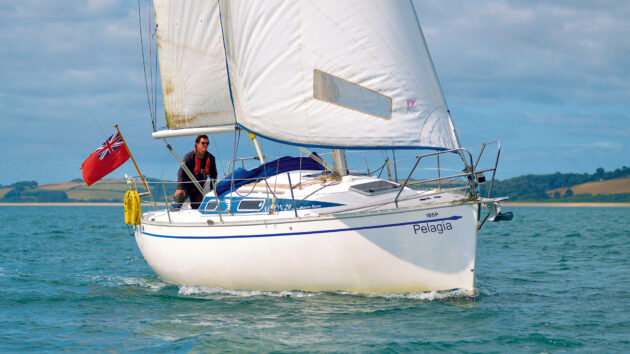
The Arion 29, on the other hand, is a very different kettle of fish. With her high freeboard, flat sheer, and blunt ends, she is very much designed for comfort rather than elegance. She is practical rather than pretty.
Second impressions? Wow. When I eventually clambered on board and went down below, I was mightily impressed by the voluminous interior and the well-crafted pale oak joinery. Even I had to admit that this was palatial compared to my beloved Ronja. I discovered other very good reasons why Mike chose Pelagia as I chatted to him in the cosy saloon.
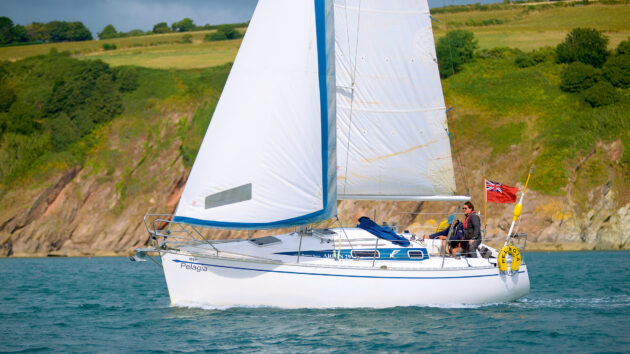
The Arion 29 was built in Poland to a design by Adam Orych. Photo: Nic Compton
Lifting keel
A relative newcomer to sailing, Mike’s main experience seems to have come through his brother and sister. One owned a 58ft Ferretti motor yacht and the other had sailed from Miami to Australia on a 36ft ketch with three children. With family like that, Mike was understandably content for a long time to let them take the burden of ownership while he rocked up for the occasional cruise.
Things changed in 2019 when, following a change of circumstances, he found himself with time on his hands and money in the bank. He decided to follow his long-standing curiosity about sailing, and in particular, sailing a boat to the Med via the French canals.
Mike explains that he was under no illusion, having listened to the stories of highlights and downsides like storms, damage, seasickness, and attempted piracy. He had none of the skills or the experience needed to undertake such adventures, just a desire to experience a taste of it.
It was not lost on him that a Competent Crew ticket in his back pocket wasn’t going to solve all his problems. Experience was what he needed, so he signed up for a Competent Crew course at the SeaRegs Training school in Plymouth.
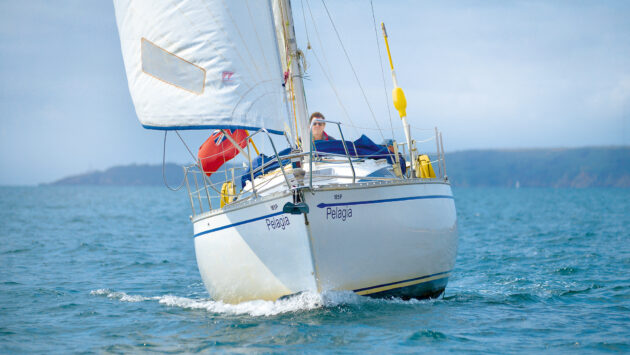
The helm is light and well balanced, at least in light airs. Photo: Nic Compton
That is when he met Brian, our mutual friend, who was an instructor on the course. At about this time, Mike’s son bought a flat in Kingston Upon Thames, which Mike agreed to help to refurbish. Rather than pay extortionate London rent while working on the flat, he decided it would be a good idea to buy a boat, moor it at Shepperton Marina, and live on board instead. Once the flat was completed, he reasoned, he could take the boat down the French canals.
It took a very particular kind of boat to meet all these criteria. A canal boat would have been the obvious choice, or a sailing boat without too much draught and a mast that could easily be lowered. Our Victoria 26 had been fitted with an ingenious mast-lowering system and came with a trailer. Her accommodation, however, was relatively ‘compact’ for anyone thinking of living on board for six months.
Enter the Arion 29, with her generous interior and lifting keel. She came with a built-in mast lowering arrangement which made Ronja’s retrofitted arrangement look clunky by comparison. Better still, the boat was located in Norfolk on the Broads, which was relatively close to the Thames and thence to Shepperton. And so, one fine day in March 2020, Mike and Brian collected Pelagia from Barton Turf and headed down river to Great Yarmouth.
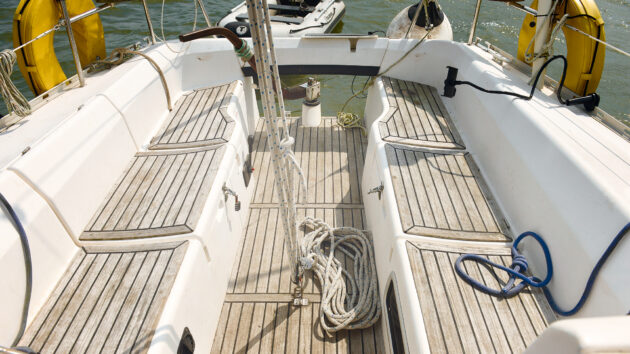
The cockpit is deep enough to feel secure. Photo: Nic Compton
There, they raised the mast for the first time. From Great Yarmouth, they sailed around to Gravesend, where they lowered the mast again and headed up the Thames. They got as far as Teddington before they were stopped by a sunken narrowboat in a lock blocking the way ahead. A week and a half later, the first Covid lockdown came into effect, and Pelagia was stuck at Teddington for the next 12 weeks.
By the time Mike reached Shepperton Marina, the flat extension project had been put on hold. With his dreams of sailing down the French canals slipping through his fingers, Mike found himself with a boat moored high up the tidal Thames, paying London-size mooring fees. This is when Brian had the bright idea of sailing Pelagia down to Devon, on the River Dart. That was just yards away from where our boat Ronja had been moored. Their trip down the Thames was an adventure in itself, but that’s another story.
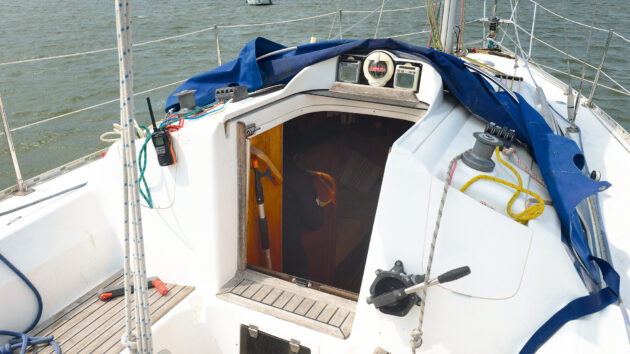
Wide, easy to access, companionway. Photo: Nic Compton
Polish builders
So, did Mike make the right choice? Polish builders Skipper Yachts had a good run in the early 2000s with a range of sailing yachts. This included the Pegaz 28, which was nominated for Best Boat of the Show at the 2006 Helsinki Boat Show. The yard sold 50 Pegaz 28s in a year, mainly to Germany and Scandinavia.
The Arion 29 was the follow-up by designer Adam Orych, providing a bit more accommodation space and performance. An upgraded Comfort version—with a navy blue hull, teak decking in the cockpit, and an American cherry interior—was built specifically for the Scandinavian market.

Voluminous interior with well-crafted pale oak joinery. Photo: Nic Compton
This version became known as the Baltic Edition. Mike’s boat was the regular version (albeit with teak decking in the cockpit) which had somehow managed to find its way across the North Sea all the way up to Barton Turf.
Mike was the boat’s fourth owner, and the third to dream of taking the boat through the French canals to the Med. In many ways, the Arion 29 is an ideal boat for such a journey, with her comfortable interior, shallow draft, and built-in mast-lowering system. Although originally designed with a fin keel giving a 4ft 11in (1.5m) draught, the centreboard version draws a mere 1ft 5in (0.43m) with the centreboard up. With the centreboard down, the draught is 5ft 3in (1.6m). The rudder lifts to a similar draft.
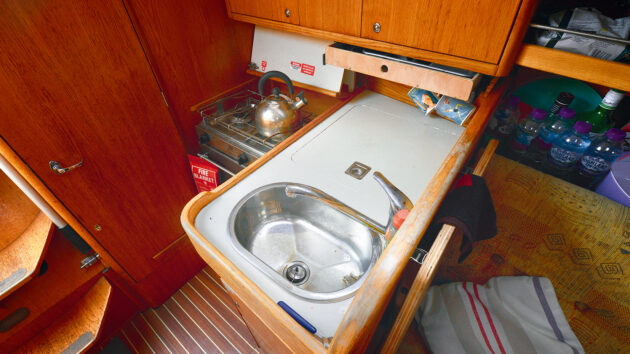
A well designed galley area makes the most of the space. Photo: Nic Compton
Shallow draught
A draught of 1ft 5in on a 29-footer seems like a minor miracle to me. Even a shoal-draught Beneteau First 29 draws 2ft 4in (0.72m). This shallow draught would of course have positive and negative consequences on the boat’s performance. By the time I took up Mike’s invitation to sail on board Pelagia, he had been moored on the Dart for around three years.
He and his son had both passed their Day Skipper exams on the boat. He had sailed the boat regularly in the local area, including trips to Salcombe, Brixham, and Torquay. The trip down the canals to the Med didn’t seem any nearer, however, not least due to having acquired a couple of dogs.

The decent-sized heads is big enough for a small family. Photo: Nic Compton
The boat was largely unchanged from how she was when Mike bought her, though he has addressed some design and construction issues. The centreboard had a tendency to slap against the side of its case. Mike has fitted an ingenious pair of nylon bolts on either side of the case which can be tightened from inside the saloon to hold the board in place. In practice, one side usually remains fixed while the other side is tightened or loosened depending on the position of the board.
Likewise, the rudder hinge has proven problematic, with insufficient leverage to lift it easily. This lifting is necessary when the boat is left on her mud berth. Mike is an engineer, however, and will no doubt find a solution. Mike has also upgraded the boat’s electrical systems. He was shocked to find house-grade cabling had been used by the original builders instead of the expected marine grade.
He’s replaced all the fuse holders, re-ran the wiring in the mast, and fitted LED bulbs in the nav lights. He also fitted USB chargers inside and out, and a plug for an autopilot in the cockpit. He even designed a retro-fit electric motor replacement but eventually gave up on the idea due to ‘range anxiety’ and the cost of installing it.
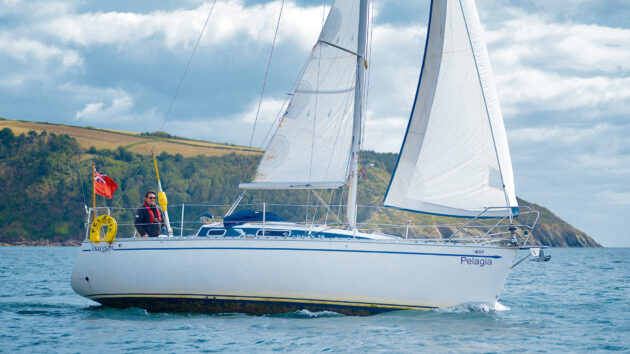
Pelagia’s shallow draught and light displacement create minimal drag through the water. Photo: Nic Compton
Arion 29 specifications
DESIGNER: Adam Orych
YEARS BUILT: 2006-11
LOA: 29ft 6in/9m
LWL: 22ft 11in/7.30m
BEAM: 9ft 8in/2.98m
DRAFT: 1ft 5in/0.43m (c/b up) 5ft 3in/1.6m (down)
DISPLACEMENT: 6,600lbs/3,000kg
BALLAST: 1,760lbs/800kg
SAIL AREA: 398ft2/37m2
PRICE: £20,000-£35,000
Enjoyed reading this?
A subscription to Yachting Monthly magazine costs around 40% less than the cover price, so you can save money compared to buying single issues.
Print and digital editions are available through Magazines Direct – where you can also find the latest deals.
YM is packed with information to help you get the most from your time on the water.
-
-
- Take your seamanship to the next level with tips, advice and skills from our experts
- Impartial in-depth reviews of the latest yachts and equipment
- Cruising guides to help you reach those dream destinations
-
Follow us on Facebook, Twitter and Instagram.
Note: We may earn a commission when you buy through links on our site, at no extra cost to you. This doesn’t affect our editorial independence.
Verdict
Pelagia came gliding out of Dartmouth at a good speed at the start of our sail. Her shallow draught and relatively light displacement of 6,600lb (3,000kg) mean there’s not a lot of drag in the water to slow her down. As a gust came off the hillside, she accelerated quickly on the flat waters that prevailed that day. On board, with her high freeboard and high cockpit floor, the Arion 29 feels like a bigger boat than she is. You might go so far as to say she’s a bit top-heavy, and certainly I prefer being closer to the water. Others will enjoy the feeling of safety of being so far above the sea. The sun was out, the sea was blue and all was well with the world, until we were hit by a stronger gust of wind. For a few moments, the boat lost steerage and headed up into the wind. It’s not the first time I’ve experienced this on a modern centreboarder, and it’s a disconcerting feeling. Mike thought it was perhaps because she was over-canvassed and that once they put in a reef she behaved much better, although by then I was back on the camera boat taking photos. Another possibility is that the 110% genoa set on a 9/10 fractional rig is a tad too small and she needs more sail up forward to help balance the helm. More generally, Mike reckons he regularly gets speeds of 6 or 6.5 knots out of her, and I can believe him. I’m tempted to say that she wouldn’t perform so well in a strong wind and a chop, but a review in a German sailing magazine suggests otherwise. The magazine reported, ‘With Force 4 winds and just under one meter of onshore waves, the Comfort Arion is truly a joy to sail.’ They continued, ‘The boat sets smoothly and can be easily kept on course with just two fingers on the unfortunately too-short tiller. There’s hardly any spray, the helmsman’s position is good, the cockpit allows for relaxed seating even in waves, the Polish boat conveys a high degree of safety.’ Not having experienced the boat in those conditions, I bow to their judgement. The Arion 29 would certainly provide a comfortable family home-from-home for coastal cruising and canal pottering—but perhaps not for sailing around the world.