



Saare’s new flagship might look conservative, but those lines hide a thoroughly modern cruiser that takes the fight to the yard’s bigger rivals. Theo Stocker went to find out how she measures up
Saare 47 review: A proper take-you-anywhere cruiser
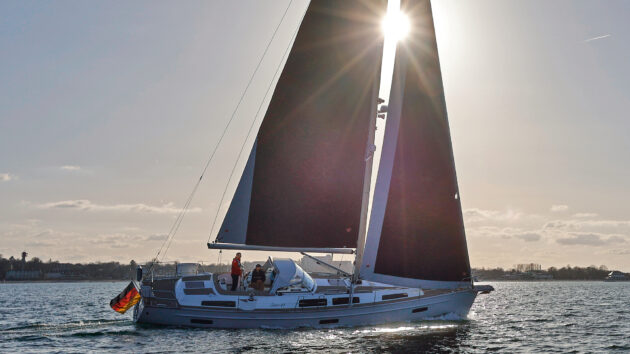
The afternoon sunlight had the sharp clarity of spring in the Baltic. Low shafts of warmth cut through cold winter shadows as we drifted out past the church spire, the lighthouse on the harbour mole, and the basket-chairs deserted on the white sand beach.
The mirror-flat water ruffled into a soft carpet across which the boat glided silently. Gradually, the breeze shifted and tumbled over the town, fluctuating from 5 to 17 knots. My eyes were glued to the telltales, but in such an unsteady breeze, our wake was that of a drunkard.
I was in Eckernförde, where Germany teeters on the edge of Scandinavia, to sail the new Saare 47, the luxury flagship of this small-volume boat builder. If you’ve not heard of Saare Yachts, that’s because they only build half a dozen or so boats a year.
The brand, though relatively young, has a long history, having grown out of a yard where 250 Finngulf yachts were built on the Estonian island of Saaremaa, where its centuries-old boat building heritage pre-dates its Soviet era isolation.
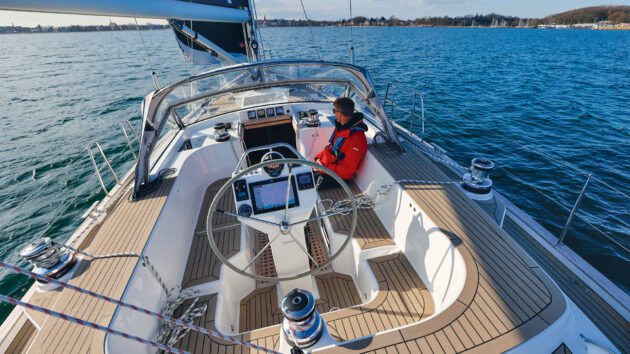
A deep centre cockpit is well protected. All but the port halyard winch are powered. Photo: Paul Wyeth
Many other well-known yacht marques have their hulls moulded on the same island, close to the University of Tallinn’s faculty of naval architecture. In 2016, the yard was bought by Saare’s German dealers, who now work hand in hand with their Estonian colleagues, with the aim of creating a small but steady stream of beautiful boats, built properly, by a long-term sustainable business to designs that evolve slowly without chasing fashions (something of a theme for many Baltic boatyards).
Now, the Saare 47 is a serious, long-distance blue-water cruising yacht, capable of taking on the world’s oceans. Light, flukey airs might not be the conditions you’d want to test a boat’s heavy-weather capability for mid-ocean storms, but they can tell you a lot about a hull. She may have stunning joinery, a full owner’s suit aft, and space for a washing machine, but this boat is comparatively light at 13 tonnes.
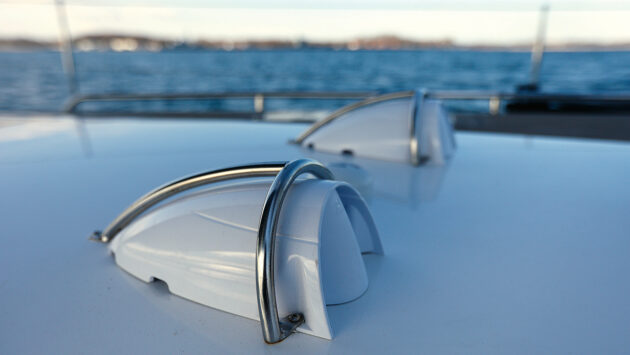
Fixed dorade vents are well protected. Photo: Paul Wyeth
This is a good two tonnes lighter than some of her immediate competitors. Unlike many modern boats, however, she has retained the relatively slender and well-balanced lines of her smaller sisters that result in such slippery and easily driven hulls.
Below the water she is relatively deep and evenly rounded with minimal wetted surface area and the shape of a capable sea boat. Augmented by a ballast ratio of 40% with 5 tonnes of lead at the bottom of a 2.2m keel, she promises to be stiff and weatherly.
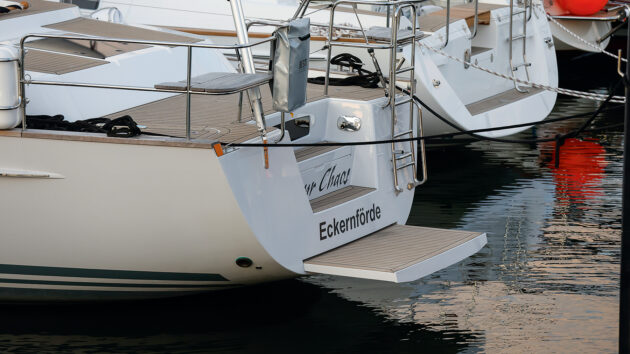
An electric bathing platform slides out. Photo: Paul Wyeth
Smooth sailing
Setting the asymmetric to clear the shoreline, the 47 responded eagerly in the faintest puffs, and notably kept her way on in the lulls. As the true wind reached a heady 5 knots, boat speed matched the breeze, and upwind we managed 6 knots thanks to the apparent wind.
In 10-12 knots true we easily sat at 7.5 knots off the wind, topping out at 8.3 knots. 7 knots upwind was easily achievable in this breeze with 15 knots across the deck at 32º apparent wind angle; I had the impression the boat had easily more to give with just a bit more breeze.
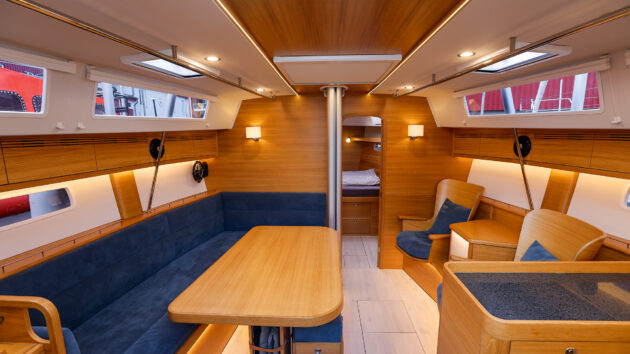
Light oak gives a modern feel but mahogany is also an option. Photo: Paul Wyeth
This then is an easily driven hull, and a stiff boat that won’t gripe. The only wobble I managed to induce, unfairly, was with the 200m2 kite up, designed for 130º wind angle, when a 17-knot gust caught us on a beam reach, 40º too high. The boat rounded up just enough to make the spinnaker flog before regaining grip and calmly bearing away back under the sail.
On the helm, she is a beautifully balanced boat – and remains so when heeled – with just the right amount of feel in the rudder to provide both effortless control and rewarding feedback.
The boat we were sailing had a single-point mainsheet aft of the helm on a two-to-one purchase, taken to a Harken UniPower winch; the 48V electrical system throughout this boat ensures the winches have plenty of torque and spin up quickly; thanks to the minimal voltage drop of the system, longer cable runs and thinner cables can be used. A traveller aft of the helm is an option I would go for, to allow for centreing the boom upwind, though with decent pointing angles anyway, you could argue this boat doesn’t really need one.
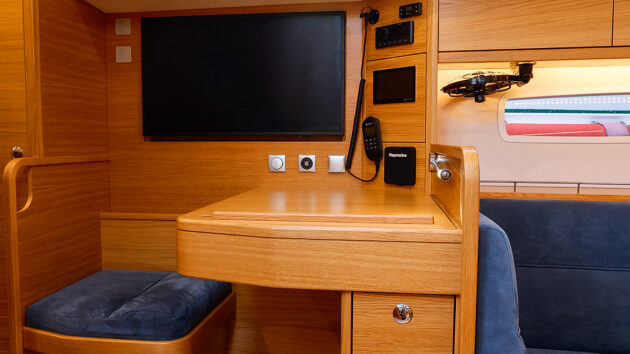
The screen for the chart table can swing out for work or as a TV. Photo: Paul Wyeth
While a slab-reefed main is standard, most Saare owners opt for in mast furling for ease, speed and neatness, and the EPEX laminate fully battened main from Elvstrom gave a very good shape and control for a furling main. This was coupled with a 105% overlapping genoa – there would be space for another 10-15% overlap outside the inner shrouds if you regularly sail in light airs, though for most purposes the Code Zero we had on board would be more than sufficient for most points of sail.
The jib is set on a below-deck manual furler, with the line taken aft to the electric halyard winch at the companionway, a setup the builders find more robust and useful than an electric furler. Genoa sheets are led aft to primary winches on plinths outboard of the wide coamings, via towable cars on long tracks. The distance of the winches outboard keeps them away from inadvertant handling, but makes easing leeward sheets when heeled a bit of stretch, and also for manual winching.
The mast is keel-stepped, 19/20ths fractionally rigged, with three spreaders while a wide bowsprit offers inboard and outboard attachments for offwind sails, as well as a convenient ladder and stepping off point for bows-first boarding.
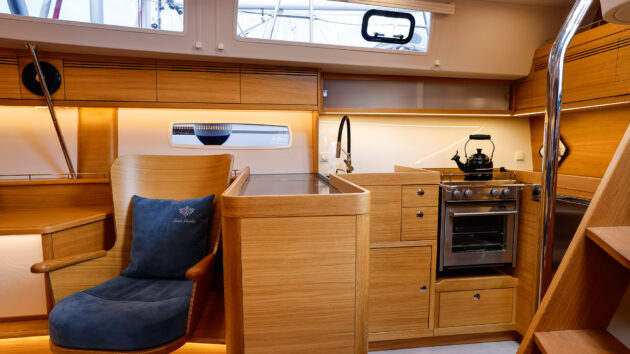
A large C-shaped galley includes an induction cooker, while armchairs can be made how you wish. This whole space could be an additional cabin, or a workspace, and the armchairs can be replaced with settees. Photo: Paul Wyeth
You’ll want plenty of anchor chain for proper cruising; 60m of 10mm stainless steel chain barely touched the sides of the large locker, also home to the secondary shore power connection point (so you don’t have to trail a cable all over your lovely decks if the pontoon power is forward of the boat). The other cable is under a hinged step in the semi-enclosed the transom, by which you reach the electric slide-out bathing platform, which is fully watertight and driven by Harken linear drives.
The cockpit itself is deep and exceptionally well protected, thanks to the large solid windscreen and sprayhood – you can opt for a hard-top doghouse or targa arch, under which the halyard winches shelter, with lines led to a rope bin under the grating aft of the companionway, with captive spring-closing washboards; the threshhold has been kept low to minimise the barriers between on deck and below so that any water that does land in the cockpit disappears through the sole grating and into the deep recess below, from where it can drain, rather than having a high threshold.
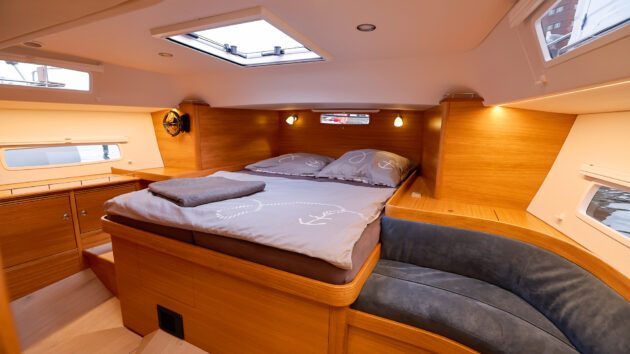
The aft cabin is palatial, though a little more standing room at the foot of the bed plus sitting space in bed would be nice. Photo: Paul Wyeth
From here, it’s four steps down into the saloon, where, despite the hull’s low freeboard and pleasant sheerline, accommodation is remarkably spacious.
In fact, these qualities, coupled with a slightly higher (though not ungainly) coachroof, means that the saloon windows are at eye-height and the deck is below it, giving more than a slight impression
of being aboard a deck saloon.
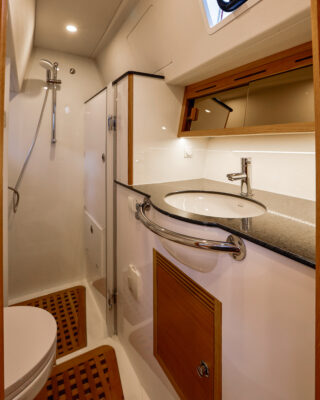
Separate heads and shower in the aft cabin includes a washing machine locker. Photo: Paul Wyeth
Responsive alternator
Our boat was fitted with the 75hp Volvo inboard with saildrive and three-bladed folding Flexofold prop. 110hp is an option, and if you prefer shaft drive, you can have that too. It’s worth noting this is fitted with two alternators: the standard 12V 115A Volvo alternator and an additional Bamar 48V alternator that can chuck out 3.6kW at max load.
This saps a little speed underway, but means you can run the engine in neutral and put load on it for more efficient charging as you would a generator. Even so cruising at 2,300rpm gives 7 knots, and a top speed of 8 knots at 2,700rpm.
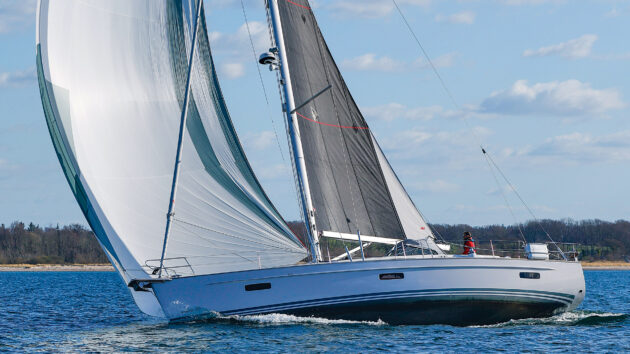
A 200m2 spinnaker is huge, adding welcome power off the wind. Photo: Paul Wyeth
She’s also a responsive boat to handle. With the propeller close to the single rudder, she’ll turn inside 1.5 boat lengths, aided at close quarters with optional retractable bow and stern thrusters from Sleipner; the brushless motors allow for proportional thrust and the ability to lock on to hold you alongside while you sort your lines out when singlehanded.
It isn’t always easy reviewing a boat which can be adapted to an owner’s wishes as much as Saare yachts can. I’m not asking for your pity – I did, after all, have two stunningly sunny days on a £1m plus yacht in the Baltic – but if something you see on this boat isn’t to your fancy, it can be changed to just how you like it when you order yours. In that, sense, we’re a million miles from a set-in-stone production boat.
Sleeping easy
The accommodation in particular has standard options for layout, but then it can be refined to your tastes. As a centre cockpit boat, there’s no negotiating a large owner’s cabin aft and a large forward cabin, both with ensuite heads and shower compartments.
In the saloon then, you will have a table and L-shaped seating, with extra stools and a folding chair around it forward to port, but everything else is open to discussion – a straight settee or double armchairs to starboard, while the galley can be down to port side and aft into the walk through or, as on our test boat, as a C-shaped unit to starboard. If you put the galley to port, the generous forward-facing chart table can move elsewhere and the space to starboard can become a third cabin with bunk beds, or an office space complete with desk.
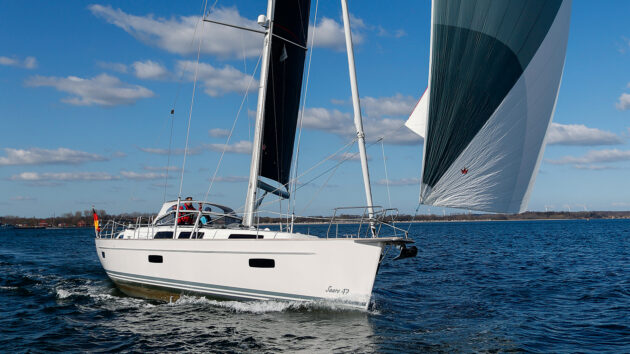
A wide bowsprit provides offwind tack points as well as easy boarding over the bow. Photo: Paul Wyeth
Our boat also had a fold-out flatscreen TV, serving both the chart table for work and navigation, and the saloon for entertainment. Obviously, there’s is an embarrassment of choice when it comes to finishing details. For flooring, our boat had waterproof and unscratchable wood-effect vinyl flooring, though varnished real wood, or even carpet, is an option.
Upholstery choices are unlimited, though 18 colours and fabrics are standard choices. Woodwork is either light European oak or Khaya mahogany.
Stowage is plentiful, provided in overhead lockers, a drinks cabinet, full-height lockers in the passageway to the aft cabin, and below all of the bunks and settees. The galley has two fridges and a freezer. Outboard is the sink (single here, though I’d opt for a 1.5 sink for drying washed items), and a two-hob Levante induction oven from GN espace.
The fact this boat is nearly 1m narrower than her competitors has little noticeable impact on the feeling of space down below, thanks to some clever design and construction. The hull-linings, for example, have been kept as thin as possible so as not to waste space, with wooden panelling hiding chainplates that would otherwise stand proud.
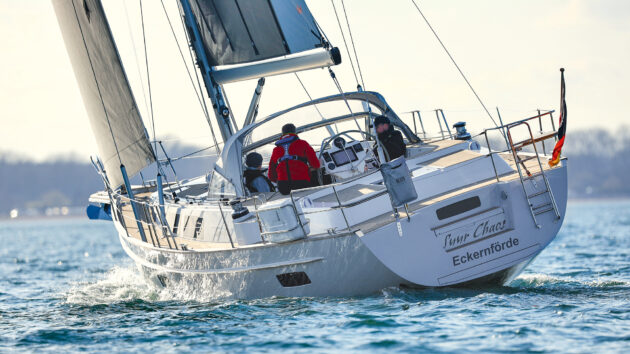
Noticably narrow by modern standards, the stern contributes to the boat’s lovely balance. Photo: Paul Wyeth
The bow sections on this boat are fine and narrow by modern standards, so in the forward cabin the bunk takes the full width rather than being an island bed. However, the generous sail locker at the bow pushes it aft sufficiently to give you a wide headboard, while the aft end is a massive 230cm wide, and 204cm of headroom gives a real sense of space.
The mattresses from Fleximar don’t come cheap, but I’ve rarely slept so comfortably – at sea or ashore. Reading lights at both ends of the bed let you decide which way round you want to sleep.
The aft cabin is the real selling point of the yacht. A fully rectangular king-sized berth lies amidships with a similarly luxurious mattress. Stowage is plentiful with multiple upright lockers, plus drawers, cubby holes, a changing seat, vanity table, and even space for a safe.
A large heads with separate shower is to starboard, where the washing machine sits in its own locker. My only criticism is that because the berth is high enough to accommodate the bathing platform and stern thruster, there isn’t full sitting headroom at the aft end of the boat, from where I would want to enjoy the view with a cup of tea in bed in the mornings.
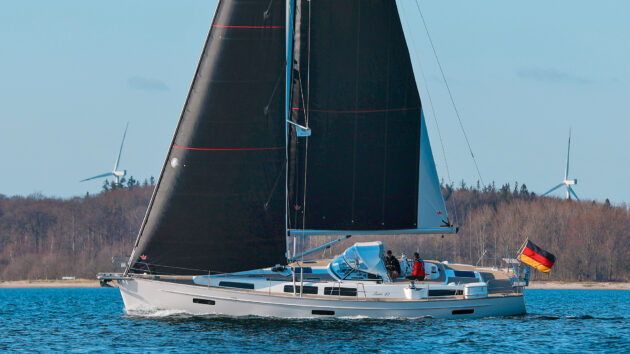
Conservative lines and a rounded hull give good load-carrying capacity. Photo: Paul Wyeth
The science bit
The real heart of true blue-water boats is the technical system, and the Saare 47 doesn’t disappoint. Access to the large engine space is via double doors in the aft cabin. Electrical systems are handled in a separate locker under the companionway at the forward end of this compartment.
In here are all the chargers, inverters and management systems required to handle the 12V, 24V and 48V systems running on this boat (all from Victron), thanks to the 3.6kW output 48V Bamar alternator, and the 14.5 kWh lithium battery bank this serves. These enable powerful winches, thrusters and windlasses, without the need for additional battery banks, thanks to minimal voltage drop and thinner cable runs at higher voltages.
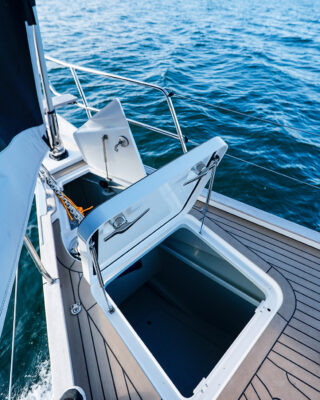
Anchor and bow lockers are separate. Both are generous. Photo: Paul Wyeth
The real boon is the ability to do away with gas, ending the challenges of finding suitable bottles and regulators in every new country, not to mention the safety risks. Cooking a meal takes just over 1kWh, so you can cook for a week without needing to charge up, and your kettle will boil in no time. Plus you can run 240V systems whenever you need, without the need for a separate generator.
Much thought has been given to accessing services and making it easy to service everything without deconstructing the boat. Only good-quality fixtures and fittings have been chosen – the fridges for example, are seawater-cooled, using seacock heat exchanger skin fittings, minimising the number of holes in the hull.
Finally, construction is done properly. Starting at the bottom, there’s the Finnish cast lead keel, bolted into the deep keel stub which ensures precise keel alignment and a deep bilge sump. A metre either side of the keel and around the rudder the hull is solid laminate, and above that is divinycell foam core.
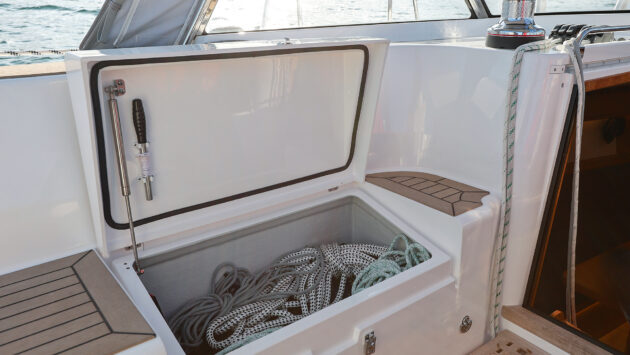
Lines are kept in a shallow cockpit locker. Photo: Paul Wyeth
Everything is vacuum-infused using vinylester resin, saving over half a tonne compared to hand lay up. The keel matrix is fully laminated into the hull – Saare didn’t want a steel frame which could corrode – while all bulkheads are structural and laminated in. Non-structural joinery is honeycomb-cored with solid wood veneers to keep weight down.
Saare 47 specifications
Price as tested: £1m – £1.1m inc VAT
LOA: 14.28m / 46ft 10in
LWL: 12.55m / 41ft 2in
BEAM: 4.20m / 13ft 9in
DRAUGHT: 2.20m / 7ft 3in (2.00m / 6ft 7in)
DISPLACEMENT: 13,000kg / 28,660lb
BALLAST: 5,050kg / 11,133lb
Sail Area: 110m2 / 1,184 sq ft
SA/Disp: 20.2
Bal/Disp ratio: 39%
Disp/Length: 183.5
ENGINE: 75 hp
AIR DRAUGHT: 21.55 m / 70ft 8in
WATER: 503L / 111 Gal (+ opt 300L/66Gal)
RCD: A
Verdict
This boat sets out to be a proper, take-you-anywhere cruising boat, whether coastal, offshore or blue-water. Certainly, she is easily handled by a shorthanded crew, and can be lived aboard in great comfort for extended periods. She also sails properly, right across the wind range, and the yard have aimed to build her properly. As the owners say, ‘We set out to build boats the right way, and it will cost what it costs.’ That’s not how you build cheap boats, but it is how you build good boats. This isn’t no planing sports boats, which is just as well for most blue-water cruisers. She is, however, a light, fast and efficient boat that is responsive, perfectly well mannered and consistently quick, at least in the light to moderate airs I sailed her in. The fact that the hull is so slippery and easily driven is a good sign, and the narrow, deep hull, massive ballast and balanced shape should make her good in a blow and well able to cope with a cruising load, while the rig and deck layout will look after you.