


Unconventional and underpowered, this 1990s cruiser from Belgium remains a popular choice. Nic Compton goes aboard to discover why
Etap 26i used boat review: Unconventional and underpowered? Not exactly

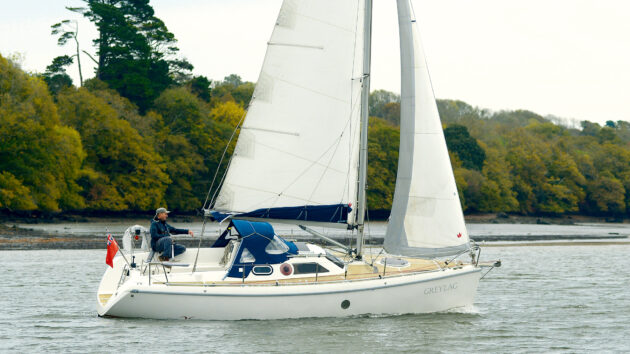
Perhaps we were being a little optimistic setting off up the River Dart only an hour after low tide. But we both knew these waters well and could practically navigate up the channel blindfolded. Or so we thought. In no time at all, Greylag had grounded off Stoke Point on that huge mud bank we both knew so well. Luckily, I was still in the camera boat, a Hardy 18 being driven by my son Sol, and we managed to tow the boat off the mud in no time at all.
The second grounding was a bit more embarrassing. By this time I was on board with the owner, David Holme, and we were tacking down the river against tide and wind, when we hit the mud in almost exactly the same spot. My son was driving the camera boat back to its mooring but happened to look back and saw us stuck fast in the mud. Without a second thought, he turned around and towed us off again.
Even without a handy camera boat to save us, it wasn’t a big deal as the mud was soft, we were on a rising tide, and it would have been only a matter of minutes before we were floating again. But the thing that really struck me was that this was exactly why David had bought this boat: to potter up and down rivers and creeks and get close to the elements, including that ubiquitous mud.
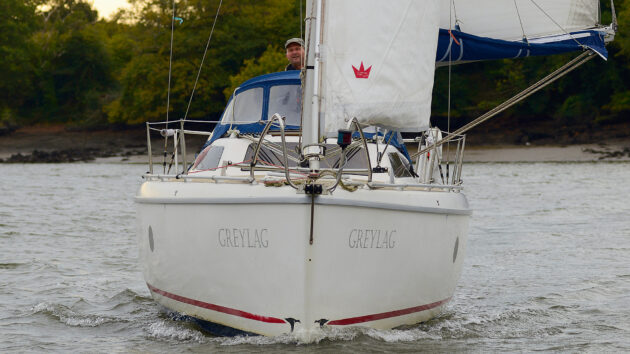
The distinctive, detailed design of the Belgian-made Etap 26i. Photo: Nic Compton
The whole time this was going on, we were surrounded by birds – swans, cormorants, dunlins and even a flock of Canada geese to match the goose on Greylag’s waterline – and some of the loveliest scenery in Devon. The river was calm and peaceful and it was a pleasure to be out even on this grey October day.
Greylag is an Etap 26i fitted with a curious tandem keel. Out of the water, the hull looks like it has a pair of shallow fin keels, joined at the bottom by a wing. At first glance you might think it was a wing keel with a hole cut in the middle, but looking more closely you can see that each keel is hydrodynamically shaped.
The concept was originally devised by British/South African yacht designer/novelist Warwick Collins and was adopted by several boats competing in the 1992 America’s Cup. The claimed advantages are: a lower centre of gravity, better directional stability, less rolling, and improved manoeuvrability. In this case, the only reason David bought a boat fitted with a tandem keel was because of its shallow draught.
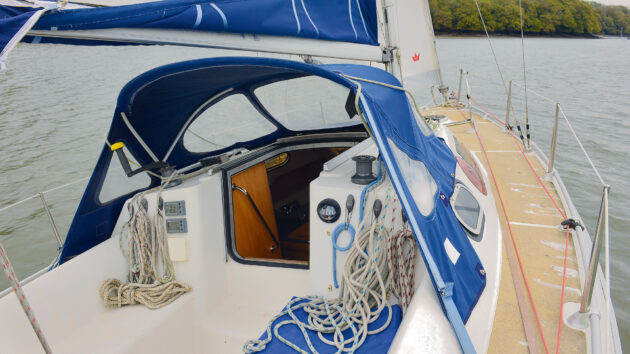
The cockpit shelter provides access to the control lines. Note the deck is covered in cork tiles. Photo: Nic Compton
David started sailing aged 12, when he and his family moved to Warsash and it seemed like the most natural thing in the world to join the local sailing club. He learned to sail starting on a Mirror dinghy, then a Topper and finally a Fireball. So far, so like almost every other kid learning to sail in the UK at that time – except that David had a special connection.
His mother was PA to the legendary dinghy designer Ian Proctor, whose company Ian Proctor Metal Masts Ltd was based at Warsash. Proctor had just designed what was to become his best-selling dinghy, the Topper, and the 14-year-old David was drafted in as a test pilot for the new design. ‘He used to give me the prototypes to see if I could break them,’ says David. ‘So I did. I used to go out in any weather and break the tiller, break the rudder attachments, break the mast, break the mast step, that kind of thing. They were working out how to attach things to plastic and make them strong enough. So it was my job to try to break them.’
Their relationship continued after David moved to Plymouth to study environmental science in the early 1980s, and he visited the designer several times at his house in Duncannon on the River Dart – barely 500 yards from the spot where Greylag hit the sticky stuff during our boat test. ‘He was a really nice guy,’ David remembers. ‘Really generous and funny.’
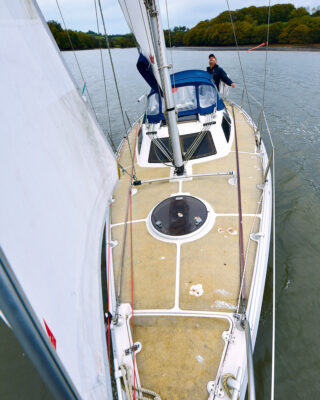
The stanchions are low, which makes walking to the bow slightly precarious. Photo: Nic Compton
And then came the ‘real life’ break, as David took time out from sailing to pursue a career, first as a primary school teacher then as a music therapist, starting in London before moving to Devon in 2008. It wasn’t until 2015 that he rediscovered sailing and bought himself that quintessential West Country boat: a Shrimper 19, which he moored on the River Dart.
‘The Shrimper was fantastic,’ he says. ‘I loved it. But it was limited in terms of comfort and the kind of sailing I could do with it. I felt I needed to have something a bit more seaworthy. Several times I found myself in the Shrimper thinking, should I be out here? I’d be off Start Point, thinking, this doesn’t feel good. And I wanted something that was comfortable in those kinds of places.’
Like many sailors with an aesthetic sensibility, he was drawn to classic designs – ‘the red sail, gaff rig thing’ as he puts it – and it took some serious soul-searching to finally admit to himself that what he really wanted was a modern, comfortable, easy-to-sail yacht. He seriously considered a Vancouver 28, but in the end he only viewed one boat, the Etap 26i.
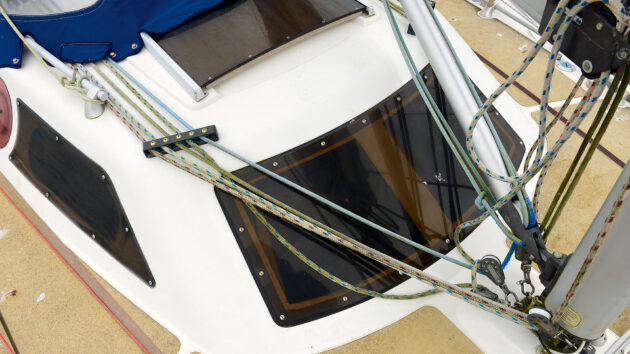
Large coachroof windows let in plenty of light below decks. Photo: Nic Compton
‘I went to see it in a boatyard in Plymouth, and I thought, that’s perfect. That’s exactly what suits me. After the Shrimper, it just seemed amazing – almost space age. The layout, all the lines leading back into the cockpit, and just the space. It seemed fantastic. I put in an offer straight away, and it’s turned out to be exactly what I need.’
Etap was a Belgian company that started life in 1949 making aluminium and fibreglass products including lighting. It branched out into boating in 1970 with its first design, the Etap 22, designed by EG van de Stadt. From the outset, the boats were built with a double-skin foam sandwich to make them ‘unsinkable’ – a claim that was put to the test in 2015 by an extremely dedicated Yachting Monthly team, who flooded an Etap 21 to see what would happen. The water reached as far as the locker lids and then stopped. The Etap sales rep who took part in that test claimed he had twice sailed a flooded Etap across the Channel, and that the boat only lost about a knot in speed.
But there was more to Etaps than being unsinkable. Perhaps due to their unusual origins, the boats were generally built to a high standard, incorporating a modern design aesthetic and sometimes unconventional materials, such as the extensive use of bespoke aluminium fittings – something only an aluminium specialist can do.
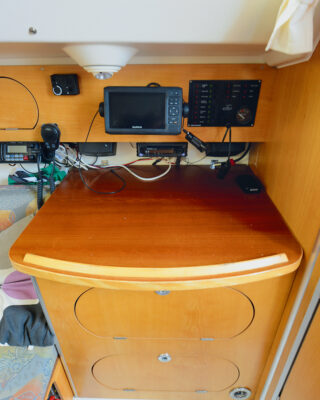
A standing chart table is a useful feature. Photo: Nic Compton
You could even say they went out of their way to break with convention and offer something different to the somewhat standard, off-the-shelf approach of most other production boat builders. And it was this distinctive aesthetic that appealed to David.
‘It was the funky design that first attracted me to the boat,’ he says. ‘I love the shape. And all the little design features, like the round stainless steel chainplate on the side of the hull, which could easily have been concealed but has been turned into a funky design feature. It doesn’t have to look so nice. And it echoes the round windows. The little things like that.’
As for the tandem keel, David had never seen one before he went to view the boat and had assumed it was another name for bilge keels. He did, however, want a boat that he could keep on his existing shallow draught mooring on the Dart, which is a convenient 15-minute drive from his home.
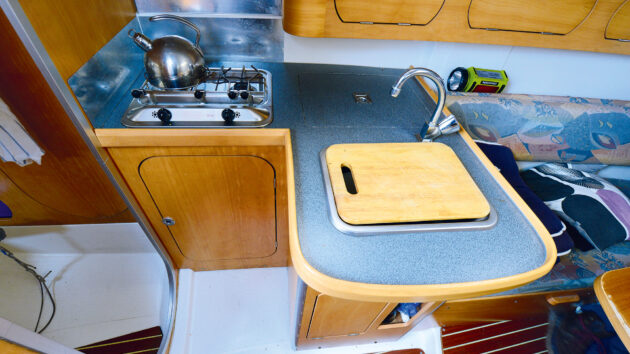
It’s a decent galley for a boat of this size, though the hob isn’t gimballed. Photo: Nic Compton
As soon as he saw the boat’s unusual keel arrangement he realised it could potentially give him the shallow draught he needed combined with good sailing performance – possibly better than most bilge keelers, which don’t have a great reputation, particularly going upwind.
So, how has the boat performed in practice?
‘I don’t notice it,’ says David. ‘It doesn’t feel as though you can tack any closer to the wind compared to other boats. But perhaps the fact that I don’t notice any difference means the boat is performing well. Sometimes, when it’s lumpy I think, wouldn’t it be nice to have a great big keel rather than this flat bottom and shallow keel. That’s when I think about that Vancouver 28 with its extra 1ft 4in (0.4m) of draught.’
More problematic than the keel is the boat’s rig. Sharp-eyed readers will have noticed it hasn’t got a backstay. That allows for a well-roached main, but it means the crosstrees have to be swept back to compensate for the lack of a backstay. This is not an issue on most angles of sail, except going dead downwind, when the crosstrees stop the main from being fully let out.
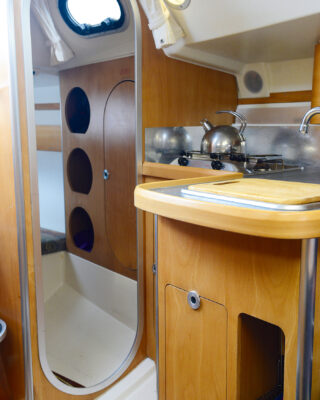
Abaft the galley is a cabin to port and heads to starboard. Photo: Nic Compton
As for the foresail, with the boat’s current set-up, David has to choose between a rather small self-tacking jib, which is underpowered going to windward and completely ineffective off the wind, and a code zero, which sets beautifully on a broad reach but isn’t designed for going to windward. Added to which the code zero doesn’t have a wire luff so it tends to not furl properly, which can be hairy in a blow. The solution David is working on is to fit a genoa, though that would entail fitting new winches and tracks for the sheets as the existing ones aren’t in the right places. A spinnaker is another option adopted by some Etap owners.
‘It’s a compromise between ease of sailing and speed,’ says David. ‘The self-tacking jib is brilliant and very useful when I’m sailing single-handed, which I often am. But it’s tiny, and sailing upwind you’re almost better off cranking in the code zero really hard. Even though it knocks out half the mainsail, it gives you more power than the jib.’
There are other parts of the boat that David doesn’t think work that well.
‘The stanchions are very low, and walking down the middle of the boat is very precarious,’ he says. ‘I’ve put a rope across the top of the sprayhood, because you get to a point where there’s nothing to hang on to. There are aspects of the boat which are more form over function. It’s as if it’s been very carefully drawn to look really funky – like a mini-version of those lovely aluminium cruising boats [eg the OVNI range, also designed by Mortain-Mavrikios].’
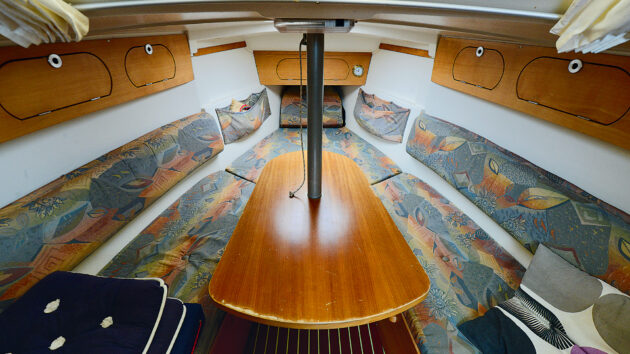
The saloon extends all the way to the bow. Photo: Nic Compton
It was the boat’s distinctive style that made Greylag stand out from the other generic cruising yachts on the Dart and prompted me to leave a note asking David to contact me for a test sail. He agreed, and in no time at all I was clambering on board, impatient to satisfy my curiosity.
First off, that scoop stern gives easy access on and off the boat both by dinghy and from the water, and is a feature David particularly likes. Once on board, the whole design is extremely ergonomic, with nicely rounded corners and soft lines, including that spacious cockpit. I’m not a great fan of the cork grip on the deck, but it certainly does the job of providing grip and looks the part as well.
But it was down below that the design element really came into its own. A huge forward cabin window combined with a large foredeck hatch and multiple portlights make the Etap 26i extremely light – probably lighter than any other boat I’ve tested. Combined with the pale wood panels and trim, with rounded corners absolutely everywhere, it gives a modern, airy feel to the accommodation. What a breath of fresh air this must have felt like when the boat first appeared in 1994!
The layout is similar to other boats of that era (eg the Hunter Ranger and MG Springs ranges), with the saloon in the bow (the table slides down to make a double berth), galley and chart table amidships, and the heads and cabin on either side of the cockpit moulding aft. It’s a pleasant space to sit in, with many of the nice touches that Etap is known for, such as the dinky round locker handles and the cool aluminium stair treads.

The traditional sheer is easy on the eye. Photo: Nic Compton
Under sail, the boat performed as you’d expect: spinning around easily on each tack (apart from when we hit the mud!) and making good headway against a strong incoming tide, despite the light airs. Under motor, the 10hp Volvo Penta is clearly underpowered, especially when you factor in some end-of-season River Dart seaweed. But even at the best of times, the engine is too small, according to David.
A triumph of style over function?
That would be going too far, but certainly the boat scores better from an aesthetic point of view than measured by its performance under sail and power. All boats are compromises, however, and there’s no doubt that, on balance, David is still smitten with Greylag.
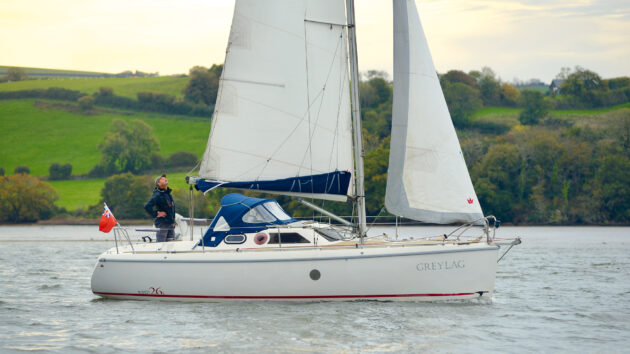
The hull form is conservative, but below the water, the tandem keel is an unusual feature. Photo: Nic Compton
‘I’m attached to what a boat looks like,’ he says. ‘You invest emotionally in the whole thing of having a boat and going sailing, so it’s important to like it. When there’s a nice breeze, the waves are rushing past, I’m sitting leaning against the stanchions, looking down at the boat, and it’s flying along – that’s fantastic. That’s why I sail: to feel the boat sailing and to look at it and enjoy it.’
ETAP 26i specifications
DESIGNER: Mortain-Mavrikios
YEARS BUILT: 1994-2006
LOA: 25ft 9in / 7.85m
LWL: 23ft 5in / 7.15m
BEAM: 9ft 1in / 2.78m
DRAUGHT: 2ft 11in / 0.89m
DISPLACEMENT: 5,071 lbs / 2,300kg
BALLAST: 1,433 lbs / 650kg
SAIL AREA: 277sq ft / 25.73m2
PRICE: £10,000-£30,000
Enjoyed reading this?
A subscription to Yachting Monthly magazine costs around 40% less than the cover price, so you can save money compared to buying single issues.
Print and digital editions are available through Magazines Direct – where you can also find the latest deals.
YM is packed with information to help you get the most from your time on the water.
-
-
- Take your seamanship to the next level with tips, advice and skills from our experts
- Impartial in-depth reviews of the latest yachts and equipment
- Cruising guides to help you reach those dream destinations
-
Follow us on Facebook, Twitter and Instagram.
Note: We may earn a commission when you buy through links on our site, at no extra cost to you. This doesn’t affect our editorial independence.