



Robust and versatile, the Island Packet SP Cruiser is a true motor-sailer. David Harding goes aboard nearly 20 years after testing her as a new boat
Island Packet SP Cruiser used boat review: Might be the ultimate utility yacht

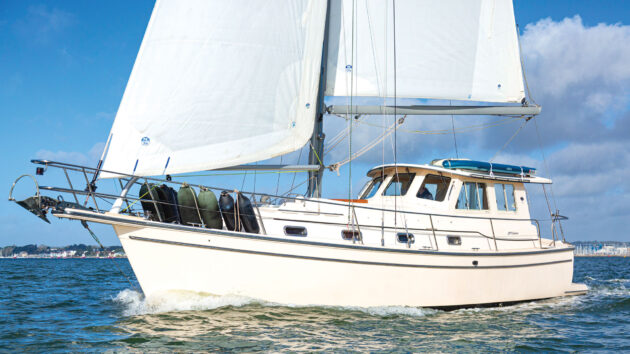
There comes a time in the lives of many racing sailors when they decide that they’ve done their share of thrashing around the cans – or along the coast, across the Channel or from one side of an ocean to the other.
That’s when they swap their racing yacht for something more comfortable and usually rather more sedate.
Changing from a J/133 to a motor-sailer like the Island Packet SP Cruiser, however, might seem a pretty radical change. And it undoubtedly is, but it makes sense when you know a little about the reasoning behind it.
Jackie and Rob Dobson had achieved many successes in their Elan 333 (including winning their class in the IRC Nationals) and then the J/133. Before the 333, Jackie owned an Elan 295 and she has always been a competitive Wayfarer sailor, continuing to race today.
Rob’s earlier sailing was rather different.
He restored a double-ended Cardinal Yawl (not dissimilar to an Albert Strange design) built of pitch pine on oak, later moving to a lift-keel Bowman 36 ketch.
Between them, this couple have many miles of racing and cruising experience under their belts. When they wanted to move on from the J/133 (which they did cruise as well as race), they were faced with a big question: what to buy next?
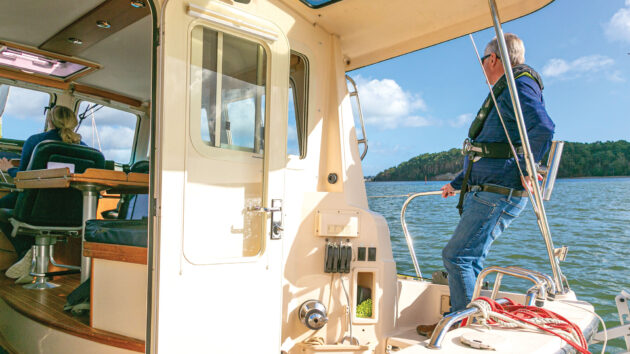
Sail handling is split between the helm station and the protected aft cockpit. Photo: David Harding / SailingScenes.com
‘We didn’t set out to buy a motor-sailer,’ explained Rob. ‘We looked at a Southerly 38, various Ovnis and lift-keel Jeanneaus, because we wanted shallow draught. We might have bought a Southerly had we found one in decent condition, but this boat is much nicer inside.’
Once they had explored the options and seen and sailed the Island Packet, it didn’t actually feel that big a step to take.
‘We were giving up racing and going cruising,’ said Jackie, ‘so we wanted shallow draught to use more of Poole Harbour and other harbours we couldn’t get into with the J’s draught of 2.3m (7ft 7in).
We test-sailed the other boats and they all had much reduced performance compared with what we were used to, so if we were going more cruisy anyway we thought we might as well have something completely different.’
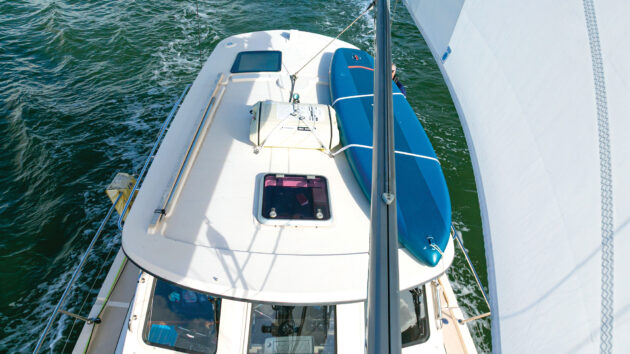
On top of the wheelhouse roof is ample space for a liferaft and a paddleboard. A hatch gives a view of the mainsail from the helm station. Photo: David Harding / SailingScenes.com
An alternative approach
Which one of them finally committed to buying the IP is still debated. As Rob sees it, ‘I made her make the decision.’ However it happened, Jackie is happy with it. ‘I love it now. I normally sail in my slippers. I haven’t worn waterproofs since we bought the boat.’
That, in essence, is what the SP Cruiser stands for: comfort. Space and solidity are part of the package too, as well as the ability to go almost anywhere because of the draught of just 4ft (1.2m).
At least that’s the quoted draught, though Rob reckons it’s a few inches more because they typically carry 880l of diesel and 500l of water, quite apart from 100m of anchor chain in a locker that could accommodate twice as much.
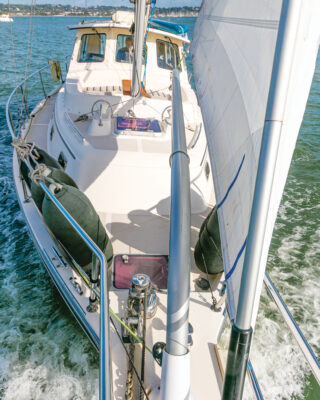
The Hoyt boom, tenoned to the deck, controls the twist and allows goose-winging with the wind on the weather quarter. Photo: David Harding / SailingScenes.com
Something else they carry is a pair of legs so they can dry out in and around Poole and in one of their favourite cruising grounds, the Isles of Scilly. With her long, shallow, encapsulated keel, the SP Cruiser dries out very happily.
She will also get you to wherever you want to go in reasonable time, provided you treat her as a motor-sailer and use the 110hp Yanmar together with the sails. ‘We always motor-sail,’ says Rob. ‘We get several knots extra with the engine running, using 2-3 litres an hour, compared with just sailing.’
That was only after they changed the fixed prop that came with the boat for a Brunton Autoprop, as Rob explains: ‘We couldn’t motor-sail with the fixed prop. The Brunton changes its pitch according to the conditions, so it’s much better. We just had to fit a longer stern tube.’
In the right conditions the SP Cruiser will sail without the engine’s help, as I found when I tested her as a new boat in 2007. Then we had a stiff northerly blowing down Southampton Water.
Not surprisingly, she barrelled along happily with the wind astern, hitting over 6.5 knots at times. And going the other way? Well, as I observed at the time, ‘That’s what the engine is for.’ Nonetheless, we established that we could, in flat water at least, gain ground to windward against the tide under sail alone.
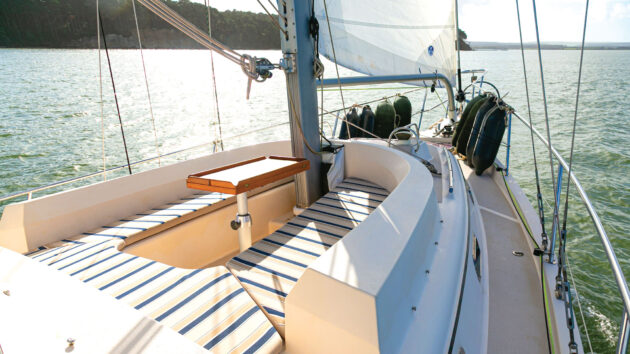
The forward cockpit makes good use of the space between the pilothouse and mast. Photo: David Harding / SailingScenes.com
In a seaway it would be a different matter. In any event, you would get there much faster with the help of the engine.
The word ‘help’ is important here, because some people might wonder about the logic of a motor-sailor and think that you might as well buy a motorboat. ‘We always put the mainsail up,’ explains Rob. ‘Not necessarily for drive, but it stops the rolling. Motorboats can roll like a pig. This moves like a yacht.’
She can also move surprisingly fast, having been clocked at 10 knots through the water, sailing with the engine running, in heavy following conditions. Jackie and Rob plan passages on the basis of averaging 6.5-7 knots; roughly the same as with a performance cruiser of similar size. Sails have other uses, too, and have saved them on two occasions: once in the Isles of Scilly, when the engine intake was blocked with weed, and again in Holland.
Upwind, the jib (on its tenoned Hoyt boom, which controls the twist) is used as well as the mainsail. They start to reef in 18 knots of wind and limit the heel to a comfortable 15°.
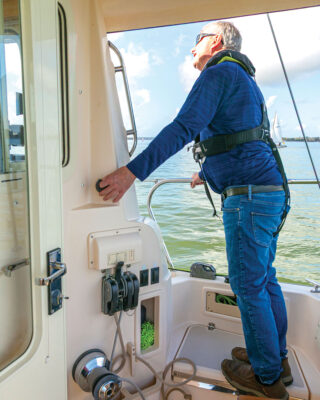
An electric self-tailing winch handles the mainsail’s outhaul and furling line in the aft cockpit. Photo: David Harding / SailingScenes.com
As I found on my breezy test nearly 20 years ago, it’s counter-productive to push the Island Packet any further. However efficient the keel may be for one that’s so long and shallow, the boat simply slides sideways if she’s allowed to heel too far.
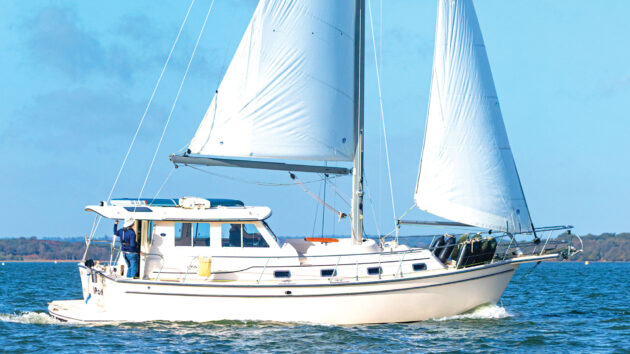
A self-tacking jib and in-mast-reefing mainsail supplement the engine and will push the boat along downwind in a breeze. Photo: David Harding / SailingScenes.com
Sailing from inside
By the time it’s breezy enough for the Island Packet to feel pressed, the crew on many boats would be getting splashed with spray.
That’s rarely a problem here, because the idea is that you do most things from inside the wheelhouse. There’s no outside helm station and you don’t need one, even when manoeuvring in confined spaces, because visibility from inside is so good.
As those of us who have made passages in wheelhouse cruisers have noticed, it does take a little while to get used to being unable to feel the wind. You have to look out through the windows and relate what you see to how the boat’s behaving.
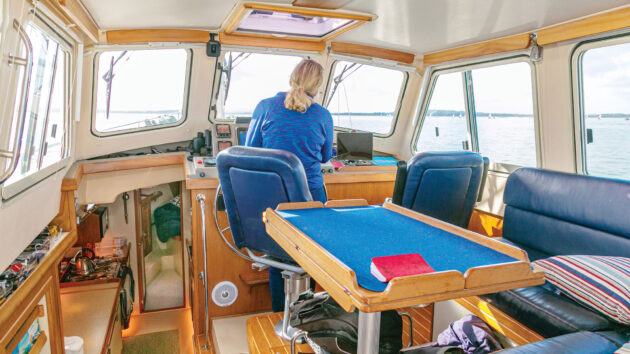
A good all-round view from the spacious wheelhouse with its helm seat, folding table and generous seating. Photo: David Harding / SailingScenes.com
The most wind iPad has experienced (iPad = Island Packet and pad = home on the water) is 45 knots from astern in Lyme Bay. The autopilot copes well with downwind conditions and the boat is happy in big following seas. She’s less happy with big seas directly on the bow, not making way into them, though Rob says she very rarely slams.
During our sail within the confines of Poole Harbour (taking advantage of the shallow draught), we had no challenges in terms of sea state. The wind wasn’t exactly challenging either, peaking at around 8 knots and allowing us to make an easy 7.5 knots with the engine in gear at little more than tick-over revs. Out of curiosity, we also tried under sail alone and made 2.7 knots.
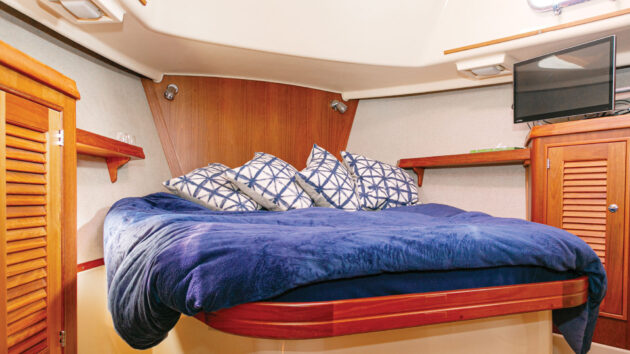
Full bow sections create a roomy forecabin, with an island berth, stowage beneath and plenty of hanging space. Photo: David Harding / SailingScenes.com
iPad is fitted with a feature that cost original buyers many thousands of pounds as an extra and is found on some, but by no means all, SP Cruisers: Lewmar’s electric, two-way StoWinches. Mounted beneath the aft cockpit, they allow push-button control of the mainsail and jib sheets, both in and out, from the aft cockpit and the helm station.
Whether or not you have the StoWinches, you have an electric Lewmar 40 self-tailer in the aft cockpit to handle the jib’s furling line and the outhaul and furling line for the in-mast-reefing mainsail.
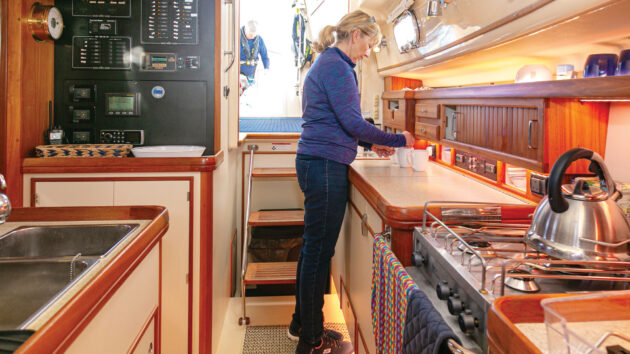
The massive galley is the heart of the Island Packet’s accommodation below decks. Note the large switch panel amidships. Photo: David Harding / SailingScenes.com
Since you’re likely to be head-to-wind when winding the sails in and out, you will be well-sheltered during your short time outside the wheelhouse and will probably keep your slippers dry.
Moving Forward
If the weather is inviting on passage, you’re likely to spend much of your time in the forward cockpit. Island Packet decided not to compromise the size of the wheelhouse to create a bigger cockpit in the stern, instead incorporating a second cockpit between the wheelhouse and the mast.
‘We use it much more than I thought we would,’ says Jackie. ‘It’s good downwind, because we’re sheltered by the wheelhouse. We can reach in through the forward opening window to trim the sails, and we have the autopilot in hand.’
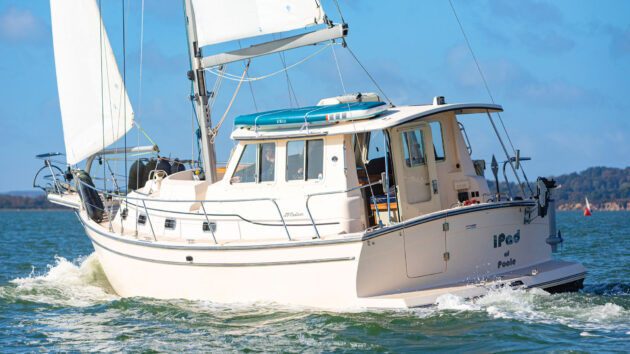
Motor-sailing is a must on this yacht. Photo: David Harding / SailingScenes.com
The aft cockpit, under its hard top that’s an extension of the wheelhouse roof, has its uses in addition to acting as a ‘porch’ and a sail-control centre. Jackie and Rob carry a couple of portable 240V induction hobs on board and often cook there. When you have two cockpits, you can choose which one to use according to the wind and sun.
Easy boarding
A door from the aft cockpit leads to the stern platform, which is actually part of the hull. The waterline extends all the way to the platform’s aft end, supporting the stern and minimising squatting under power.
Even at full chat, when the log reads close to 9 knots, there’s minimal stern-dragging.
As Jackie points out, the platform makes it easy to step aboard from a dinghy. When the dinghy (a 2.8m/9ft 2in inflatable in this case) is not in use, it hooks to clips on the platform and hinges up on its side.
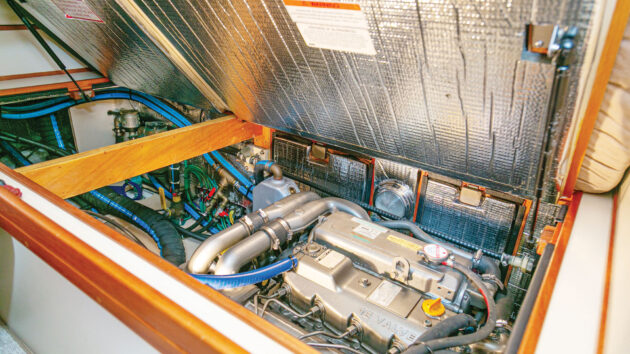
Good access to the engine under the inboard bunk in the aft cabin. Photo: David Harding / SailingScenes.com
A platform like this helps in so many ways, including when it comes to lifting a paddleboard up or down from the roof of the wheelhouse.
When you need to move between the cockpits and along the deck, security is provided by stainless-steel guardrails rather than guardwires. That’s typical of the SP Cruiser: everything is substantial.
That, and the load carried on iPad, is why she weighs 15 tonnes. ‘We have to be able to carry a Nespresso machine and a hair-drier,’ says Jackie. On board they also have a 7kW generator, a watermaker and a washing machine. It means they can be self-sufficient for several weeks.
They certainly have the space and comfort below decks to stay aboard for extended periods. The deck saloon, with plenty of opening windows, the helm station, a co-pilot’s seat and seating around a generous table, is naturally where SP owners will spend most of their time. Jackie loves it. ‘It’s fantastic at anchor, being so high up.’
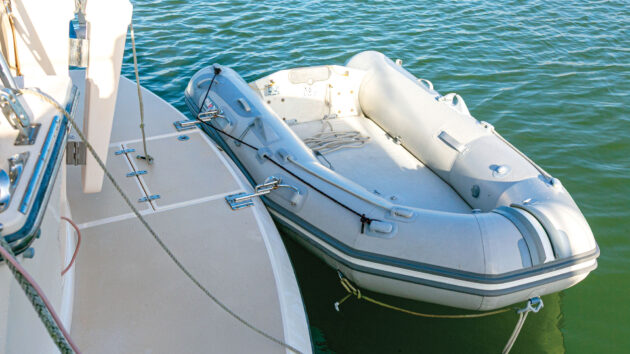
The inflatable is easily hinged up across the transom her on here. Photo: David Harding / SailingScenes.com
Moving forward and down, you find a galley that, as Jackie and Rob point out, would do justice to a 60-footer. It runs along the port side and has large twin sinks in a central island beneath the forward cockpit.
It’s very much a two-plus-two layout down here. The master cabin is in the bow, then there’s a Jack-and-Jill heads to starboard that’s also used by the twin-berth cabin in the stern, abaft the desk-cum-chart table. Beneath the inboard berth is access to the engine.
Utility space is reached via a hatch abaft the companionway steps. Among other things in here are the generator and the legs. As I noted in 2007, all the systems seem well designed and engineered.
Island Packet SP Cruiser specifications
BUILT: 2007-2010
PRICE: £170,000-£200,000
LOA: (inc. bowsprit & stern platform) 12.53m/41ft 1in
LWL: 10.59m/34ft 9in
BEAM: 3.89m/12ft 9in
DRAUGHT: 1.20m/4ft 0in
DISPLACEMENT: 10,430kg/23,000lb
BALLAST: 2,268kg/10,430lb
SAIL AREA: 66.33m2 (714sq ft)
Enjoyed reading this?
A subscription to Yachting Monthly magazine costs around 40% less than the cover price, so you can save money compared to buying single issues.
Print and digital editions are available through Magazines Direct – where you can also find the latest deals.
YM is packed with information to help you get the most from your time on the water.
-
-
- Take your seamanship to the next level with tips, advice and skills from our experts
- Impartial in-depth reviews of the latest yachts and equipment
- Cruising guides to help you reach those dream destinations
-
Follow us on Facebook, Twitter and Instagram.
Note: We may earn a commission when you buy through links on our site, at no extra cost to you. This doesn’t affect our editorial independence.
Verdict
The Island Packet SP Cruiser is a very solid little ship. ‘It’s a utility yacht,’ says Rob, ‘a small big boat; an eco-motorboat with sails – definitely ahead of its time.’ After my sail in 2007, I wrote: ‘The SP Cruiser made me want to sail away for a week or more… to see how well she really worked and whether my initial impressions were borne out.’ I didn’t sail away for a week this time, but sailed with a couple who have amassed a great deal of racing and cruising experience and for whom the Island Packet has proved to be a very good choice indeed. Interestingly, it seems Jackie and Rob might not be the only sailors to have changed course pretty radically in choosing an SP Cruiser. Rob says he saw a video of a journalist at the Annapolis boat show sitting in the SP’s forward cockpit and saying, ‘If you have ever wondered where racing sailors go when they stop racing, it’s here.’