




Everything you need to know about the protests against RNLI volunteers after the lifesaving charity aided asylum seekers in the English Channel, and what it all means for sailors
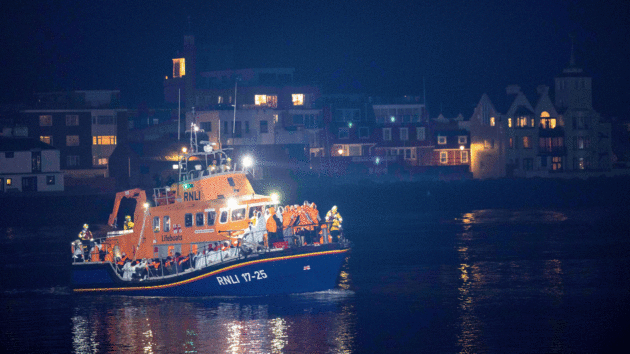
‘Illegal immigration is a political issue; the RNLI exists to save lives at sea,’ Chief Executive of the RNLI Peter Sparkes said in a recent statement.
The distinction follows protests prompted by the charity’s rescue of two small boats in the English Channel, one of the busiest shipping lanes in the world.
For over two hundred years, the RNLI has been an essential, enduring resource for sailors, offering safety training and emergency assistance at sea.
The charity receives no direct government funding for its life-saving activites, and 97% of operational crew are volunteers.
Since 1824, RNLI volunteers have saved more than 146,000 people, ‘without judgment, fear or favour.’
‘I love the RNLI for what it stands for and how it is set up,’ legendary yachtsman Pete Goss MBE tells YM.
‘I have worked with them on a number of occasions, including the Fastnet 1979 disaster and have also been rescued by them. Bravo to this amazing organisation’.
RNLI: 200 years of keeping sailors safe
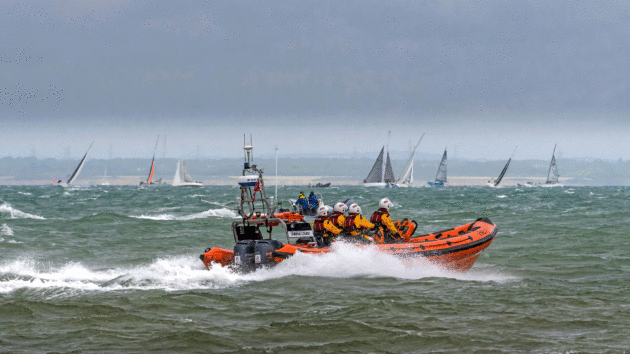
RNLI lifeboat at start of 2021 Rolex Fastnet Race. Photo by Wendy Johnson via Alamy
According to figures published by the charity, RNLI lifeboats launched 9,058 times in 2025 alone, saving 389 lives.
Sailors, swimmers, children in difficulty, and coastal accidents account for 98.8% of these rescues, leaving one thing clear: safety at sea is and always will be a sailing issue.
‘We will always answer the call, whoever needs our help,’ comments Sparkes.
Not to mention, ‘It is a legal and moral obligation that our country has, under the United Nations Convention of the Law of the Sea and SOLAS, Safety of Life at Sea.’
Yet over the past month, the charity’s rescue operations have become a focal point for aggression and fears over UK border policy in the south-east of England, drawing alleged physical and online abuse towards the charity’s volunteers.
Two inciting incidents
On the evening of Sunday 6 September, two RNLI crews intercepted a dinghy carrying 120 asylum seekers off the Isle of Wight as it crossed the English Channel.
After requests to dock at Portsmouth Harbour and Southampton Port were denied, the vessel was escorted to safety to Eastney, Portsmouth, near Haslar Marina and the RNLI station.
The rescue prompted a slew of protests, personal attacks, and online abuse, and soon became a battleground for tensions around immigration.
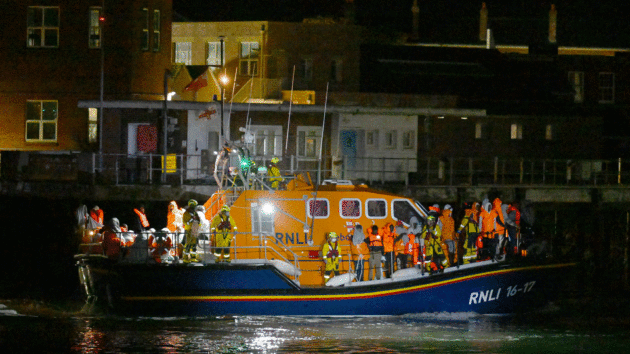
A RNLI lifeboat arrives in Gosport on 4 October while anti-migrant protesters gather. Photo by Finnbarr Webster via Getty Images
Within a month, on Sunday 4 October, the RNLI reportedly performed another rescue of 149 asylum seekers.
The unseaworthy dinghy was shadowed by French rescue vessels and met in the Channel by RNLI crews from Bembridge and Yarmouth, before being taken into Gosport, Hampshire.
The rescue operation landed near Haslar Marina in Portsmouth, from where the refugees were soon transported to Dover, Kent for processing.
The boat reportedly may have launched from Utah Beach in Normandy, roughly 170 miles from Calais and further west than boats normally depart.
According to a BBC article, migration analysts believe human traffickers may be ‘experimenting with new departure points to avoid a heavy police presence in Calais and Dunkirk.’
Migrant boats only a fraction of the work, says RNLI

Coastguard search and rescue helicopter and winch man on exercise with RNLI Severn class lifeboat. Photo by Dorset Media Service via Alamy
Though recent controversy paints it as a ‘migrant taxi service,’ launches to vessels in distress in the English Channel represent a mere 1.2% per cent of the RNLI’s total rescue work in 2025.
In 2025, nearly 95% of English Channel crossings in small boats were instead picked up by the UK Border Force.
‘Our mission, and our tasking is to rescue those women, children and men in danger of drowning,’ says RNLI CEO Peter Sparkes.
‘Anyone rescued from a small boat by the RNLI is immediately handed over to the UK’s immigration authorities.’
As a volunteer rescue organisation, the RNLI does not have the authority to detain or arrest people.
Sparkes clarifies, ‘The RNLI and our crews strive only to prevent people like you and me from drowning at sea.’
Radio abuse during the recent rescue
While carrying out their duties at sea during the October rescue, RNLI volunteer personnel and Coastguard crews were allegedly threatened with physical harm and called slurs via VHF Shipping Channel 11, reports the BBC.
The channel is usually reserved for marine use, and commonly used to report sudden weather changes, obstructions, or unidentified floating objects in the area.
Police and Crime Commissioner (PCC) Donna Jones, Conservative, has called the behaviour ‘a disgrace and completely unacceptable’.
The RNLI, ‘bravely put their lives at risk to keep others safe on the water and should not be threatened and vilified while doing so.’
The incident was referred to communications regulator Ofcom, and a police investigation is underway.
‘Violent’ anti-immigration backlash
After the first rescue in September, hundreds of anti-immigration protestors, many in black shirts and balaclavas, gathered in Portsmouth to protest the RNLI’s aid of the small boat.
Protesters stood in front of police vans and were reported to be chanting choruses of ‘shame on you’ and ‘deport the lot’, blocking road access to the port in the hopes of preventing the asylum seekers from being transferred to a processing centre in Kent.
Poole, where the RNLI has its headquarters, saw additional protests. A march organised by Stand up to Racism Dorset was later held in support of the charity.
Assistant Chief Constable in Hampshire Simon Dodds told the BBC the Portsmouth demonstration was ‘clearly not peaceful protest, rather violent public disorder.’
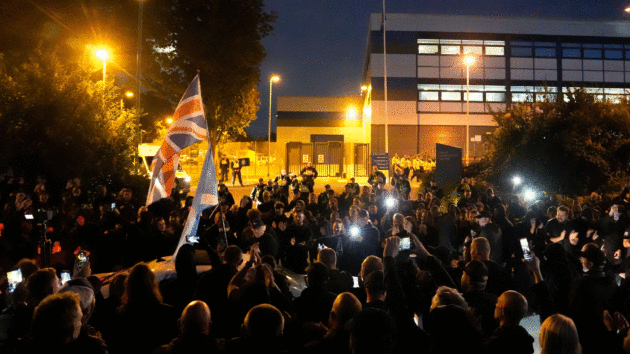
24 September 2026 – Protesters gathered outside the Hampshire Constabulary Police Investigation Centre in Basingstoke, Hampshire, following the arrest of far-right agitator Daniel Thomas after he was filmed slashing the side of a dinghy in the English Channel with a rescue crew member still on board. Photo by PA Images via Alamy
These protests led to the arrest of eleven men and one woman, some of which resulted in prison sentences.
Listed offences included affray, assaults against police officers and emergency workers, racially aggravated public order, and criminal damages.
In an email to volunteers, RNLI chief executive Peter Sparkes established that during the protests, as many protesters were in or near the water, four RNLI lifeboats stood by for their safety.
Local protests co-opted by Right-Wing
While the protests began as local demonstrations, they were expanded by far-right group Patriot Platform, lead by anti-asylum activist and convicted criminal Daniel Thomas, says the BBC.
Thomas would later plead ‘not guilty’ to accusations of slashing a rubber dinghy in the English Channel while a rescuer was still on board.
‘Something is about to go down and it is about to send a fucking shock wave,’ Thomas said in a YouTube video, no longer available.
‘What is the end goal of all of this? It is to start something that will then snowball. Once we pull this off it will then snowball across the country.’
On a livestream, he also reportedly invited people across the UK to join the Portsmouth protest.
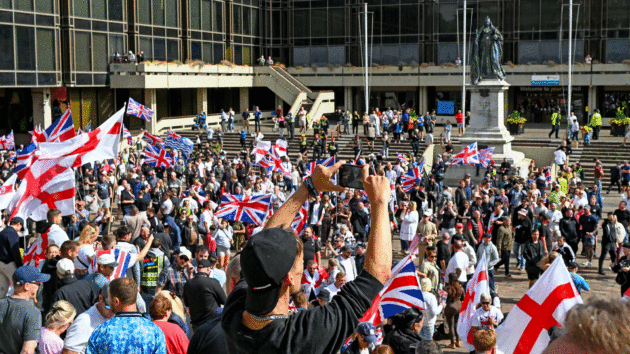
An anti-migrant march through the centre of Portsmouth on 12 September 2026. photo by Thompson Media via Alamy
Thomas’ comments uphold fears that the RNLI is being used as a pawn in a bigger game.
‘I understand the anxiety of local people when they’re about to see a change to their community,’ says UK Home Secretary Shabana Mahmood.
‘But it is important to distinguish that anxiety, where reasonable people can have a conversation, and the far right and outright racists like Danny Thomas walking into town, hijacking an issue and then using that to divide our communities.’
RNLI volunteers targeted
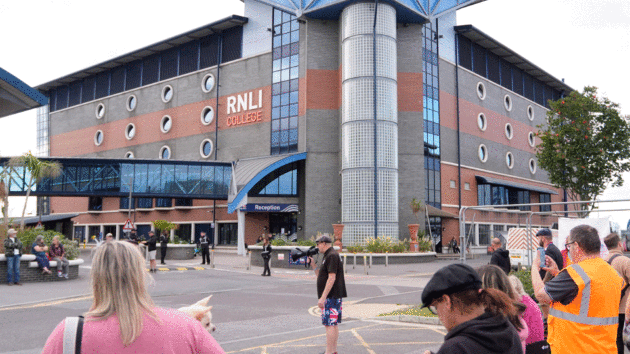
9 September 2026 – Protesters organised by the Patriot Platform group outside the Royal National Lifeboat Institute (RNLI) College in Poole, Dorset, where the charity’s volunteer lifeboat crews and lifeguards train. Photo by PA Images via Alamy
Some RNLI crew members involved in the September rescue were directly targeted, with their photos and names shared in posts on social media accusing them of treason.
Digital Secretary Lisa Nandy has said that she is ‘personally concerned’ about and ‘appalled’ by the social media doxxing directed towards volunteers, police officers, and journalists.
Doxxing is when an individual’s personal information is publicly shared, usually with the purpose of harassment, humiliation, or threat.
Nandy chaired a meeting to challenge firms, including Meta, TikTok, Snap and YouTube owner Google, after lifeboat crews were targeted during anti-migrant protests to safeguard users.
She added that it was ‘an absolute disgrace’ that representatives from Elon Musk’s platform X, ‘didn’t even bother to turn up’.
Caught in the crossfire
Already in September, the BBC reported that ‘people from ethnic minority backgrounds have expressed fears of becoming targets of abuse or being mistaken for asylum seekers.’
Days after the asylum seekers were taken ashore, anti-immigrant protesters staged another demonstration at a Marriott hotel in Portsmouth after mistaking four coaches carrying the under-19 Pakistani national cricket team for asylum seekers.
The Royal National Institute of Blind People (RNIB) was also erroneously targeted on social media.
After reminding the public that they’re ‘not the lifeboat people,’ the RNIB added, ‘But here’s something we’re sure we can all agree on. The RNLI are brave and brilliant.’
RNLI Response
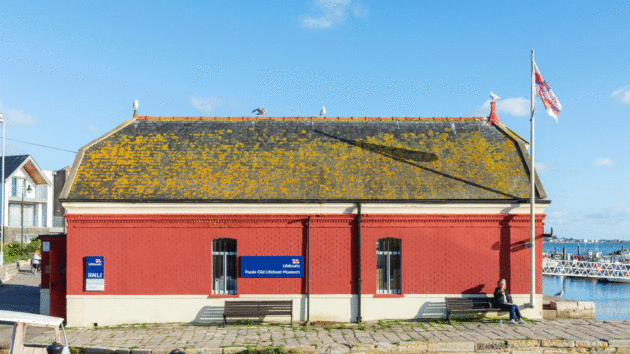
The RNLI Poole Old Lifeboat Museum, a former lifeboat station. Photo by Paul Mendoza via Alamy
Following violent protests, online threats, and staff abuse, the Portsmouth Lifeboat Station at Eastney Point suspended its services on 7 September. The Poole Old Lifeboat Museum was also temporarily closed.
‘We have a duty of care to our people,’ said head of the south-east region of the RNLI Jacqui Irons.
RNLI volunteers across the UK have been advised not to wear their RNLI badges or RNLI branded clothing, and that they should feel empowered to close shops or lifeboat stations if they feel in danger, reports the Guardian.
Back up and running
The RNLI stations resumed operations on October 5 to ‘provide lifesaving cover in the area alongside partner agencies’.
There are proposed plans, open for consultation until October 14, to increase security after a number of security breaches.
The RNLI has also reportedly turned off lifeboat trackers to prevent the abuse of its crews.
Despite calls for the withdrawal of donor funding, since revealing its volunteers have been subjected to attacks from anti-migrant protestors to consider its valuable, the charity has reported an increase in donations to support its life-saving work.
Enjoyed reading about the RNLI?
A subscription to Yachting Monthly magazine costs around 40% less than the cover price, so you can save money compared to buying single issues.
Print and digital editions are available through Magazines Direct – where you can also find the latest deals.
YM is packed with information to help you get the most from your time on the water.
-
-
- Take your seamanship to the next level with tips, advice and skills from our experts
- Impartial in-depth reviews of the latest yachts and equipment
- Cruising guides to help you reach those dream destinations
-
Follow us on Facebook, Twitter and Instagram.
Note: We may earn a commission when you buy through links on our site, at no extra cost to you. This doesn’t affect our editorial independence.