




Every month out resident expert, Rachael Sprot takes on a reader's question. This month getting a long-keeled yacht out of a tight spot
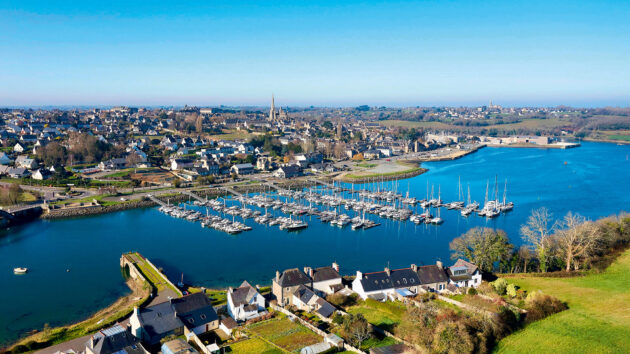
Annie and Fred are in Tréguier aboard their Vancouver 38, Gallant, and would like to depart for Lézardrieux, 20 miles to the east.
They want to catch the flood tide, but first they need to depart the berth, which isn’t looking very easy. The tide runs hard through the marina and the harbourmaster has advised departing at either high or low water when it’s slack.
At low water, there’s only a narrow deep-water channel alongside the marina, with a steep, unmarked mudbank a boat length or so beyond the pontoons. To make matters worse, there’s a catamaran moored on the outside of the upstream hammerhead, narrowing the channel even further.
Gallant has a long keel and backs strongly to starboard. They’re moored starboard side-to on a short finger berth, bows in, with a large, wide-sterned yacht next to them.
The northwesterly breeze funnelling upriver is enough to impact the manoeuvre.
Should they exit the berth at low water, and if so, how?
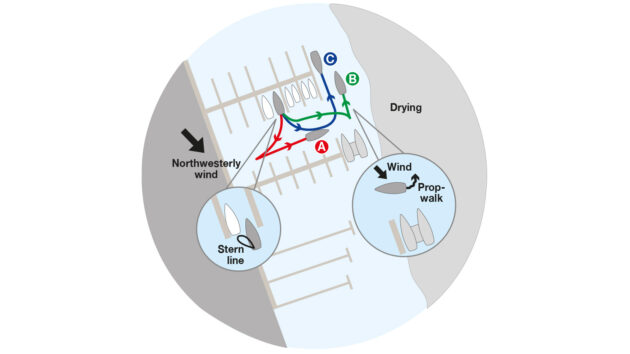
Can you get a long-keeled yacht out of this tight spot?
This is a tricky dilemma with no clear solution. Before doing anything, I’d find out if the adjacent boat is moving. If they leave first, things would be a lot easier.
Assuming they don’t, there are three options here: A – somehow turn the boat within the pen to drive forwards out of the pontoons; B – reverse out and turn in the channel; C – reverse all the way out until there’s more room to turn. Each route will vary depending on the state of the tide and other vessel movements, so there’s a lot to consider.
Option A: With a large, wide-sterned yacht alongside, and prop-walk pulling in the opposite direction, it will be tricky to reverse into the pen. A long midships or stern line on the port side, probably leading to the stern of the adjacent yacht (with permission), would be required to help make the turn.
This needs careful handling, being paid out as they reverse back and held momentarily once the bow is clear of the pontoon in order to hold the stern while the bow swings.
At a certain point the wind will catch the bow, helping to bring the boat around, and the line can be released. There needs to be good fendering on the port bow and shoulder and, ideally, someone from the marina could guide the bow out by keeping the pulpit close, but clear, of the pontoon.
If the people on the next-door yacht are on hand, they could release the line to avoid the risk of a snag, which is always the downside of using long warps.
Option B: Letting the boat follow the prop-walk out is the simpler option; however, it will be hard to turn the bow up into the wind after exiting the pontoons – both the northwesterly wind and the prop-walk are acting against the turn.
Many long keelers won’t overcome the prop-walk enough to follow their rudders, and there’s a risk of being blown down onto the catamaran. This option would be easier if the wind drops or comes from the south.
Even in a well-behaved fin-keeler, I’d favour high water for this manoeuvre, since it’s unclear how much deep water there is beyond the pontoons. There’s a waiting pontoon north of the marina, and various anchorages in the river where, once out, they could await the east-going tide.
Option C: With the wind from the northern sector, the boat would more naturally reverse all the way out, but they might need to go a long way in reverse before they find space to turn. I try to avoid reversing long keelers over long distances.
My own boat has taught me that steerage astern is a privilege which may be withdrawn at short notice. One variation would be to reverse onto the empty hammerhead – the lines and fenders are already set on the starboard side – make fast, and then warp the boat around to depart.
In this scenario, I’d go for option A, with help from the marina. The Vancouver 38 is small enough to manhandle in gentle conditions, it allows for a low-water departure, and the majority of the manoeuvre will be in forward gear.
There’s more than one way to skin a cat here, though. All of these departure routes could be made to work. At neaps, a more manoeuvrable boat could use a trickle of tide creatively, ferry-gliding out.
Manoeuvring a long-keeler requires forethought, but whatever the vessel, berthing and unberthing are important, but often overlooked, passage constraints in tidal waters.
Enjoyed reading this?
A subscription to Yachting Monthly magazine costs around 40% less than the cover price, so you can save money compared to buying single issues.
Print and digital editions are available through Magazines Direct – where you can also find the latest deals.
YM is packed with information to help you get the most from your time on the water.
-
-
- Take your seamanship to the next level with tips, advice and skills from our experts
- Impartial in-depth reviews of the latest yachts and equipment
- Cruising guides to help you reach those dream destinations
-
Follow us on Facebook, Twitter and Instagram.
Note: We may earn a commission when you buy through links on our site, at no extra cost to you. This doesn’t affect our editorial independence.