



Richard Rogers reveals the true cost of how much he spent rebuilding his 'bargain' yacht, and asks if it has been worth all the effort
Out-of-season sailing attracts us. Winter here in Scotland, and early spring, when days are lengthening and the colours returning, are the best times to be outside. In those glorious few weeks when the glens are warming but there’s snow on the summits.
We also dream of going further afield: Orkney, Shetland or ‘properly north’ to Iceland and Greenland. The Arctic Circle is less than 550 nautical miles from here. We hope to go ashore and explore remote mountains and glaciers.
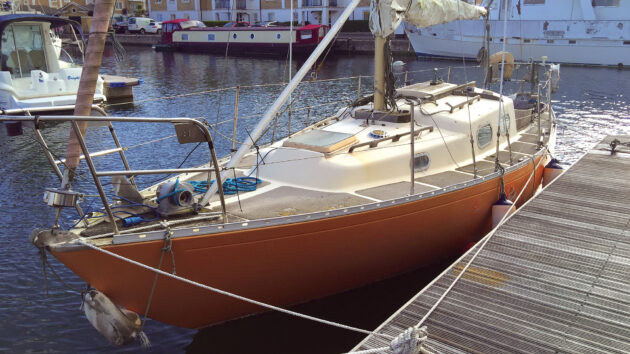
That’s why we bought Aurora, a Morgan Giles 30, for a song from a marina who wanted rid of her. She’d been abandoned. The marina even paid for a rigger to get the mast down and a lift-out to get her on her way.
But how often do you see someone posting with enthusiasm on social media that they’ve got themselves a free boat, something utterly derelict, and plan to fix it up?
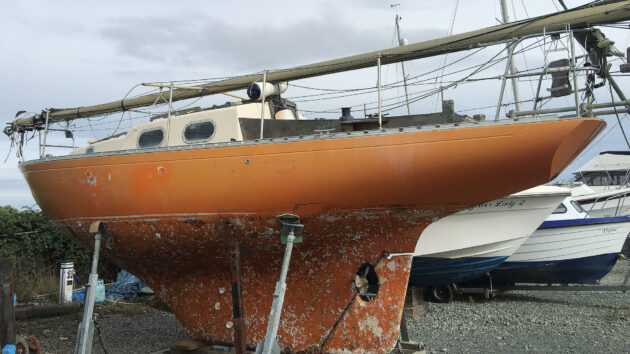
On the hard with all the work still to come. Photo: Photos: Richard Rogers
Typically there are two flavours of response: 1. Best of luck mate, you’ll enjoy the work, and 2. Sorry buddy, big mistake, the most expensive boat is a free one.
Those are two very different answers, so what’s the truth here? And if you’re thinking of saying ‘yes’ to that free boat, how do you decide whether to proceed or not?
Vandalism or restoration?
The concept was simple: we proposed to reduce her berths from five to three, to make room for more water and fuel carrying capacity. We also wanted to insulate her thoroughly for out-of-season and cold-weather work.
Low temperatures mean we’ll use diesel for both heating and cooking. There’s anyway not enough room for propane gas on a boat this size, which comes in bottles too large. And butane isn’t much use in the cold.
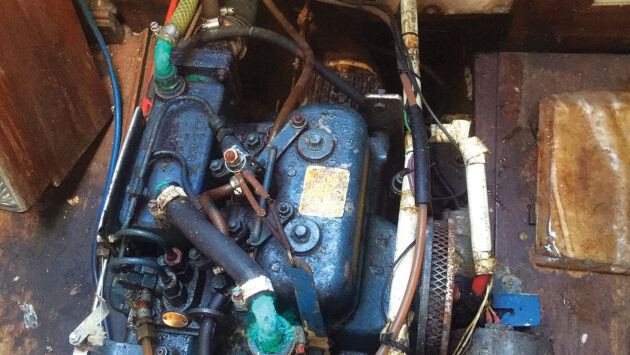
The original 10hp engine is gone. Photo: Photos: Richard Rogers
Other design ideas – the sort of things one is unlikely to find on a production boat of this size include:
- A chart table which is permanent but ergonomically realistic in a small space
- A big bucket-like storage space to take all the shore gear like tents and walking boots
- A heads big enough to shower in without occupying the whole width of the boat
- A towel rail run from the engine cooling system or a diesel water heater, to dry stuff in cold places
- An insulated locker-cum-icebox rather than a fridge so we can power Aurora with fewer batteries
- Rain catchers to collect water from the lowest area of the deck
- An inflatable expedition-grade kayak as a tender (so avoiding an outboard)
- Wine racks under the cabin sole where it’s cool
As with any expedition boat there were extra requirements, such as comprehensive strong points on deck, self-steering, mast steps and storm sails.
There are perhaps some who would accuse us of vandalising a classic design, but we don’t see it like that: the Morgan Giles 30 was generally sold as a bare hull for home finishing, so we are only doing what was intended for her.
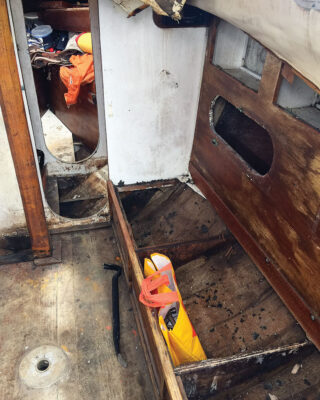
The early stages of dismantling the interior. Photo: Photos: Richard Rogers
Initial costs
Alice and I paid £1,500 for Aurora, so she’s not quite a free boat, but the joke goes that the Aries 2 self-steering gear was worth about that, so you could say we bought a self-steering vane with a free boat attached.
Whichever way you look at it, we could have bought a much better boat. Nearly everything wooden was rotten; of the wooden components, we kept only the mast post, engine beds and three minor bulkheads. All the other wood we had to cut out and throw away.
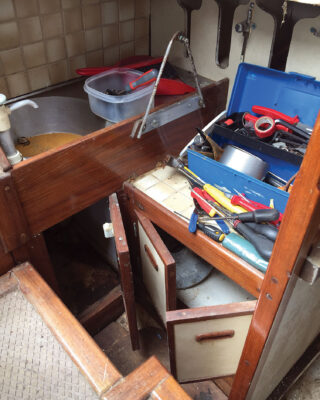
The tiny original galley. Photo: Photos: Richard Rogers
Most metal components we rescued, such as the mast, toe rails, windows, pushpit and pulpit. But the engine needed replacing and there were some expensive write-offs such as hatches and primary winches.
Once the interior had been removed, the hull and superstructure needed much modification and repair. We glassed over the two foremost portlights and three through-hull fittings because we either didn’t need them or wanted to move them.
Getting the Treadmaster off the deck left us with several rounds of filling and sanding. The sealant in the hull-deck joint was dry and leaky, so the joint had to be opened, re-sealed and closed.
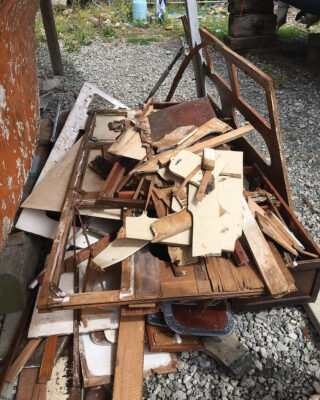
Just one load of the discarded interior. Photo: Photos: Richard Rogers
Getting to the point that we had a hull and superstructure we could work with was a lot of effort. We spent substantial time and money just getting to the starting line.
Time and effort
Rebuilding a yacht from scratch, even a small one, requires at least 2,000 hours of work. That was my opinion last time I wrote about building Aurora, but I was very wrong. We recently crossed the 5,000 hours mark. That’s huge. To put it in perspective, that’s seven hours a day, seven days a week for two years.
External help
There has been some relief because we chose to work with a small yard, who have been truly great. The deal with Aurora was this: Simon Papendick at J-Star Boat Services in Walton-on-the-Naze would restore the outside, while I’d rebuild the inside.
There were some exceptions to that rule but not many. Simon did the heavy internal demolition, made the big structural bulkheads and fitted the engine; I did some of the exterior work such as making locker lids and handrails, rebuilding the portlights and fitting the deck gear.
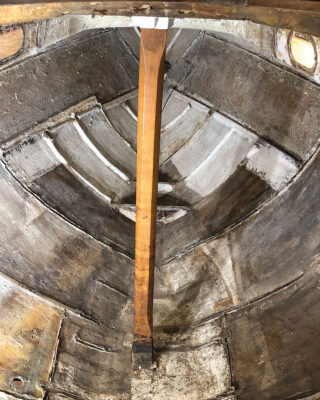
Starting with a blank canvas. Photo: Photos: Richard Rogers
Simon’s help has been invaluable. I would have found it much harder to keep going without someone else working on Aurora, someone to talk to. I may even have given up. The long ranks of part-finished project boats in any boatyard are testimony that many fail to complete a boat project.
Then there is Simon’s expertise. He is a master boatbuilder, engineer and a talented and patient teacher. I could not have wished for a better partner for the project and would have been way out of my depth without him.
I estimated I would spend 1,000 hours on the project and Simon would spend the same: only 2,000 hours in total. Of the extra 3,000 hours, about 500 were carried out by my partner Alice and a few dear and generous friends, and 400 by Simon; the other 2,100 hours falling to me.
In the end I’ll have spent three times as much time as my original, outrageously naive estimate.
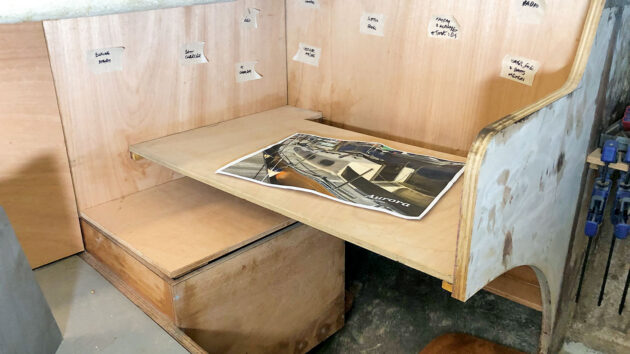
Rebuilding has given Alice and Richard freedom to redesign, like this small but permanent chart table in the saloon with battery box underneath. Photo: Photos: Richard Rogers
What it actually cost us
Donor boat: Includes the mast, boom and self-steering vane – £1,500.
Yard labour, and parts and materials for internal demolition and dismantling of the boat: Opening and re-sealing the hull-deck joint; making and fitting structural bulkheads; modifying the hull and superstructure; sanding, filling, fairing and painting the entire exterior; repairing and refitting toe rails; fitting refurbished portlights; making new hatch frames and fitting new hatches; making or repairing wooden components such as plinths for the traveller, jib cars, deck organisers and winches; reconstructing the companionway/main hatch; fabricating, repairing and refitting metal components such as chainplates, bow roller, through-hull fittings, deck fillers, cockpit drains and second fuel tank; making custom glassfibre components such as shower tray, main water tank, and icebox; repairing and refitting the rudder; making a new tiller; fitting handrails, vents; fitting the engine, antifouling, and a long list of miscellaneous shipwrighting, engineering and snagging – £48,700.
Materials for a new interior: Marine ply, teak, iroko, mahogany; polyester glassfibre and resin, epoxy resin and fillers; paints and varnishes; gloves (hundreds of pairs), sanding discs (lots); insulation and trims; straps, screws, nuts and bolts – £10,700.
Plumbing components: calorifier, matrix heater and towel rail; diesel cooker; custom fuel and black-water tanks; rain catchers, vents, through-hulls, and seacocks; bilge pump and related components; a complete set of fittings for heads compartment and galley; lots of pipes, hoses and clips for the hot, cold, black and grey water systems; several pumps – £10,200.
Machinery, wiring and electrical equipment: tablet, compass, instruments and gauges; fixed radio; internal and external lights; switch panels, batteries, chargers, anodes, power supplies and outlets; fitting a new engine, all peripherals and drive-train – £16,800.
Sailing and safety equipment: Anchoring tackle and docking equipment; liferaft and grab bag; fire equipment and alarms; running rigging, standing rigging, strong points, rigger; refurbishing the Aries 2 self-steering gear; personal locator beacons (PLBs) and electronic flares; lots of deck gear from winches to windlass – £12,800.
Other expenditure: Upholstery, cushions, pictures, fittings, and signs; spares and repair materials for on board; tools I did not have – £2,600.
Total cost – £103,300
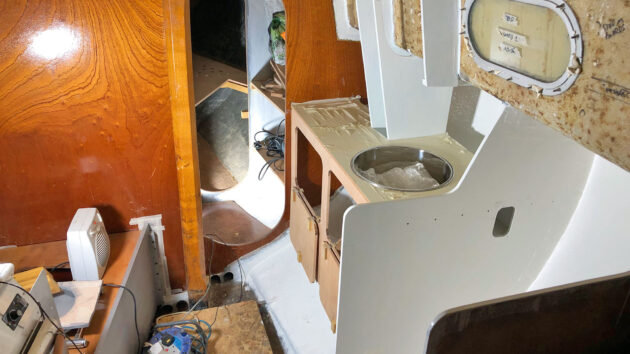
Three years into the rebuild they began painting the interior. Photo: Photos: Richard Rogers
And that’s just the boat… at old prices! The cost of materials is much higher now than when I bought marine ply, paints, resins and glassfibre seven years ago.
In addition, there was also the cost of travel and accommodation, plus lifts and trucks, surveys, insurance and storage.
Some of these expenses are the usual costs of owning a boat (insurance and storage, for example) and some are my fault (travel and accommodation, for living a long way from the project), so may be considered not strictly rebuilding costs.
Certainly, some costs are specific to Aurora: insulation for sailing to cold places, which was not expensive but time-consuming to fit, and she has extra components – such as large water and fuel tanks – for sailing to far-off places.
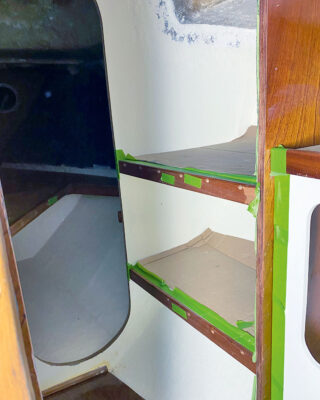
Space for crew holdalls; more useful than a hanging locker. Photo: Photos: Richard Rogers
I’ve also not included the cost of gear which we have yet to fit, such as a diesel water heater, wind generator, more new sails, drogue and sprayhood, or items we already have, such as galley equipment, bedding, handheld radio, tender, clothing and footwear, lifejackets, harnesses and various other essential gadgetry.
The cost of my time has also not been added and to be honest I think it would be scary to know.
So is it worth it?
My first answer is the one I give our friends and family when they ask. We could have completed the project for around £50,000 had we not decided to refit Aurora as an expedition boat and had I done all the work myself.
On the other hand, had we drawn up plans for a new hull and custom design and given them to a yard saying ‘build us that’ we would have no change from maybe £200,000.
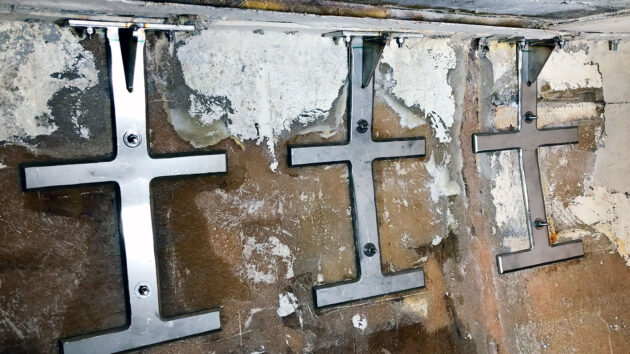
Chainplates in progress. Photo: Photos: Richard Rogers
So in round numbers, Aurora, at around £100,000, is twice the price she could have been and half the price she might have been. We’re happy with that. If we’re lucky, we’ll get 15 to 20 years of sailing out of her; that is six to eight weeks a year (around 850 days of sailing each or 1,700 in total), which is about £60 per day per person for the boat.
Sure, we’ll have maintenance, insurance and other costs, but we can still expect to sail for well under what it would cost us to sail on other people’s boats, especially as we want to cruise high latitudes.
It doesn’t matter that we could have bought a well-found Morgan Giles 30 for a lot less. I saw one advertised for about £20,000, which according to the broker had been refurbished for £120,000. She was gorgeous, and astonishing value, but she’d not have taken us to where we want to sail.
You can’t compare Aurora with other Morgan Giles 30s; instead, you need to compare her with those typically aluminium or steel expedition boats which are much bigger than Aurora and cost hundreds of thousands of pounds. They are well beyond our reach. Aurora, despite being expensive for her class, is expedition sailing on a budget.
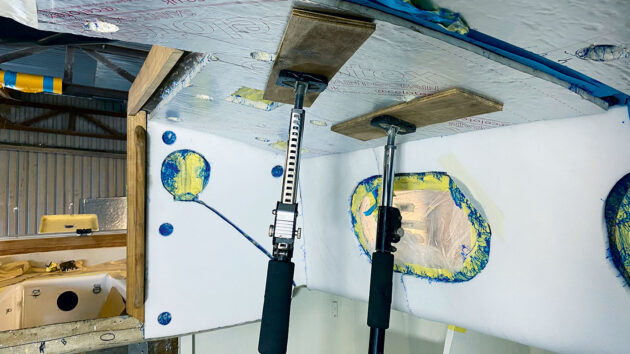
Insulation in progress. Photo: Photos: Richard Rogers
We knew from the start it wasn’t possible to take a small glassfibre yacht to cold and remote places unless we had the freedom to create a boat which suited how we want to sail and live.
The settee-bunk is wider and therefore more comfortable than one in a standard 30ft boat. The forward bunk has been reinvented so it’s easy to get in and out when set up as a double. Except for the heads, all internal doors have been eliminated.
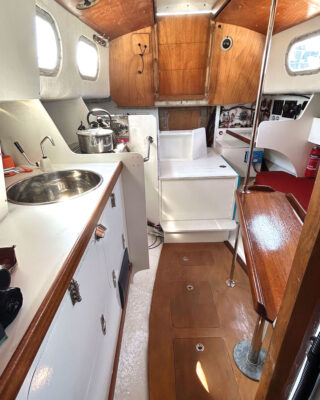
Aurora now sleeps three instead of five, but is well specified for high latitudes. Photo: Photos: Richard Rogers
Shelves have been made to fit the crew’s holdalls, which avoids a bugbear of mine – holdalls on bunks and floors where they don’t belong, getting under your head or your toes or tripping everyone up.
We’ve downsized the massive and awkward dining table, using the beautiful drop leaves to make a smaller one. We will also have the luxury of new plumbing, wiring and instrumentation. Then of course there is love. All logic is futile when you fall in love with a boat. Aurora is worth what we have spent because she is special to us.
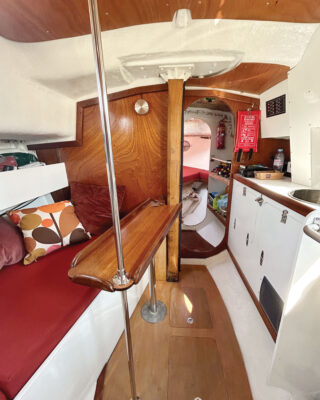
Aurora refurbished for expedition sailing. Photo: Photos: Richard Rogers
The moral is this…
If a production boat will do what you want, buy the very best example out there and go sailing. If you can’t afford the best out there, buy a smaller boat, one you can afford, but still the best example you can find of that boat. And go sailing.
If you catch yourself looking with dangerous desire at something rare, ask yourself if a production boat will do the job anyway; do your best to answer yes, then buy the best and go sailing.
If you can’t manage that and must rebuild that free boat, go in with your eyes open. A total rebuild is years of effort. It has the potential to break your will and your bank balance. For me, the only justification for a complete rebuild is if you want the boat to meet your specifications…and you love the boat.
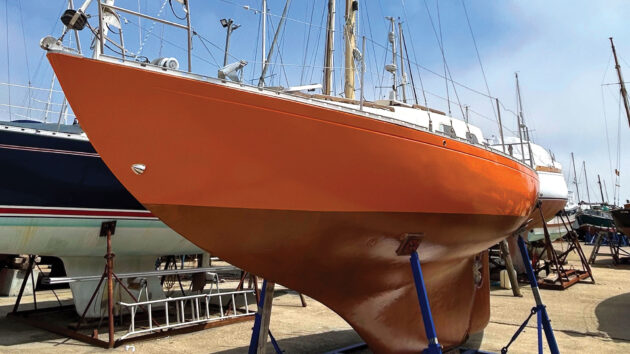
Aurora on the hard at Walton-on-the-Naze ready to launch in early 2027. Photo: Photos: Richard Rogers
Of course, there is a caveat: if you’re more of a boatbuilder than a sailor and you love being at the yard then simply just enjoy the work.
When rebuilding a free boat, you have to choose where the value lies for you. Is it in boatbuilding for its own sake? Or is it in making and sailing a special boat, something you’d not otherwise be able to sail?
Follow the Aurora adventure on Instagram @aurora.explore
Enjoyed reading this?

A subscription to Yachting Monthly magazine costs around 40% less than the cover price, so you can save money compared to buying single issues.
Print and digital editions are available through Magazines Direct – where you can also find the latest deals.
YM is packed with information to help you get the most from your time on the water.
-
-
- Take your seamanship to the next level with tips, advice and skills from our experts
- Impartial in-depth reviews of the latest yachts and equipment
- Cruising guides to help you reach those dream destinations
-
Follow us on Facebook, Twitter and Instagram.
Note: We may earn a commission when you buy through links on our site, at no extra cost to you. This doesn’t affect our editorial independence.