



Looking for a new career in the marine industry? One reader's query took us to the door of independent South Coast sailmaker Crusader Sails for some excellent in-depth advice...
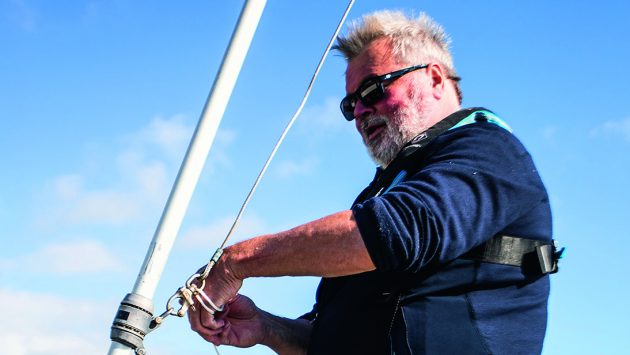
How do you get started in a career as a sailmaker? It’s an interesting question that one Yachting Monthly reader, Catarina Santos, from Santa Maria in the Azores, was grappling with, so she sent us an email and we asked for the advice of Paul Lees, founder of Crusader Sails. His response is delightful: realistic, but warm and encouraging. Send us your queries – we do read them all and respond, even if we can’t always publish!
‘My husband is considering a career change and is very interested in becoming a sailmaker.
He has a strong connection to sailing and the maritime world, but no formal training in sailmaking yet.
We have found several short workshops online, but we are struggling to identify professional or vocational training paths that would allow someone to properly learn the craft (eg apprenticeships, certified courses, or technical schools).
I was wondering if you might be able to share any recommendations of professional sailmaking courses or schools (particularly in Europe or the UK), or advice on how people typically enter the profession today (apprenticeships, working directly with sail lofts etc)’
Paul Lees, founder of Crusader Sails responds:
Firstly it should be understood that the sailmaking industry is actually worldwide a lot smaller than it looks and is divided into four basic types of company:
A. The one-man band, usually self-taught and operating from economical premises with minimal machinery.
B. The mid-sized national sailmaker, 10-20 employees, serving a wide market and types of boat.
C. Multinationals with 100 or more employees, mostly sited in favourable economic zones.
D. The franchise model where small companies are operating under the flag of a multinational providing local service for clients of the multinational and passing trade
There have in the past been a couple of training/education schemes in the UK but to my knowledge they have all fallen by the wayside, as have a couple of sailmaking trade organisations which have since disappeared from view leaving only the national trade organisations, by and large supporting the larger parts of the marine trade which has had a heavy bias towards the powerboat sector.
Sailmaking itself is an interesting mixture of detailed craft skills which require greater than average physical and manual skills combined with an extremely wide knowledge of sailing and all the different sizes of boats that may be encountered and the multitude of handling systems associated with the different types of boat; and a comprehensive knowledge of the multitude of fabrics and their characteristics and a good understanding of the various applications that the product can be used for, combined with all the usual skills of running a commercial operation in what can be a very seasonal business.
This is why most sailmakers learn their skills at the side of experienced craftsmen.
On the positive side, just like plumbers, carpenters, bricklayers etc. people with these skills are increasingly becoming in very short supply. Most of the younger generation have been indoctrinated with the mantra of learning to drive a computer being a top priority in education. The fact is that one person with good computer skills can supply sufficient designs to a busy Loft to keep 50 people working, more if the production is based around supplying OEMs (Original Equipment Manufacturers).
That said, it is immensely satisfying to see the product of one’s own skill and craftsmanship sailing the world, competing on the race course or simply putting smiles on people’s faces.
Article continues below…

Eco sails: options for sustainable sails
Wind power may seem eco-friendly, but with most sails essentially made from plastic, it’s time for greener technology, says Sam…

Choosing sails – some further thoughts from Nigel Calder
Further thoughts from Nigel Calder to supplement his article on choosing sails in the May 2005 issue of Yachting Monthly
I would advise that you buy a cheap zigzag industrial sewing machine, find a discarded sail or two and give it a go and don’t believe that everything on YouTube is the correct way of doing things. Hands on experience and common sense are a good guide. Best of luck.
Enjoyed reading this?
A subscription to Yachting Monthly magazine costs around 40% less than the cover price, so you can save money compared to buying single issues.
Print and digital editions are available through Magazines Direct – where you can also find the latest deals.
YM is packed with information to help you get the most from your time on the water.
-
-
- Take your seamanship to the next level with tips, advice and skills from our experts
- Impartial in-depth reviews of the latest yachts and equipment
- Cruising guides to help you reach those dream destinations
-
Follow us on Facebook, Twitter and Instagram.
Note: We may earn a commission when you buy through links on our site, at no extra cost to you. This doesn’t affect our editorial independence.