



Triple-amputee sailor Craig Wood has received the prestigious Seamaster Award at Boots Dusseldorf for his solo pacific crossing. In this unreleased interview, he talks creative problem solving onboard, the importance of mentorship, and his top tips for sailors with a disability.
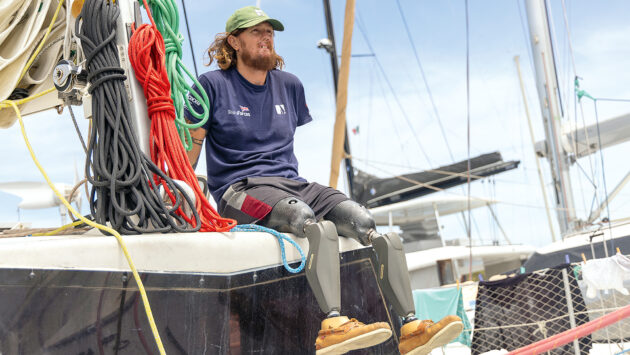
Craig Wood, solo sailor, former Army rifleman, and now the first triple amputee to cross the Pacific single-handed, is fresh off a 7506 mile journey from Mexico to Japan on his modified 41ft aluminium catamaran.
His account of the 90 day crossing is a masterclass in creative problem solving at sea and an insightful look at what it means to sail with a physical disability.
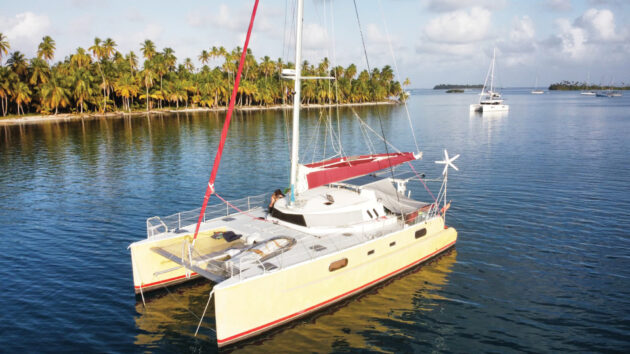
When he is not solo navigating, Craig Wood and his family live aboard Sirius II. Photo: Craig Wood
Problem solving at sea
More than a sport, Wood thinks of sailing as a problem solving methodology. He’s blithe about possible setbacks, systematic in how he tries to resolve them, by his own account secretly thrilled when something needs tinkering.
‘It’s funny, I actually find I’m happiest when something’s breaking. At least my brain’s engaged.’
Faced with any problem, he always starts with the same question: ‘Can I fix it? Is it in the realm of my possibilities or am I not able enough?’ (Wood uses ‘able’ both in terms of skillset and actual physical ability.)
Sailing as a triple amputee means he deals with a set of unique practical challenges. When his prosthetic arm broke early in the voyage, he had to rethink his most basic onboard processes.
‘I didn’t realise I utilised my prosthetic arm as much as I did until it came to something as simple as pulling a rope,’ he reflects.
He trialled different workarounds, first sitting on the rope and pulling it under his leg to keep tension, then using a single leg. Eventually he ended up hooking it under his arm or sticking it around the winch, as needed.
But this is exactly what sailing comes down to, he points out. Small fixes, being adaptable, and making your circumstances work for you.
After all, most issues at sea are less a matter of survival than one of ingenuity.
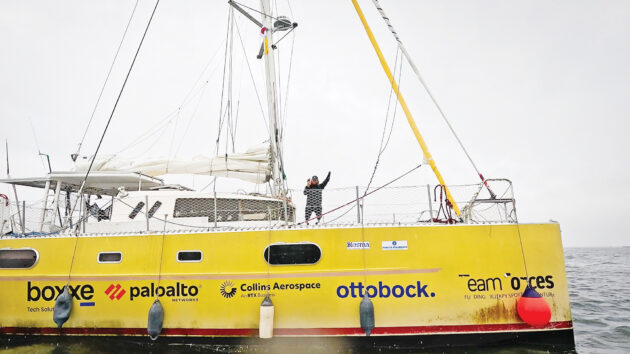
Craig Wood had to re-rig all of his reefing lines on the 41ft Galileo catamaran mid-ocean to prevent chafe. Photo: GD Media
Earlier in the morning, he’d been working with the local mechanic who’d come down to see if the boat needed lifting out.
They got to talking shop, discussing man power. Soon they were taking the whole power system apart, working together to find a failure in Wood’s engine (it was the diodes!).
Unruffled, Wood details a laundry list of further mishaps and breakages from the voyage (he’s shared his biggest lessons with our sister title, Practical Boat Owner).
Snapped furling and reefing lines, sails going under the boat multiple times. He had to patch the jib, gennaker, and main sail, re-plumb his shower. His GPS developed a big black spot in the middle of the visual, the boom came off the gooseneck, his anemometer stopped working.
‘And those are just the highlights,’ he laughs. ‘But I didn’t crash the boat into anything, and I didn’t die again. We’re on a roll.’
IED Explosion and Recovery
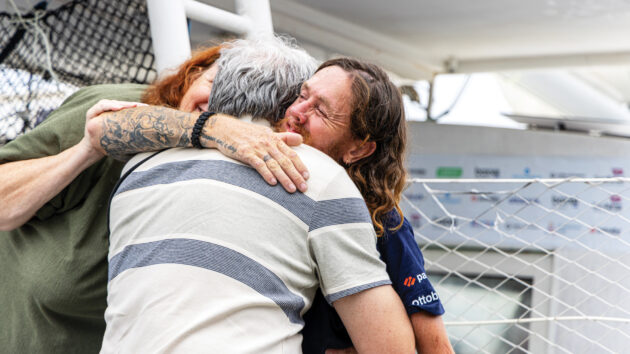
Craig Wood is greeted by his parents at the finish of his Pacific Ocean voyage. Photo: GD Media
To say that Wood’s sense of emergency is calibrated differently than the average sailor’s would be an understatement.
It only takes a quick search to understand why.
Wood went through basic training as a rifleman in the British Army before getting posted to Afghanistan shortly after his 18th birthday.
Three months into his first tour, he lost both legs and his left hand in an IED (improvised explosive device) bomb blast. He had his face ravaged by shrapnel and suffered two collapsed lungs, lost 27 pints of blood.
Over the next four years he took on the long-term mental and physical challenge of rehabilitation, learning to walk again.
More than fifteen years later, he’s clear-eyed about facing less totalising kinds of hardship.
‘The sailing world can be a bit dramatic, making everything out to be a matter of survival. I try to take a very tactical approach to it. Keep a level head, react with surprise and curiosity. Or try to find the humour.’
Sailing Inspiration & Mentorship
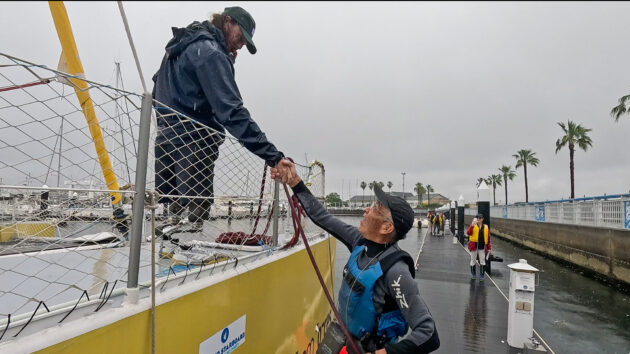
Greetings from a well-wisher at the finish in Hiroshima. Photo: GD Media
Wood tries to transmit his spirited, adaptable attitude to other sailors whenever he can.
‘There’s this mindset in people who don’t have as much experience, where they think there’s got to be a “right” way to do things. Just find what’s best for you. Whatever works is what works.’
He learned the approach reading the accounts of his “written mentors,” circumnavigators like Bernard Moitessier, Robin Knox-Johnston, and Vito Dumas, who he admires not only for their technical skill but for their willingness to learn through error.
‘These guys weren’t afraid to say that they messed up. Moitessier is maybe the greatest sailor there is, and he still wrecked three boats,’ Wood points out. ‘But he just kept sailing.’
Their creative solutions inform his own sailing techniques.
‘Take Robin Knox Johnston. While he was on passage in the Golden Globe Race, he didn’t know the spark gap. So he got the Bible, measured the pages in the Bible to an inch, then deducted that value to get whatever measurement he needed. It’s brilliant out-of-the-box thinking. Now I know how to do that if I’ve ever got to.’
And Vito Dumas?
‘Oh, he’s just fantastic, everything you want a sailor to be. Of course if there was YouTube when he was around, he would’ve been the playboy of the Southern Ocean, getting put in jail for roaming around with princesses.’
More importantly, ‘He was a deeply skilled. Moitessier even used one of his styles in the Southern Ocean, going around the Horn.’
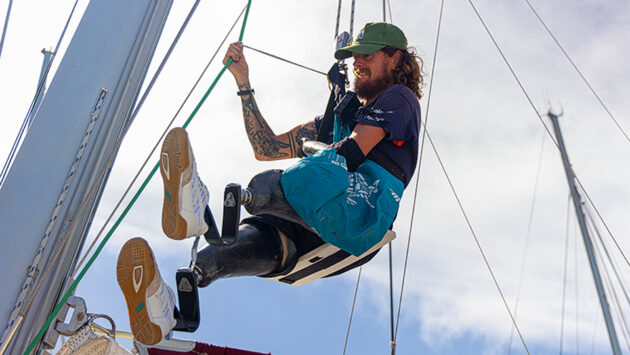
Photo by GD Media
For Wood, these figures represent, ‘What we all wish we had, an actual mentor who can pat you on the back when you ask a silly question and explain it anyways.’
They were generous with their knowledge, an attitude he doesn’t always find in modern sailors.
‘Sometimes sailors can be gatekeepers, or act like everything is obvious, like it all comes easy. But when you’re a beginner, how do you know something if no one’s taught you?’
When a veteran sailor got in touch asking how to get into sailing, Wood invited him to Guatemala, where he was living aboard with his family, to get a taste of what boat ownership is all about.
‘We ended up sailing all the way to Panama. When he left, he went to the charity Turn to Starboard having no qualifications. By the time I got there the following summer, he was a Yachtmaster. He even crewed for me when I did my own exam. I was so, so proud of him. It came full circle.’
The two have kept in regular contact, even throughout Wood’s Pacific crossing.
‘He’s an amputee, too, so we can talk about a very specific niche in sailing. You’ve got to think differently as an amputee compared to an able-bodied person. I’ve been giving him tips that I wish I’d learned earlier.’
Craig Wood’s advice for amputee sailors
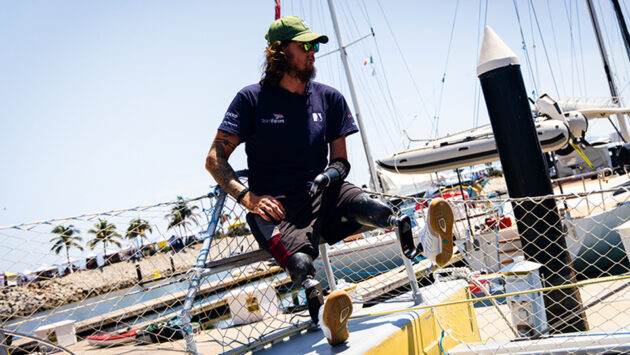
Photo by GD Media
As a first, Wood recommends amputee sailors prioritise learning the lay of their vessel.
‘You have to find the quickest way to get on deck safely in the dark, rain, waves, even if that means going up without your prosthetics.
And figure out what’s going to trip you up, because most of us can’t feel our feet. If we’ve got a rope wrapped around our foot, we won’t know until we get tripped over.’
On his own boat, he has several habits to help make sailing more accessible, like identifying ropes by colour instead of name to facilitate manoeuvres with foreign crews.
‘I think for a lot of people it helps to learn by doing, instead of having all the lingo garbling up in their brains,’ he says.
Thinking creatively to adjust for different skillsets, languages, sailing levels, and physical abilities makes for a good mentor, I point out, one that can put himself in other sailors’ shoes.
Wood, ever humble, has never thought of it like that. But teaching and mentoring are something he’d like to do more of.
‘I really enjoy that part, simplifying the whole process of sailing for people who might find it overwhelming,’ he says. ‘I’d love to take more amputees on board and teach them how to sail. Give back.’
Craig Wood on sailing for a cause
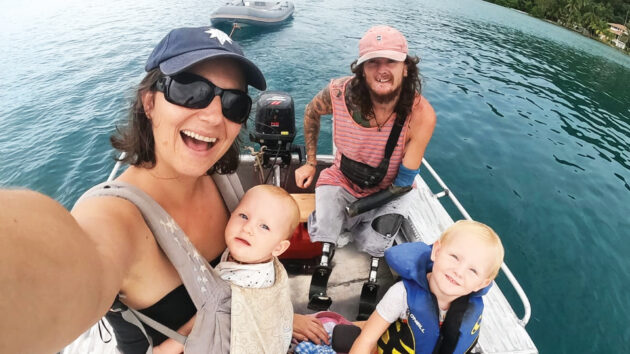
Craig Wood with his wife, Renate, and eldest son, Amaru and daughter, Madeira. Photo: Renate Wood
Give back, that is, to Turn to Starboard and Blesma, the two charities he credits with getting him where he is today.
‘Turn to Starboard taught me the ins and outs of sailing around the world. And Blesma, they were like having a big brother. They help thousands of soldiers and veterans every year. I wanted to give back, and the best way I felt I could do that was by sailing.’
Wood ended up raising over £50,00o pounds through his crossing.
As the dust settles and he readjusts to life back on land, he reflects on the significance of his achievement.
He’s proud of the fundraising effort, of his record. But the crossing is first and foremost a personal victory, and a message to other differently-abled sailors that they can overcome their individual challenges.
He hopes the achievement can be an important step in changing the narrative around disability, Wood says.
‘I suppose it all boils down to proof of what’s possible.’
Enjoyed reading this profile of Craig Wood?
A subscription to Yachting Monthly magazine costs around 40% less than the cover price, so you can save money compared to buying single issues.
Print and digital editions are available through Magazines Direct – where you can also find the latest deals.
YM is packed with information to help you get the most from your time on the water.
-
-
- Take your seamanship to the next level with tips, advice and skills from our experts
- Impartial in-depth reviews of the latest yachts and equipment
- Cruising guides to help you reach those dream destinations
-
Follow us on Facebook, Twitter and Instagram.
Note: We may earn a commission when you buy through links on our site, at no extra cost to you. This doesn’t affect our editorial independence.