


Far from being a lightweight trailer sailer, Nic Compton finds the third version of the Cornish Crabber 24 to be a serious little cruising boat capable of handling far more than a little creek crawling
Cornish Crabber 24 Mk3 used boat review: More than just a creek crawler

The village of St Just in Roseland is best known for its stunning 13th century church, described by the poet John Betjeman as ‘the most beautiful churchyard on earth’. Set amidst a semi-tropical garden, the churchyard is a slightly anarchic mix of exotic plants and ancient gravestones, including a child’s grave dating from the 1700s featuring skulls and crossbones – an emblem of mortality at the time and nothing to do with pirates.
Keep walking and you get to Pasco’s boatyard, partly located on a spit of sand that stretches across the creek. There has been a boatyard of some kind here since 1771, and hundreds of wooden workboats were built here, first for local fishermen and later the Admiralty. Nowadays, yachts of all kinds are moored in the creek, though like any harbour in this part of the world, it’s hard to avoid the preponderance of Cornish Crabbers.
I’ve come here to meet Kevin Chipman, aka Chip, who grew up in the village and returned to live here just before he retired in 2014.
‘I went to school in Falmouth, so I travelled by boat every day from St Mawes across to Prince of Wales pier,’ he remembers. ‘My father had a little motorboat, which he used for fishing locally. And then we had a small sailing dinghy, smaller than a Mirror, which we learned to sail on. When I got to the age of 15, I started to work in the holidays at the boatyard here, hiring out boats and teaching people to sail. So I really got into boating then, and it was just great, fantastic fun.’
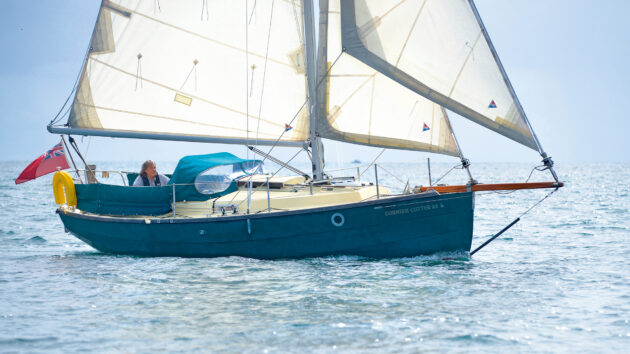
In lighter airs the heavier hull is possibly undercanvassed. Photo: Nic Compton
A career in academia followed this idyllic childhood – specifically researching the causes of environmental pollution and cancer at Birmingham University. He ended up flying around the world advising government bodies and others on how toxic chemicals can damage cells and genes in the body.
But whenever he could he returned to St Just to go boating, first on his own small motorboat then on a Drascombe Coaster. When he retired, his overwhelming desire was to return to Cornwall and to get back into sailing – effectively picking up where he had left off 50 years before.
He was fortunate enough to find an old cow shed in the village, 10 minutes’ walk from the creek, that he and his partner Kate converted into a retirement home.
The only thing missing was a bigger boat to complete the picture.
‘I wanted a boat that was a little bit more stable, that I could sail a little bit further. A boat I could stay overnight on,’ he says. ‘Having sailed in this creek since I was a child, I’ve noticed the Crabbers.
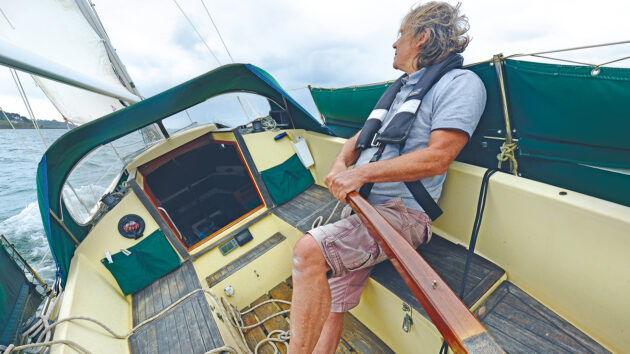
There was a fair bit of weatherhelm, but some sail tweaking might improve this. Photo: Nic Compton
‘There are a lot here, and I’ve always quite fancied owning one. This Crabber 24 has been in this creek since she was born in 1995. I remember years and years ago thinking what a lovely cutter, so when I saw her for sale, I thought it’s time for me to have a go.’
Cornish Crabbers went out on a limb when they started building the Crabber 24 Mk3 in 1992. They had made their name building shallow drafted centreboarders for coastal sailing.
It all started in 1974 with the Crabber 24 Mk1, which Roger Dongray originally designed for himself and built in plywood, before he found a backer and switched to fibreglass production. It was the start of the Cornish Crabber legend – although strictly speaking the original boat was loosely based on a fishing boat he spotted in Brittany, not Cornwall.
My first command was a Crabber 24 Mk1, which I skippered in Greece in the late 1970s, taking the owners and their guests for day sails around the island of Spetses in the Saronic Gulf. On my days off, I larked around on the boat with friends, one time setting two spinnakers to see how fast it would go.
As I recall, it didn’t add much speed, but it did look pretty cool. One year my girlfriend and I sailed the boat 400 miles from Spetses to Kefalonia and back, via the Corinth Canal, so I got to know the sailing characteristics of the boat quite well. Great in flat water, but not so good in a seaway.
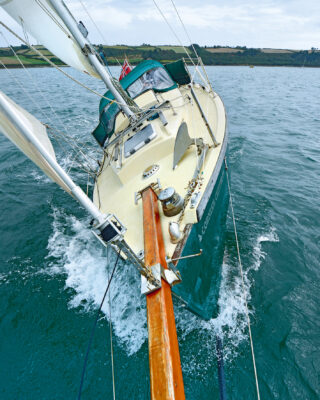
A long bowsprit facilitates a cutter rig, giving a good range of options for a sailplan. Photo: Nic Compton
Evolution of the brand
Cornish Crabbers sold hundreds of Mk1s and Mk2s (same hull with larger sail area and more ballast) before retiring the brand in the late 1980s. By then, the Shrimper 19 had taken over as the company’s most popular boat, as it continued to be for the next few decades, eventually numbering more than 1,300, including the later Shrimper 21.
When the Crabber 24 was reintroduced in 1991, it was quite a different beast to the slightly boxy, shoal-draught boat that launched the company. The design Dongray came up with used the same moulds as the Cornish Yawl, introduced in 1988, but with a encapsulated fixed keel incorporating 3,300lb (1,497kg) of ballast poured into the keel moulding.
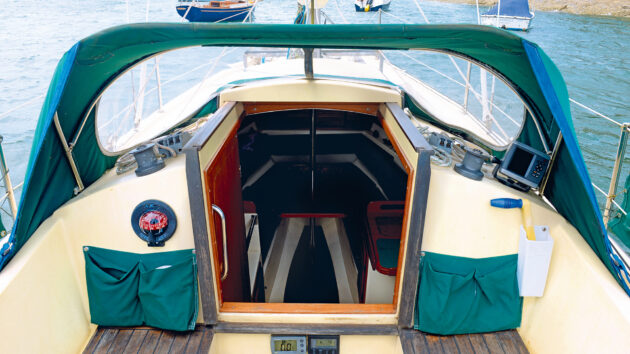
Deep coamings, plus sprayhood and dodgers, and an aft mainsheet make the cockpit secure and uncluttered. Photo: Nic Compton
It was the only smaller Crabber with a fixed keel – in common with its bigger sisters, the 30ft Trader and Pilot Cutter – which clearly indicated it aspired to greater things, to being more of a long-distance cruiser.
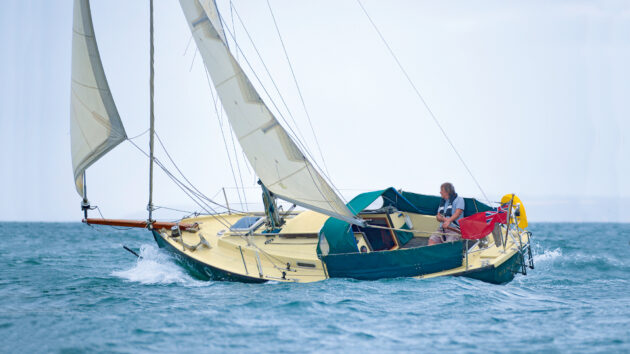
It was a blustery day in late August when I drove across the Roseland peninsula to St Just for a sail on Chip’s boat. As he rowed us to the other side of the creek, we went past several other Cornish Crabbers but, with her dark green hull and matching canvas work, Ein Cariad (Welsh for ‘my love’) was the prettiest of the lot.
She had the same elegant counter stern as the Cornish Yawl which happened to be moored right behind her, but with a simpler rig and a lower, more streamlined coachroof. No wonder Chip had spotted her and coveted her all those years before.
On board, the cream-coloured deck moulding with plenty of wood trim – including teak decking in the cockpit – gave the boat a salty feel. The deep coamings imbued the cockpit with a sense of security and spoke of a boat designed to take a few waves without complaint. And the counter stern proved to be practical as well as pretty, creating a small aft deck with a dinky lazarette, just big enough to house two gas cylinders.
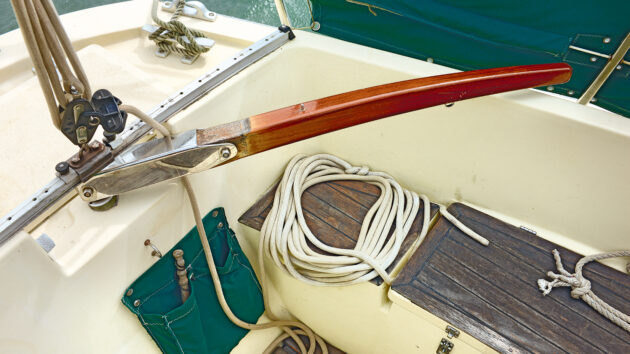
A short mainsheet traveller runs aft of the cockpit, ahead of the small lazarette. Photo: Nic Compton
But it was when I went down below that I got my biggest surprise. Having spent two summers living in the somewhat cramped accommodations of a Crabber 24 Mk1, I assumed Chip’s boat would be a slightly updated version of that. I wasn’t expecting to step down several steps into an almost cavernous open plan interior.
It’s amazing how an extra foot or so of draft (plus an extra tonne of ballast) can transform a weekend sailer into a boat you could imagine spending several weeks on board in relative comfort. Or, to put it more simply: there’s a big difference between the Mk1’s 4ft 3in ‘sitting headroom’ and the Mk3’s ‘almost standing’ (for a 6ft tall person) headroom of 5ft 10in.
Raising the bar
And it’s not just the extra volume. The Mk3 is fitted out to a higher standard than the old Mk1, with louvred cupboard doors, nicely buttoned upholstery, and a lot of varnished wood on display. The layout is perhaps a little quirky, with a large saloon with U-shaped settee taking up most of the forward space.
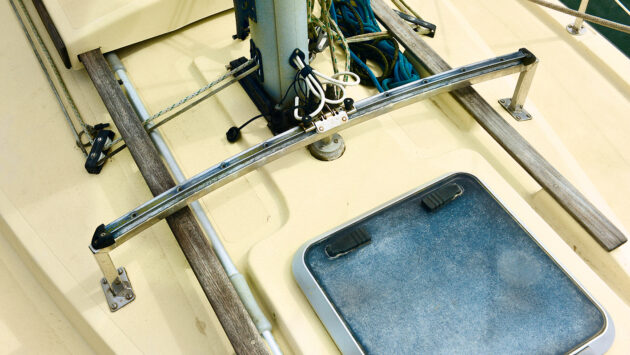
A self-tacking jib is an option for the inner headsail. Photo: Nic Compton
The table slides up and down the stainless steel mast support so that it can be used as an infill, turning the settee into a large double bed. Some versions of the boat have a hinged bulkhead forward, which folds down and turns into a double berth, overhanging the front end of the saloon berths – perfect for kids. The bulkhead was fixed on Chip’s boat, creating a large stowage area instead.
Aft of the saloon, there’s a galley to port and chart table over a galley sink to starboard. And, a real improvement on the old Mk1 with its crappy chemical toilet, there’s a fully enclosed marine heads aft of the galley. With a quarter berth aft of the chart table, Chip’s boat had three berths, although four- and five-berth versions were also available.
Ein Cariad is largely unchanged from when Chip bought her, though he has added a chartplotter and an autopilot to facilitate longer passages and singlehanding. He and Kate have cruised widely on the south coast of Cornwall, visiting places such as Fowey, Mevagissey, and Kingsand to the east and the Helford River and Penzance to the west.
The flip side of that deeper draught, of course, is that they can’t creek crawl the way you might on a Mk1, but they use their inflatable to do that instead. Most times, they take with them their border terrier Arch Stanton – so called after a scene in the Clint Eastwood movie The Good, the Bad and the Ugly, in which the name appears on a graveside cross. If you know, you know.
‘Arch Stanton likes it on board if it’s calm,’ says Chip. ‘She loves looking out over the stern for mullet, and will stand there all day long doing that. But she’s not so keen if it’s choppy. Every time we go about, we don’t have to say anything, she just moves across to the leeward side every time. It’s really funny.’
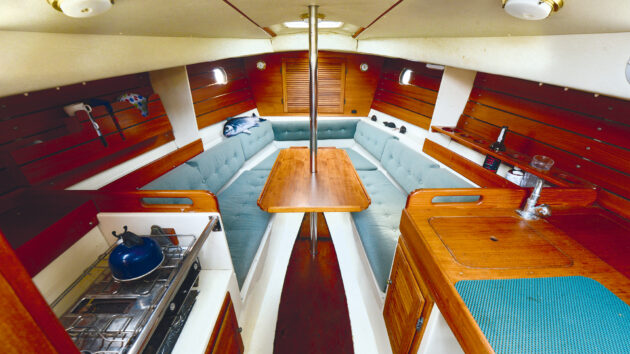
Three layouts were offered. This one has the U-shaped settee and forward locker with aft heads. Photo: Nic Compton
There was a blustery Force 4-5 blowing when we set off from St Just under full sail. Straight away I was impressed that Chip was confident enough not to bother with a reef, something that would have been risky with the old Mk1. And sure enough we were soon heeling over dramatically as Chip hung on to full sail, not even bothering to luff up in the gusts. Okay, it wasn’t exactly storm conditions and the sea was pretty flat on the Carrick Roads, but the boat seemed to lap it up.
The Crabber 24 Mk3 was the first boat in the Cornish Crabber range to be offered with a Bermudan rig as well as their standard gaff, which caused quite a stir at the time. The experiment proved a success, however, and several other boats in the range were eventually offered with Bermudan rigs.
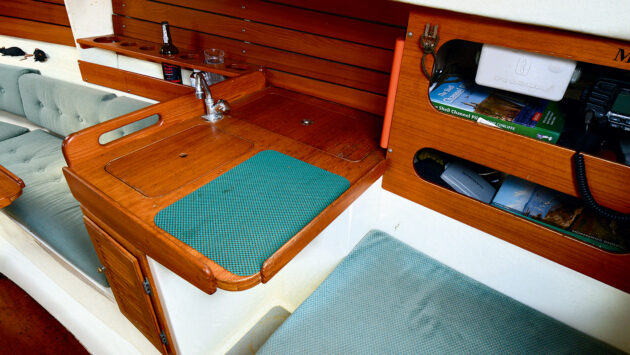
There’s a proper chart table; lift the cover and there’s a sink and fridge below. Photo: Nic Compton
Chip’s boat had the Bermudan set-up which, theoretically, performs slightly better to windward than the gaff version, while being a little slower off the wind. I certainly had no complaints with her windward performance when I took the tiller, though in the gusty wind conditions that prevailed that day there was a fair amount of weather helm.
But the real test came a little later when we met up with local fisherman Dave and his punt off St Mawes. The wind chose that exact moment to pick up dramatically and suddenly start blowing close to a Force 6. I managed to transfer to Dave’s boat, intending to get some shots of Ein Cariad under sail, and was immediately drenched from head to toe in spray.
More to the point, I wondered how Chip would manage on his own under full sail in these conditions. I needn’t have worried. The retired prof carried on regardless, furling the staysail and tacking up and down off Pendennis Castle as if he’d done this a hundred times before.
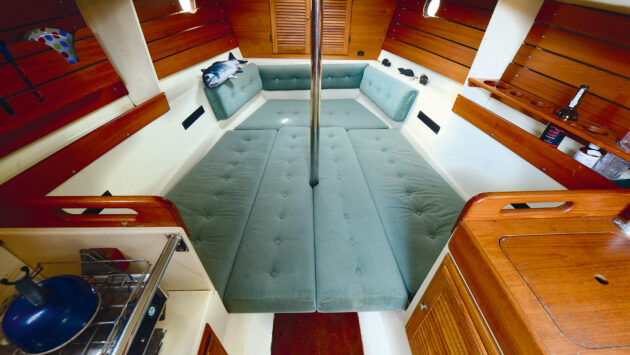
Lower the table to create a large double berth. Photo: Nic Compton
Fifteen minutes later, the wind dropped as suddenly as it had started, the clouds parted, and the Carrick Roads was bathed in sunshine. In no time at all, the dramatic, wind-torn scene turned into an idyllic summer’s day, as if nothing had happened. Ein Cariad carried on under full sail, though her performance now was obviously quite a bit slower, leading me to wonder if she was a tad undercanvassed for such light airs…
Cornish Crabber 24 Mk3 specifications
DESIGNER: Roger Dongray
YEARS BUILT: 1991-2014
LOA: 24ft 6in / 7.47m
LWL: 20ft 9in / 6.32m
BEAM: 8ft 6in / 2.59m
DRAUGHT: 3ft 6in / 1.07m
DISPLACEMENT: 7,826lbs / 3,550kg
BALLAST: 3,300lbs / 1,497kg
SAIL AREA: 386 sqft / 35.9m2 (berm) 397sq ft / 36.88m2 (gaff)
PRICE: £15,000-£25,000
Enjoyed reading this?
A subscription to Yachting Monthly magazine costs around 40% less than the cover price, so you can save money compared to buying single issues.
Print and digital editions are available through Magazines Direct – where you can also find the latest deals.
YM is packed with information to help you get the most from your time on the water.
-
-
- Take your seamanship to the next level with tips, advice and skills from our experts
- Impartial in-depth reviews of the latest yachts and equipment
- Cruising guides to help you reach those dream destinations
-
Follow us on Facebook, Twitter and Instagram.
Note: We may earn a commission when you buy through links on our site, at no extra cost to you. This doesn’t affect our editorial independence.
Verdict
Before I venture an opinion, let’s hear it from the man himself, who has the benefit of 14 years’ ownership. ‘She’s been really solid,’ says Chip. ‘The rig is quite flexible, because you can use just the jib and the mainsail, or you can reef the mainsail with the other sails up. And when the wind’s right and you have all three sails fully set, it’s just fantastic. Another big advantage is that I can handle her singlehanded, as I can control everything from the cockpit, which I find quite convenient. The only negative is reversing her: it’s just impossible to steer because of the long keel! Apart from that, she’s served me well.’ The Crabber Mk3 is a completely different vessel from the Mk1 I sailed all those years ago: more seaworthy, more solid, and more comfortable. A proper little yacht. Of course you pay for those advantages, and a good Mk3 will sell for up to £25,000 compared to £15,000 for a good Mk1. For many, the simplicity of a shoal-draught boat that can go on a trailer (just about!) will outweigh the later model’s seagoing capabilities. The Mk3 wasn’t the end of the story. First the company tweaked the design giving it extra headroom down below to produce the Mk4 version. Then they cut off the counter stern to produce the Crabber 22. Finally, in 2017, they went back to the drawing board with a brand new design by Andrew Wolstenholme, which revisited the concept of a shallow draught, trailable cruiser, albeit with added extras such as hot water and a carbon-fibre mast. The Mk3 is therefore something of a rarity in the Cornish Crabber range, and arguably all the better for it.