


Can a boat as big and muscular as the new Dufour 48 be fun and even nimble to sail as well as comfortable to live aboard? Theo Stocker went to find out
Dufour 48 review: Pushing the cruising concept to the extreme
Dufour seems to introduce new models at a blisteringly fast pace. The truth is, each mould they build will last for about 300 hulls, after which it’s worn out and they have to make a new one. When they make a new mould, they may as well make it a new shape that’s bang up to date. This suggests Dufour yachts are selling like hotcakes, and whatever they’re doing is clearly working.
Dufour’s UK dealers, Universal Yachting, were one of the few companies feeling genuinely sunny after what was, for them, a highly successful Southampton Boat Show 2025. This is where the new 48 was given its world premier. At the grand old age of five, the Dufour 470 was due to be replaced, leading to the introduction of the 48. This new yacht is beamier, longer, and features more sail area, more muscular chines, and flashy windows adorning every curve.
Umberto Felci’s concept is the same, just on steroids: 30cm longer, 11cm wider, and 10m2 more canvas. The bow is even fuller, though the chines keep the waterline narrower. A deeper, more rounded forefoot aims to make her more forgiving at sea. The topsides are higher, the cockpit is more spacious, and the interior is more voluminous with more headroom, windows, light, and ventilation. The changes may be subtle, but the concept is being pushed to extremes.
Far from being an extreme machine, however, the Dufour 48 is all about fun, engaging, and rewarding sailing without being demanding to handle. Comfort on deck and down below, both at sea and in harbour, remains paramount. This isn’t a stripped-out racer, or even a performance cruiser, but she is intended to sail in the high single figures without really trying. Nor is she made for hardcore offshore work, high latitudes, or other crazy adventures, though the hull is perfectly capable of taking you across the Atlantic.
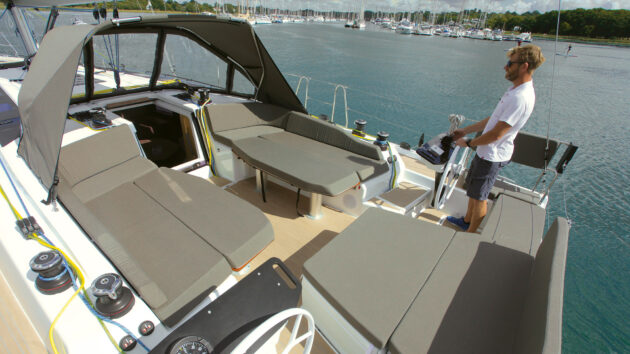
Movement around the cockpit and security within it has been well thought through. Photo: Joe McCarthy
What she does do, Dufour believes, is reflect the kind of sailing that most cruising yachties actually do. This involves coastal port-hopping in generally reasonable weather, before anchoring or mooring up. The goal is enjoying a drink or a barbecue and relaxing in as much comfort as possible, before settling in for a quiet, spacious night safely tied up.
The question for a boat tester, then, is whether this level of space and comfort detracts from the sailing enjoyment, or indeed the seaworthiness of the boat. The key is whether Dufour has been successful in reconciling the two.
We couldn’t have had much better weather for our test, as we wrung the last warmth and sunshine out of the summer in early September. Amid a week of heavy rain, clear skies and a warm zephyr from the south-west soon delivered the fluffy white cumulus that heralded a good sea breeze.
By the time we set sail, we had a pleasant 10−15 knots against an ebbing tide. So new was the boat that wind and speed instruments weren’t yet up and running, so we were relying on true wind readings from local weather stations and speed and course over the ground.
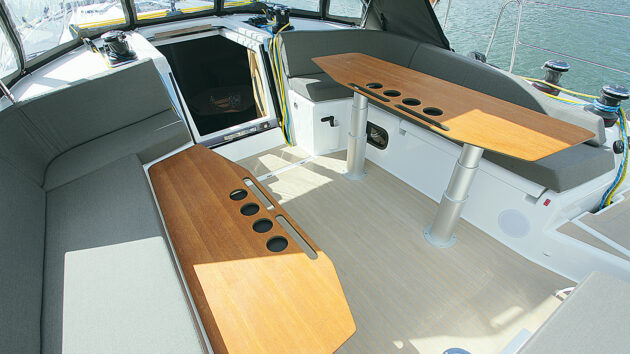
Split tables ensure the cockpit feels secure when heeled, and lower electrically to form sunpads. Photo: Joe McCarthy
Weather window
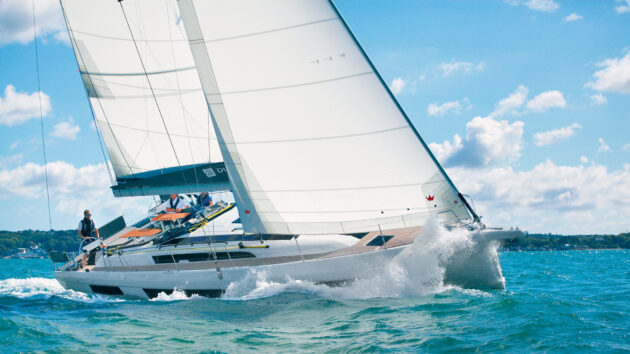
It wasn’t long before we were powering away to windward, sped along by the tide at 8.5−9 knots. This gave us a speed through the water of about 7.5−8.5 knots and 18−20 knots across the deck under full sail. Inevitably, a short, sharp Solent chop gave sufficient conditions to get an idea of how the 48 would handle proper waves. I was pleasantly surprised at just how seakindly she was.
With spray being thrown away to windward, the chines kept water off the deck. Importantly, there was no inclination to slam, which is a credit to the deeper forefoot and absence of flat spots below. This absence of flat spots is uncommon in older high volume cruisers with wide, shallow bows.
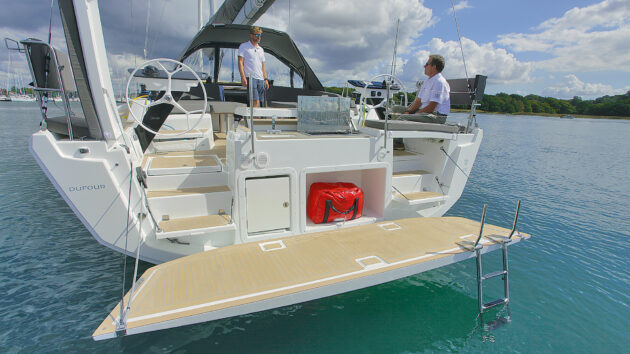
The full-beam bathing platform lowers quickly on an electric winch. Photo: Joe McCarthy
Magic lines
The other piece of magic the naval architects have wrought with these lines is the power of the wide bow to balance the hull shape fore and aft. This keeps the heeled hull shape far more symmetrical. It also ensures the stern doesn’t lift unduly and the rudder remains sufficiently submerged to retain control at all but extreme angles of heel.
Even bearing away while sheeted in hard, the deep single rudder maintained grip. The boat nimbly bore away or came back on the wind under total control, save for one tiny wobble. The wheel remained light, taught, and precise, an agility due in part to the boat’s relatively light displacement. This boat may look like a rugby player, but she is remarkably nimble on the dancefloor.
Thanks to its huge form stability and 2.35m deep keel of 3.85 tonnes, this is a boat you can push reasonably hard. However, she is designed to be happiest at 18º of heel. Heel to 25º degrees and it’s probably time to tuck in a reef, so nervous crew will be reassured by a boat that sails pretty upright without having to be depowered.
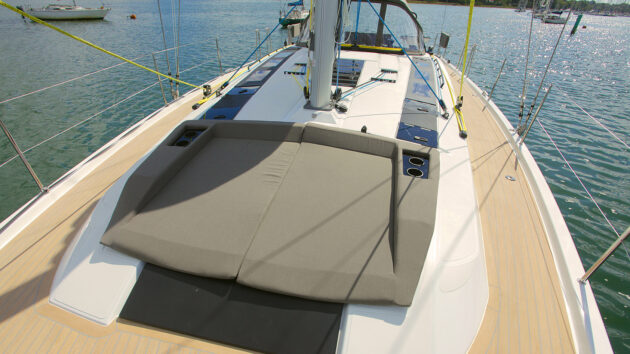
The ‘forward cockpit’ adds more lounging space on deck. Note the lines of windows set into the coachroof, some of which open. Photo: Joe McCarthy
They will also be helped by the two fixed cockpit tables, which provide excellent bracing, making an otherwise wide cockpit feel much more secure. These tables can also be electrically lowered in harbour to create two large sunpads. In conjunction with the aft sunpad and the ‘forward cockpit’ lounging area, this brings those crucial sunbathing spaces up to eight.
On our run back downwind, we clocked 5.5−7.0 knots over the ground against the tide, with a boat speed of roughly 6−7.5 knots. This is not bad under plain sail. The bowsprit with integral bowroller could accommodate a furling sail for easy offwind sailing. On deck, the side decks have been kept entirely clear of lines.
Synthetic teak and moulded bulwarks keep your feet secure. Handrails take you to the mast, and you’re unlikely to venture onto the foredeck in much of a seastate. Our test boat had the overlapping genoa, but the track for a self-tacking jib comes as standard. Twin backstays are fixed, but you can opt for tensioners to play with the 19/20ths fraction rig. At the start and end of your sail, handing the mainsail is helped by the low, waist-height gooseneck and mast steps, so you can easily get hold of the mainsail head.
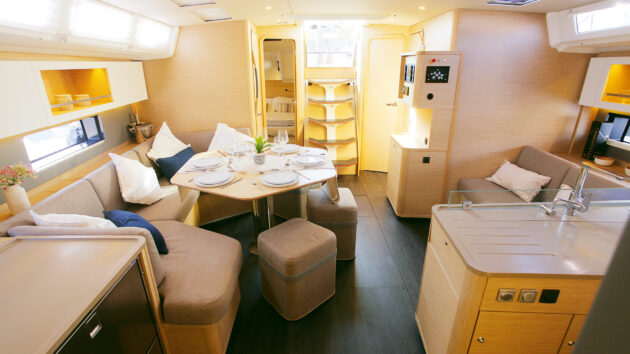
Using the full beam, the vast saloon is focused around the hexagonal table. Photo: Joe McCarthy
Full throttle
At the helm, foot chocks are not standard as you don’t really need them at those angles of heel, though you could add them. It’s good to see two powered winches either side for the mainsheet and jib sheets, as a single winch is a pain. The winches themselves are a bit of a reach from the wheel, though not an impossible one. The walkthrough in front of the wheel allows space for crew to get involved and handle lines, which I think is preferable, while still being manageable solo.
Buttons on the aft end of the coaming are easier to reach, so sails can easily be trimmed and the step between coaming and wheel lifts to reveal a decent rope bin for sheet tails. I’d have liked to see a crash stop button for the winches on the pedestals. The only snag was that the pedestal tops were marginally too close to the wheels and clipped knuckles when steering, though this is being rectified. The pedestals also house controls for the electric cockpit tables, bowthruster, autopilot, and the hybrid propulsion system control unit and throttle.
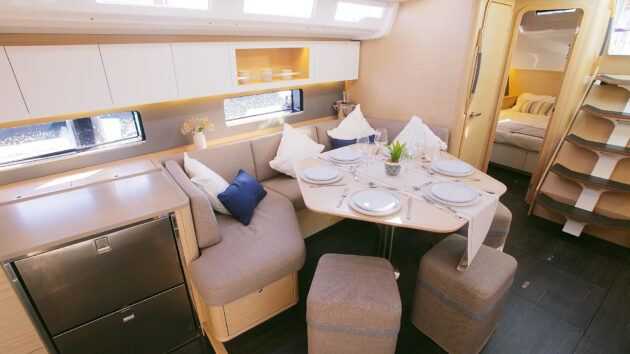
Using the full beam, the vast saloon focuses around the hexagonal table, with lightweight movable stools for inboard seating. Photo: Joe McCarthy
Propulsion is perhaps one of the most interesting areas of the boat, given the architecture of the system employed by Dufour. The system has come from propulsion company Joool, which has been building electric commercial boats for over 20 years, so it’s well tested tech. Essentially, an electric 25kW pod drive can be powered from the boat’s 32kWh batteries (27kWh is standard) for around three hours. This gives a range of roughly 15 miles at 6 knots.
You can of course charge the batteries as you go with the on-board diesel generator. Alternatively, if there was a fault with the batteries, you can drive the pod directly from the 14 kW generator, giving you pretty good resilience and potentially several days’ motoring. With the system off, the prop is locked in position while sailing. Power it up and you can flick it into regeneration mode, select how much resistance you want as a percentage, and watch as up to 1kW of power surges back into the batteries.
At 100% input and 8−9 knots, this costs no more than half a knot of boat speed. The other benefit of electric propulsion is the ability to motor-sail silently, adding just enough power to give you some apparent wind and get you sailing again. This means you can start sailing sooner than you would do with a diesel engine. If you stick with conventional propulsion, you can opt for either a 60hp or an 80hp inboard Yanmar diesel.
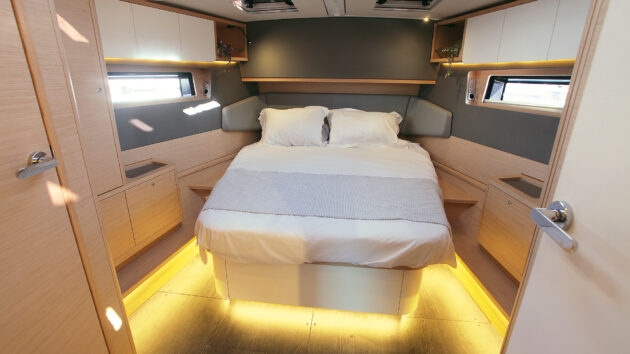
A luxurious headboard surrounds the head of the bed, but the boxing above needs to be moved to make use of it. Photo: Joe McCarthy
Safe and secure
Stowage on deck is pretty good, with shallow lockers under the cockpit seats. There is a good big forepeak with loads of space for sails and fenders. Ahead of this, the chain locker is accessed through a watertight hatch, so there’s no access to this on deck, and the chain windlass sits on deck above the hawse pipe.
Aft, the midships transom pod can be used for stowage, but a key Dufour selling point is its open-air grill and sink, which most owners opt for. The seats lift forwards, so you can stand on the bathing platform and cook at a comfortable height, out of the way. The central sunlounger pod adds some useful shallow stowage.
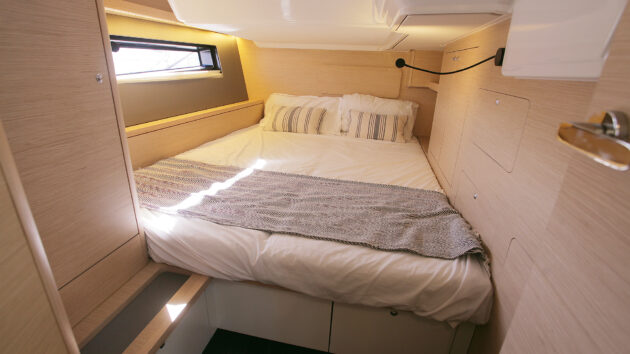
Aft berths are fully rectangular and the cabins have plenty of light, ventilation and stowage. Photo: Joe McCarthy
The liferaft slots into the transom below the outdoor galley, as does the gas locker. The gas locker is open to quickly drain any leaks, though it could potentially be a little damp in terms of long-term corrosion. The large lazarette is accessed through hatches below the helm’s feet.
The hatches aren’t huge, and as they open forwards, the helm seat needs to be lifted, so getting in here is most easily done when the bathing platform is down. The large space is organised with canvas bags below the hatches, with some of the remaining space accommodating the generator.
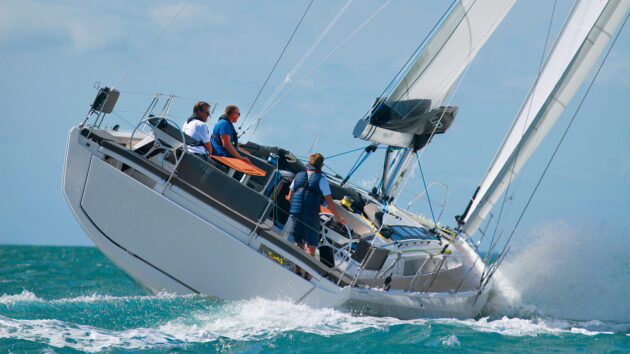
This is a pleasantly seakindly boat to sail, while the deck remains largely dry. Photo: Joe McCarthy
Light and space
Going down below, you are struck by just how much space there is in the saloon, both width, length and height (193−206cm headroom throughout). As with other Dufours, a forward galley against the bulkhead is standard, with gas stove and sink to port and fridges and more worksurface to starboard. Lockers below and above offer plenty of stowage. Aft of this is a small settee to port, made into a lounging bed by the addition of the three lightweight stools, which remained securely wedged in here throughout our sail.
The focus, however, is on the hexagonal table with C-shaped seating to starboard, which is long enough for a seaberth. The three inboard spaces are catered for by the moveable stools. If you choose to opt for a longitudinal galley to port, this table and seating extends forwards into a more conventional layout. When it comes to the layout of heads and cabins, there is a vast range of options, from three cabins and three heads to five cabins and three heads, or four cabins and four heads.
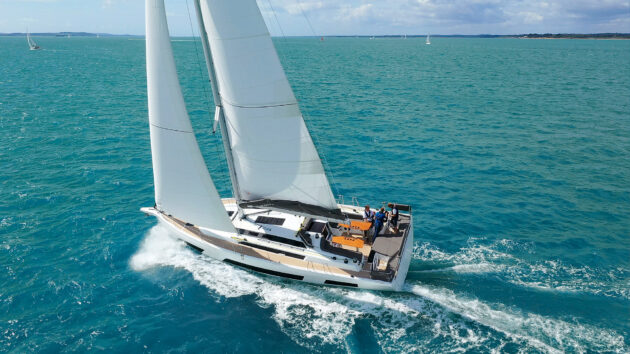
The full bow sections help keep the bow up and the rudder in the water. Photo: Joe McCarthy
I’d imagine charter companies will take five cabins, in which the forward cabin is split into two and is still wide enough for each to have a proper double berth (205cm×165cm) and ensuite heads. In this scenario, the main heads aft port becomes a bunk cabin. In the three-cabin layout that I think most private owners would go for, the huge forward cabin features a large island bed (215cm×177cm) with a stunning wraparound headboard. It has separate shower and toilet compartments, with acres of locker space.
My only quibble here was that the boxing above the headboard meant there wasn’t quite room to sit up in bed. This is a small comfort I’d want for this sort of money, as the views out are excellent through the various hull windows and hatches. Dufour has told us it’s looking into remedying this.
Layout decisions
The aft cabins are also generous, and the large beds (204cm×163cm) are fully rectangular, and supplied with plenty of stowage too. Then you can start to decide what you want to do with the heads compartments. The starboard compartment can be a small heads, or you can take out the bulkheads and turn it into a decent-sized work and nav station. This nav station is otherwise missing entirely from down below, save for the switch panel and single instrument repeater to port.
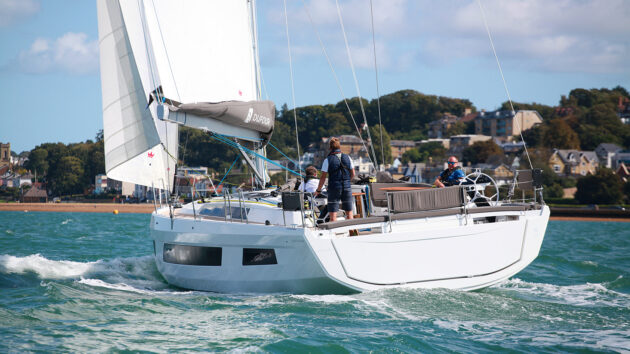
Modest displacement ensures the boat is easily driven off the wind. Photo: Joe McCarthy
The large, main port heads with enclosed shower compartment can also be converted to a utility and stowage room. Alternatively, it could be a twin bunk room, or a mix of the two for occasional guests, as long as you keep a heads compartment somewhere. There’s little doubt Dufour has gone to a lot of effort to create comfortable spaces that really work both in harbour and at sea. These are production rather than custom boats, but the surfaces of pale alpi veneers, white panelling, leather-covered handholds and recessed lighting all help elevate the feel of the finish.
Lockers and unseen joinery is largely thinly-varnished plywood, but underway there was very little creaking. Getting around when heeled wasn’t too bad, with a couple of well-placed handholds. The galley fiddles were slightly too low to make good holds, so I would be opting for overhead grab rails, and maybe another hold or two on the port-side joinery.
In the electric version, the engine space will be lined out to offer additional stowage, with nothing but some wires and the Joool white boxes at the back of the space. The hull retains the moulding for a saildrive engine to be fitted if desired.
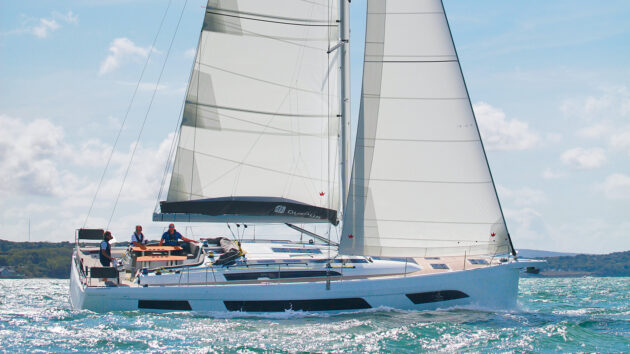
Buoyancy in the bow ensures the stern and rudder don’t rise when heeled. Photo: Joe McCarthy
Dufour 48 specifications
LOA: 15.29m/50ft 2in
Hull length: 14.32m/47ft 0in
LWL: 12.23m/40ft 1in
Beam: 4.85m/15ft 11in
Draught: 2.35m/7ft 9in (Shoal 1.75m/5ft 9in)
Displacement: 13,900 kg/30,644 lbs
Ballast: 3,850kg/8,487lbs
Sail area: 117m²/384 sq ft
Bal/disp ratio: 27.7
Disp/length: 212.2
SA/D: 20.6
Engine: 60/80hp Yanmar OR 25kW Joool electric pod
Transmission: Saildrive/pod
Water: 530L/140 gal
Fuel: 250L / 66 gal
RCD: Category A
Price as tested: £723,000 inc VAT
Enjoyed reading this?
A subscription to Yachting Monthly magazine costs around 40% less than the cover price, so you can save money compared to buying single issues.
Print and digital editions are available through Magazines Direct – where you can also find the latest deals.
YM is packed with information to help you get the most from your time on the water.
-
-
- Take your seamanship to the next level with tips, advice and skills from our experts
- Impartial in-depth reviews of the latest yachts and equipment
- Cruising guides to help you reach those dream destinations
-
Follow us on Facebook, Twitter and Instagram.
Note: We may earn a commission when you buy through links on our site, at no extra cost to you. This doesn’t affect our editorial independence.
Verdict
If you want the maximum amount of boat for your buck, there are few boats that squeeze more into the marina berth than the Dufour 48. The sheer amount of space this boat has is staggering. The fact Dufour has managed to make a boat that genuinely sails as well as she does is a testament to modern boat building. Sure, you might not get the solid joinery or elegant overhangs of days gone by, but down below, she is light, spacious and comfortable. On the water, the 48’s form stability develops an impressive amount of power, and construction is light enough to let the boat really pick up her heels. She was much more seakindly than you might expect, while the wide bow keeps the hull balanced, which all results in a boat that for a high volume cruising boat is remarkably responsive and fun to sail. The optional electric propulsion system appeared to work well and provide a sensible solution for longer-distance cruising.