



A top Half-Tonner from the 1970s might not sound like an ideal first cruiser, but the Hustler 32 offers much more than you might imagine, says David Harding
Hustler 32 used boat review: Why this IOR racers makes an ideal cruiser

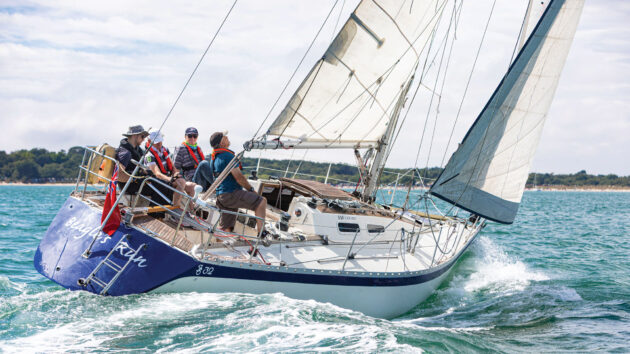
Can a boat designed for top-level offshore racing ever make a good cruiser? It’s a question likely to spark a lively debate in many sailing circles but, in the case of the Hustler 32, I would maintain that the answer is an unequivocal ‘yes’.
Here is a boat that finished second in the 1978 Half-Ton World Championship, yet which has since found a surprisingly strong following among cruising sailors.
Let’s briefly go back to the 1970s. This was the heyday of the International Offshore Rule (IOR); a rule that, at various times, encouraged pinched sterns, distorted hull shapes, low stability, skinny, trim-tab mainsails and massive overlapping genoas.
I currently race with a hugely experienced sailor on a 33-footer from the 1980s. He reckons the boat is both faster and easier to sail than the IOR 44-footer that he raced at the highest level in the 1970s with some of the biggest names of the day. I also race on another 33-footer, this one designed in 2010, which is significantly faster, more forgiving and easier to sail than the older boat of the same size.
In some respects and in some instances, design has moved on in leaps and bounds over the decades. It could be argued, however, that it’s partly because it was held back at times by rules like the IOR.
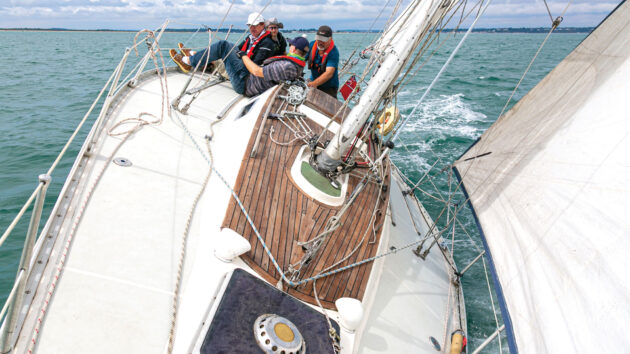
A generous beam and a narrow coachroof make for easy movement on deck. Photo: David Harding
Then again, the IOR was not all bad. This was an era when designers such as Stephen Jones, Rob Humphreys, Ed Dubois, Ron Holland, Bruce Farr, Doug Peterson, David Thomas and Julian Everitt were experimenting with a lot of ideas, and not only to find ways around constraints imposed by the rule.
These designers and others produced some great boats that are radically different from each other and far less ‘of a type’ than your typical racing yacht or cruiser-racer of today.
Some of them are still going and still winning. Just look at the Quarter-Tonners, for example. While a few are much as they were when first launched, many have been extensively rebuilt and, in light conditions especially, they’re very hard to beat (as those of us racing in the 2026 IRC European Championship will testify).
Half-Tonners have seen something of a revival, too. And, as with the Quarter-Tonners, some of the more successful ones from the 1970s and 1980s spawned production versions, typically with shallower keels and smaller rigs, that were aimed at cruiser-racing sailors and often marketed on the basis of their success on the race course. Rob Humphreys’ Trapper 31, Beneteau’s original First 30 and Dufour’s Arpège aren good examples of this.
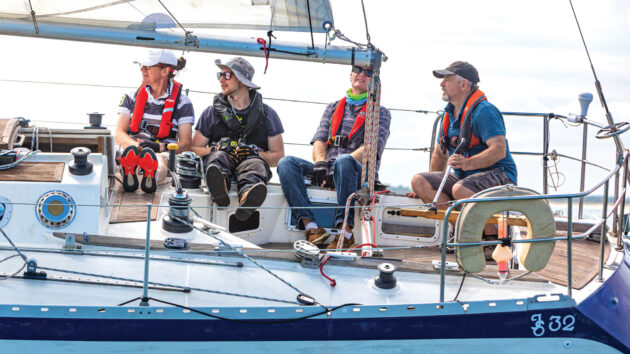
The headsail winches are mounted well inboard to make the crew’s job easier when tacking. Photo: David Harding
Interestingly, things happened the other way round with the Hustler 32. John Harrison of Island Boat Sales in West Mersea was the man behind the Hustler range. The first generation of Hustlers – the 30, 35 and 25.5 – were designed by Holman and Pye. They were fast, good-looking, and successful racers that later served their owners well as cruisers. Having sailed the 25.5 and 35, I can confirm that they’re fine boats.
Wanting a new range of Hustlers that would be competitive on the race course, Harrison commissioned the 32 from Stephen Jones, having been impressed by one of Jones’s earlier one-off Half-Tonners. The prototype Hustler 32 was built in wood by Landamores and given a masthead rig for ease of tuning.
Production boats, built by Verlvale, were offered with a choice of masthead or fractional configurations along with variations in interior finish, deck layout and more according to what the owners wanted.
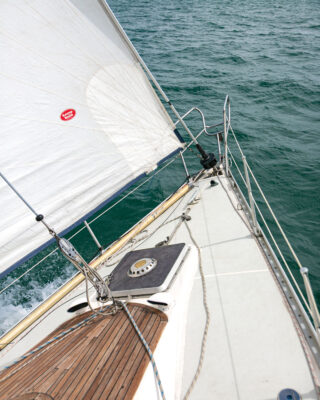
A removable babystay helps stabilise the masthead rig but is probably unnecessary in most conditions. Photo: David Harding
These were fast boats, as Smokey Bear proved by finishing second to Laurie Davidson’s Waverider in the Half-Ton Worlds in Poole in 1978. Another Hustler 32, Indulgence, finished sixth, having been leading at the half-way stage.
For a design conceived as a production boat, it was no mean feat to have two top-10 finishers in a World Championship. The 32 made its mark in other ways, too, with one journalist writing: ‘The Hustler 32s looked massive against the majority of the fleet and were about the only boats present with decent internal space and real cruising potential for the future.’
Significantly, the 1978 Half-Tonners were designed and built just before changes in the IOR that made future designs rather different. Although she still had to be designed to rate under the rule, the Hustler has always been known as a boat that’s much better behaved and easier to sail than many that came before or after.
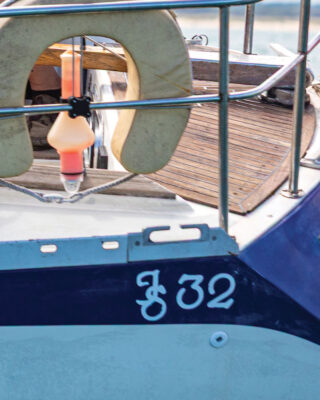
The ‘SJ’ is not normally included in the Hustler 32’s designation, but is with the Hustler 30 to distinguish her from the earlier Hustler 30 by Holman & Pye. Photo: David Harding
Big, fast and tolerant
It was the Hustler’s size and space that, among other factors, appealed to Jacob Bennett, Josh Lightfoot and Ed Chads when they were searching for a boat.
Josh and Ed, both with dinghy-racing backgrounds, had met while studying at Exeter University. Their quest for ‘a bit of an adventure’ started with the idea of buying a dinghy that they could paddle down to Exeter Quay.
As often seems to happen when boats are involved, their ideas soon evolved and they found themselves looking at a 26ft trailer-sailer. As Josh explained, ‘We then did a bit of market research and realised we could get a pretty shabby yacht for under £6,000 with an engine that wouldn’t start.
‘Ed and I had a couple of shopping trips to try to get an idea of what we liked. One took us to the East Coast and made us realise that increasing our budget to £10,000-£12,000 would allow us to buy a much better boat – but for that we needed a third party.’
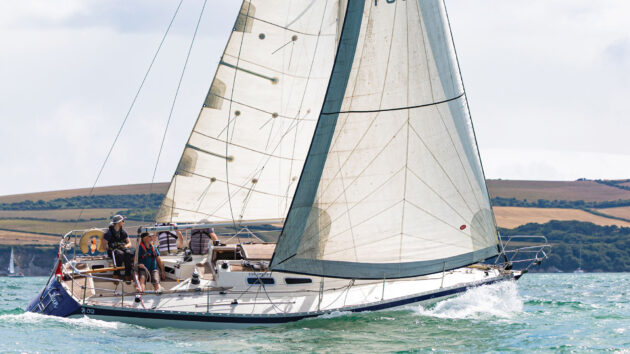
The best-known racing Hustler 32s had fractional rigs, but the masthead option was equally popular. Photo: David Harding
Enter Jacob Bennett, who had grown up racing Poole AB dinghies at Parkstone with Josh. The trio then spent several more months looking at various options, including one of Stephen Jones’s Oyster SJ 30s on the East Coast.
This was essentially a (new-generation) Hustler 30, but in those days there was a lot of interaction between Verlvale, Landamores and Oyster and some of Jones’s designs were marketed under different names according to how and where they were fitted out.
Let’s not forget that the Hustler 25.5 is the boat that inspired Richard Matthews to found Oyster Marine with the UFO 34.
Their search led them to a Hustler 32 in Harwich for an affordable price. As Josh said, ‘I think we found a great boat for the money despite the fact that it had a saildrive, which we had been warned against.’
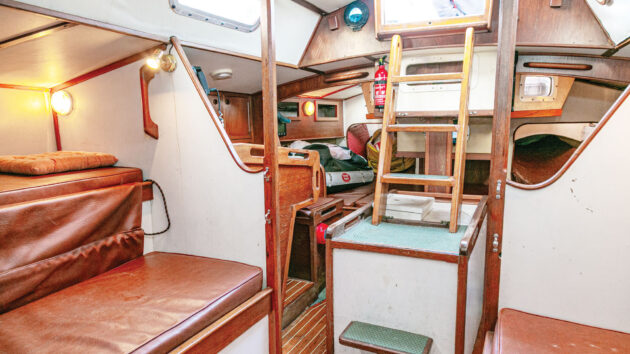
Engine is mounted well forward for weight distribution, making it easily accessible from three sides. Photo: David Harding
In every other respect, the boat stacked up very well indeed. As Jacob put it: ‘We had realised we could get an older, bigger, faster boat for the same money as a newer smaller one. This had more space and longer legs, so it meant we could go further.’
After a survey that showed up nothing untoward, they accepted the owner’s word that it was good to go, and sailed non-stop from Harwich to their berth in Southampton.
‘As soon as we started sailing on the delivery trip, we realised it was quicker than we thought it would be,’ said Jacob.
Beagle’s Run proved to be consistently quick. That summer the three owners took part in a West Country tour with Poole Yacht Racing Association (PYRA), winning the race from Poole to Weymouth and going as far as Fowey. Other successes followed in the Round the Island Race: fifth in their ISC class in 2021 (out of 37 entrants) and third in 2023.
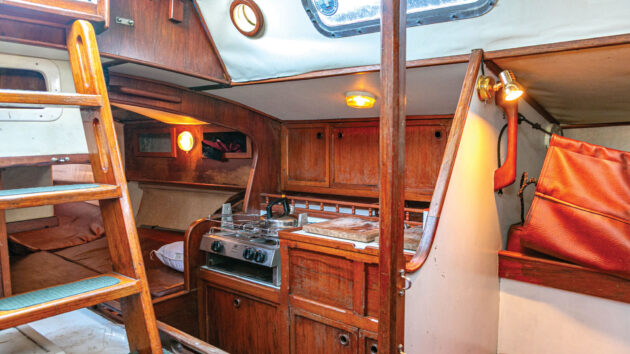
To port by the companionway the galley, like the rest of the interior, is more fully fitted than you would expect on a cruiser-racer. Photo: David Harding
It was on the way from Weymouth to Southampton that they encountered a waterspout that took the wind from very little up to 65 knots in a matter of seconds.
The boat was laid flat before popping back up and then being knocked down a second time, again righting herself undamaged. The only immediate consequence was an MOB, but the late-summer sea was warm and they performed a textbook recovery.
As tough as they come
No aspect of the Hustler’s performance or construction gave rise to any concern during five years of ownership. Upwind, to her owners’ great satisfaction, Beagle’s Run would often overtake much bigger and newer boats that had cost their owners hundreds of thousands of pounds.
Stephen Jones made sure she went the other way too, designing the 32 to handle heavy downwind conditions well. Jacob, Josh and Ed admit to having flown the spinnaker in 25-30 knots of wind and to ‘looking out for big winds and tidal races to test the SOG [speed over ground] record’. The highest they recorded was 14.7 knots.
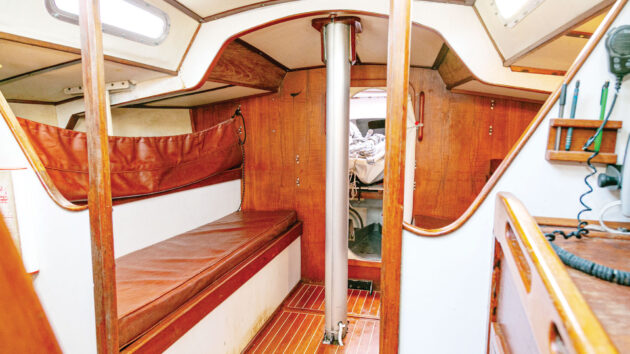
Plentiful handholds and bracing points. Photo: David Harding
You don’t do this sort of thing unless you’re competent and have faith in your boat. Being young and fit, with a lot of dinghy-racing experience, also helps.
‘We have all grown up racing dinghies’, explained Josh. ‘We would never have forgiven ourselves if we had bought a caravan. We wanted to be able to race. In the end we didn’t do very much, which is a shame. Had we moved the boat from Southampton to Poole earlier we would have done more.’
What they did do was all the maintenance themselves, including replacing the saildrive leg when it suffered severe corrosion during a season in a Southampton marina. They serviced and winterised the Bukh DV 20 engine, which ‘never missed a beat’. They took advice before undertaking jobs with which they were unfamiliar, but the only time they called in a professional was for the initial survey.
Beagle’s Run was for sale by the time I sailed her, because careers and other practicalities were getting in the way and five years of fun had been had by all. Josh and Ed were elsewhere on the day, so Jacob rustled up a crew that included Josh’s dad, Julien.
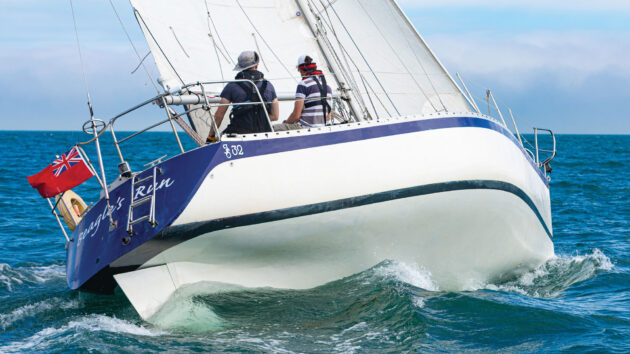
Hustle and bustle: stern bustles were used in some IOR designs to shorten the static waterline for rating purposes. A long stern overhang then extended the sailing length. Photo: David Harding
In 17-20 knots of breeze, the Hustler proved every bit as fast as I had expected. She dug in her broad midships sections on the wind and powered along at close to six knots even without all the crew on the rail and with sails that were well past their prime.
Given her reputation and racing record, performance and handling are almost a given. Balance was good, the helm light (it’s a tiller, naturally) and grip from the rudder excellent. Downwind, under spinnaker, she surged along happily.
The only feature I found surprising was the combination of docility and responsiveness, because I had imagined she would be more twitchy and demanding.
She’s known for her space below decks, so that came as no surprise.
On Beagle’s Run, the forecabin is devoted to stowage. In the saloon she has settee berths with pilot berths outboard (great for stowing kit bags, notes Jacob). Between the galley and chart table is the engine, with a case that comes away on three sides to give excellent access.
Abaft the engine, under the forward end of the cockpit, is a large area of bunk that could accommodate at least two people sleeping athwartships. Then there are two ‘torpedo tubes’ (quarter berths) further aft.
Beagle’s Run was completed some years after being moulded in 1978. She was finished with a good amount of well-finished joinery, suggesting that her original owner might not have had serious racing in mind.
Enjoyed reading this?
A subscription to Yachting Monthly magazine costs around 40% less than the cover price, so you can save money compared to buying single issues.
Print and digital editions are available through Magazines Direct – where you can also find the latest deals.
YM is packed with information to help you get the most from your time on the water.
-
-
- Take your seamanship to the next level with tips, advice and skills from our experts
- Impartial in-depth reviews of the latest yachts and equipment
- Cruising guides to help you reach those dream destinations
-
Follow us on Facebook, Twitter and Instagram.
Note: We may earn a commission when you buy through links on our site, at no extra cost to you. This doesn’t affect our editorial independence.
Verdict
Good things came out of the 1970s, and the Hustler 32 is one of them. She proved to be an ideal first cruiser for three young dinghy-sailing graduates, allowing them to clock up the miles, win a race or two and learn a lot along the way. As Josh observes, ‘It’s quite a safe boat, and very forgiving. We all took out inexperienced friends with no problems at all. We might not have done everything by the book, but we did our best and the boat allowed us to get away with it.’ Beagle’s Run proved to be tough and capable despite her relatively light displacement, surviving the winds of a waterspout just as another Hustler 32 survived the 1979 Fastnet. She’s also fast, roomy down below and fun to sail. Josh sums up by saying, ‘We were very pleased with the Hustler. It will make it far more difficult to be satisfied with a second boat, whenever that comes around.’