


This design may have been around a while, but it will still sweep you off your feet and show you how sailing boats are meant to be, as Theo Stocker found on a trip to Sweden
Linjett 34 review: ‘How a sailing yacht is meant to be’
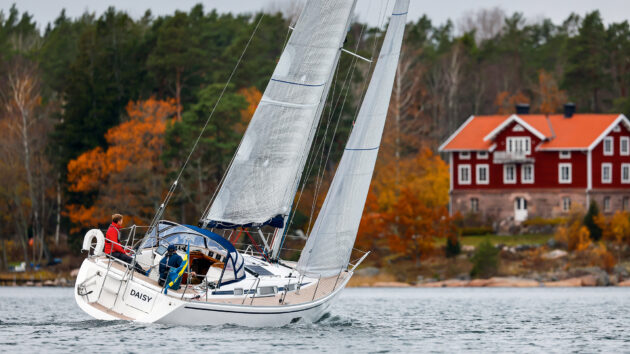
With slow beats of its vast wings, the sea eagle circled overhead, then continued its hunt across the fjord. Brown and gold forests lined the rocky shores of the Lidofjard under a leaden sky, punctuated by Falu-red houses, private jetties and the occasional waterside sauna.
If Abba, meatballs and flatpack furniture is one side of Sweden, this is the flip side. Traditional, rugged, and (this close to Stockholm at least), probably really rather wealthy in a very understated way.
A fitting backdrop perhaps against which to test a boat from one of the more conservative of Sweden’s several top-end yacht builders. Now, the Linjett 34 is not a new design – unveiled in 2012, it’s done solid service already and the boat on which we were sailing was already four years old, so arguably we could run this as a used boat review.
The owner is even a reader of this very magazine, so many thanks for letting us sail your boat! But given that we’ve never tested the Linjett 34, and only two other Linjetts in the brand’s 53-year history, this an oversight I believe needs remedying.
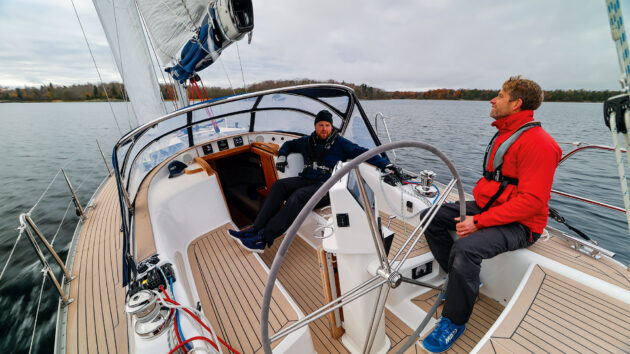
Tiller or wheel steering is an option, while the cockpit is ideal for shorthanded cruising. Photos: Paul Wyeth
Furthermore, the question of whether conservative lines, understated appearance, and sparkling sailing can hold their own against the gym-bro muscularity of the latest full-volume cruisers is one worth exploring in these pages.
Having ventured far into the depths of the forest to the north east of Stockholm (well, an hour and a half), the day dawned chilly, overcast and with just the faintest flutter of breeze. This didn’t bode well for a sailing test, but after a morning dip in the fjord (to the bemusement of the yard workers) and a stiff coffee, we resolved to hunt down some breeze and motored out into the Lidofjard and towards Arholma, until we found a suitable fetch across
which the timid breeze could embolden itself.
In the end, a tremulous 5-8 knots filled in, gusting up to a dizzying 10 knots. In the grey morning light, it was the boat that was going to have to sparkle.
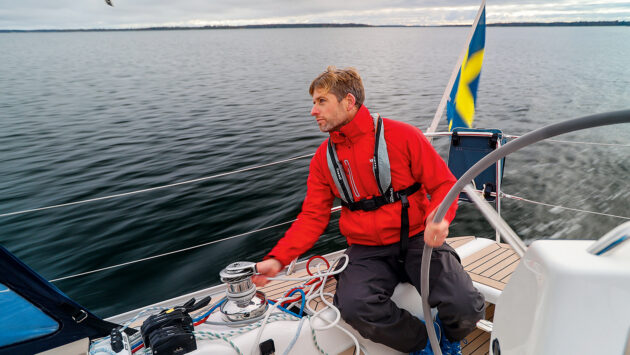
With 10 clutches a side, you can tweak the sails to your heart’s content. Photos: Paul Wyeth
Look like you mean it
In many ways, looking at the 34 is like going back to a time a boat’s sailing manners could be guessed at from how she looked. Low, purposeful topsides, an elegantly understated sheer, sleek coachroof, a fine entry and well-proportioned stern make this look like a boat that knows what it’s doing. Inboard chainplates are rare these days, but allow for neat, compact spreaders and a solid looking rig, as well as the option of setting a large 140% overlapping headsail in case a Code sail doesn’t take your fancy.
The modest beam, evenly rounded bilge and moderate rocker fore and aft suggest a boat that focuses on being slippery and easily driven rather than on overall power. It also creates a forgiving shape that changes little, either when heeled or heavily laden, whether racing or long-distance cruising.
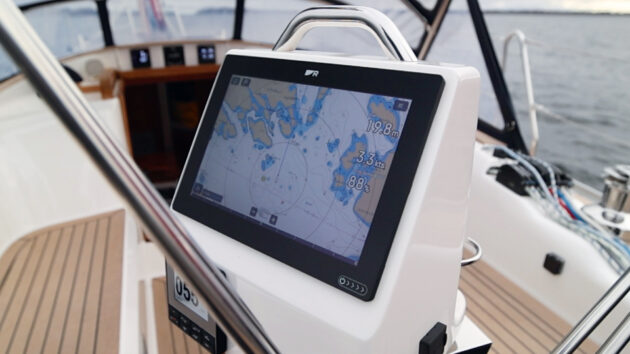
The large chartplotter swivel pod at the wheel is a nod to modernity. Photos: Paul Wyeth
Further points of note include the large, deep balanced spade rudder set on a stainless steel shaft, and a 1.84m deep lead keel, set on a significant moulded stub which is stepped on three levels so that there is no single line weakness for the keel to fail along, and creating a usefully deep bilge sump.
Looking at the numbers, she is remarkably light for her length especially given the level of fitout below, well canvassed, and with a generous amount of ballast located at the bottom of deep keel, which all serves to make a boat that should be tough, stiff, very seaworthy and also more than a little fun to sail.
Upwind magic
With all sails set – 110% genoa sheeted to the short, coachroof-top tracks and a generously roached main – we set about hunting the zephyrs. Before long, boat speed matched the true wind, fetching at three knots into 3-3.5 knots of wind. Above 5 knots of breeze, and 8 knots across the deck, the boat started to feel more alive, heeling modestly and creeping over 5 knots through the water.
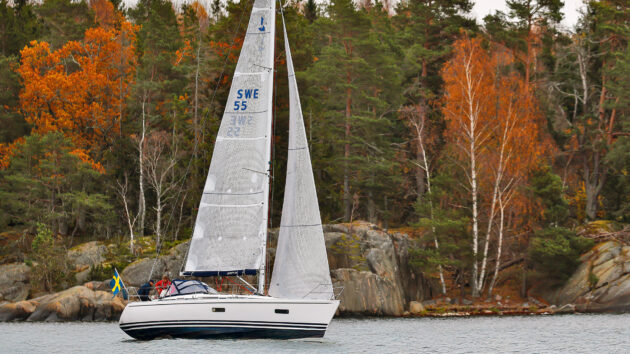
Construction is vacuum infused polyester resin with solid below waterline and 18mm Divinycell foam core above it, with a hand laminated deck moulding to achieve a high-gloss finish. Photos: Paul Wyeth
It’s a shame there wasn’t a real breeze, as the hull slipped along beautifully across this carpet-soft water. More importantly, she did so at astonishingly narrow angles, reaching 25-27º to the apparent without breaking a sweat and tacking through 70-80º on the compass. That’s like having a magic conveyor belt to windward, and for coastal cruising, that makes a real difference to getting to where you’re going.
In the bigger gusts, she heeled past 15º and in reality, she’ll be fully powered up at 25º of heel; rather more than the latest crop of ultra-wide, hard-chined hulls, but at this angle, her 40% ballast ratio makes her rock solid and able to take more and more.
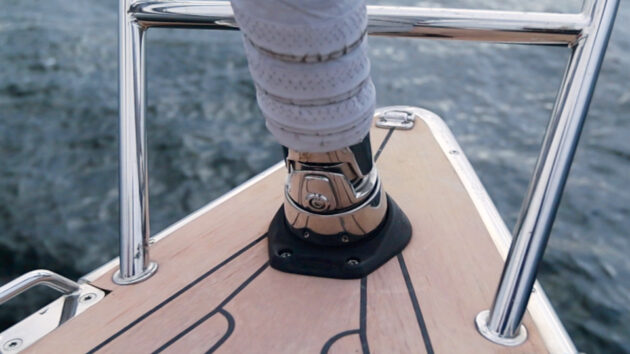
Furling is below deck. You can specify a bow anchor, though Baltic boats often don’t. Photos: Paul Wyeth
I suspect that in a Force 6, she’ll really show her claws, devouring miles effortlessly while the young guns start looking for shelter.
For now, however, I relished the refinement of milimetre-precise steering, nudging the headsails telltales up or down with the merest movement of a finger. This, in my view, is the most important sensation to consider in choosing a boat – if you don’t get that immediacy and satisfaction at the helm, then the rest is basically pointless.
Proper control
The other thing that singles this boat out is the combination of ease of handling for shorthanded sailing, coupled with proper sail controls – you normally have to choose between all of the lines to tweak with multiple winches and clutches spread out around the cockpit for crewed racing, or a few basic lines led aft to the helms.
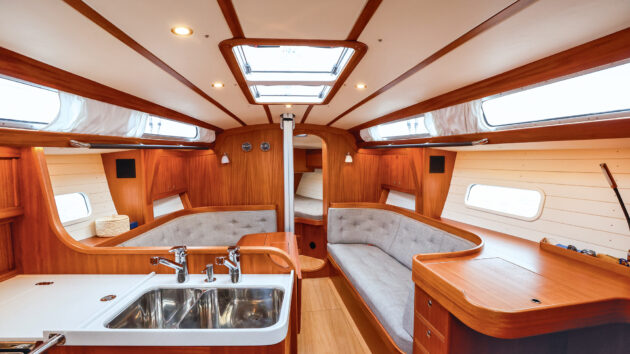
Oak is an alternative to the Khaya mahogany and can be finished in various shades. Photos: Paul Wyeth
The 10 clutches ahead of each powered Andersen 46 self tailing winch, however, put all of the controls within arm’s reach, and the means of tweaking to my heart’s content – mainsheet traveller (mounted ahead of the companionway to keep the cockpit clear), cunningham, outhaul, 24:1-purchase backstay. The only things lacking were towable jib cars or inhaulers to play with the headsail sheeting angles.
With just one winch either side, this can make things rather busy, though you can opt for more winches further forward on the coamings to handle spinnakers and the like if that’s your wont. Also on the options list is wheel or tiller steering – the latter connects direct to the rudderhead under the stern seat, while the large stainless wheel gives sufficient width to steer from the coamings, and is comfortable whether sitting or standing, outboard, forward of or behind the wheel.
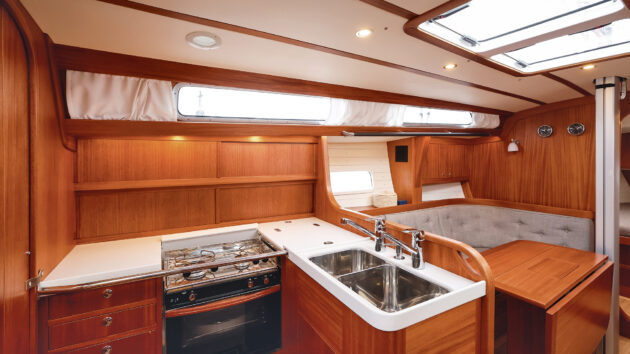
Few 34-footers have a galley this large or well-appointed. I’d have liked an opening hatch above the galley, though there is a dorade vent. Photos: Paul Wyeth
Atop the pedestal, a 12in Raymarine plotter is mounted in a pod which swivels 360º for an easy view wherever you are. For tiller steering, this would be bracket-mounted on the coachroof next to the companionway.
Storage aplenty
As with all Linjetts, stowage is excellent. The opening rope bins under the outboard helm seats are huge, while the open end is large enough to shove lines into without opening the lid. The portside helm seat houses a properly lined hull-depth lazarette with the windlass for the stern anchor tucked inside – so essential for this part of the world that this boat has no bower anchor, while a boat going to the UK might have a bow anchor and no stern anchor.
The starboard helm seat lifts then folds down aft, creating a walk-through and step down to the sugar scoop bathing platform. Below the walk-through is a shallow liferaft locker, close to the point from which you would want to launch it.
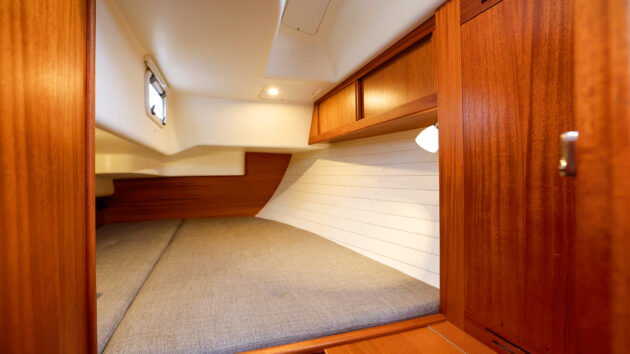
Nearly rectangular, this is a decent-sized guest cabin with good stowage. One opening hatch gives modest ventilation. Photos: Paul Wyeth
The main cockpit locker, under the starboard bench seat, is vast, and other than the diesel tank under the panelling at the aft end, is hull-depth and easily large enough to swallow folding bikes, a deflated dinghy, organised stowage for boat hooks, and hanging space for lifejackets and foulies, and is also accessible from the heads compartment.
The cockpit itself is deep, secure and narrow enough for easy bracing underway, with good high coamings and curved angles to make for comfortable backrests whatever the angle of heel. With an autopilot control at the forward end, you could con the boat inside the shelter of the sprayhood, enclosed with a tent screen, while enjoying the heat emanating from below. The final little bespoke touch is a folding table attached to the steering binnacle, which extends to offer full dining space for six on deck.
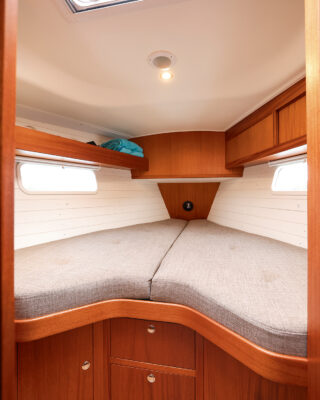
The forward double is 2m long by 1.8m wide and very comfortable. Photos: Paul Wyeth
On deck the aluminium toerails slightly date the boat’s appearance – you could swap them for wooden toerails if you don’t mind the maintenance. For a mere 34-footer, the side decks are wide and uncluttered, with short grabrails taking you from sprayhood to inboard shrouds, which make passage forward a doddle.
The aft end of the guardwires unclip to form a large boarding gate next to the cockpit when alongside. Our test boat had the coachroof-top jib tracks, deck-mounted genoa tracks, and a self-tacking jib track. There’s no bowsprit forward of the below-deck jib furler, so asymmetric sails are flown from the stem, unless you add a deck-mounted sprit.
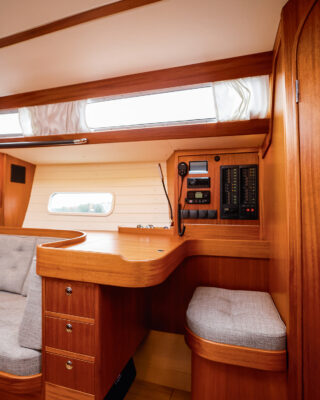
A column of handy drawers supports the forward-facing chart table. Photos: Paul Wyeth
Warm embrace
On the coachroof is the mainsheet traveller with a 4:1 purchase – enough to adjust the sheeting position underway, if not to play it in the gusts as on an aft-sheeted race boat. Two flush hatches provide light and air in the saloon, with another for the forward cabin, as well as 230W of solar capacity split across two 115W flush panels.
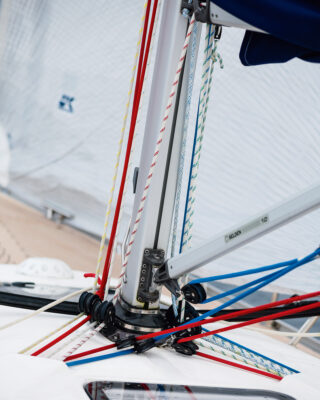
All lines are led aft under the coachroof. Photos: Paul Wyeth
On the foredeck, the self-tacker sheet emerges from the deck abaft the large bow locker capable of holding plenty of chain under a windlass at the forward end, with room for two large 5kg gas bottles on a shelf at the aft end and half a dozen fenders in the middle; downwind sails will need to be stored aft though.
If that all weren’t enough to convince you of the boat’s quality, stepping below into the warm, softly lit embrace of the saloon surely would. Fitted out in Khaya mahogany, a curving fiddle sweeps around the chart table and behind the settees, enfolding the whole saloon. Immaculately finished joinery gleams from every surface; all the framing for lockers is in solid timber, and doors have extra thick veneers around the edges.
The L-shaped galley is huge for a boat this size, providing ample space for a large two-burner oven, deep double sink, large fridge and generous Corian worktop. Below this are lockers and drawers – soft-close, of course, built in solid oak with dovetailed corners – while outboard, two tiers of lockers provide all the space a small crew would need to live comfortably, complete with the obligatory espresso machine and milk frother.
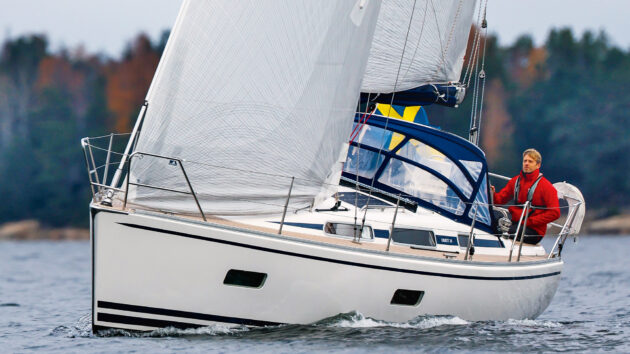
The well balanced hull is a joy to sail. She will heel slightly more than newer, beamier designs. Photos: Paul Wyeth
Facing this is a well-proportioned heads. It’s not large enough for a separate shower, but it does give access to not one, but two drying lockers warmed by outlets for the diesel heating, as well as an electric toilet as standard. Even the little shelf under the coaming is finished in curving, gleaming mahogany.
In the saloon, both settees are 190cm long and lifting seatbacks make for wide sea-berths. The port settee has a slight L at the forward end, though I’d like a proper seat here to put my feet up. The central table is nicely rounded to avoid sharp corners at sea.
A forward-facing chart table is large enough for leisure folio charts and proper chartwork, while electronic nav planning can be done on a tablet; this boat’s owner has added Orca to this boat in addition to the Raymarine suite already installed.
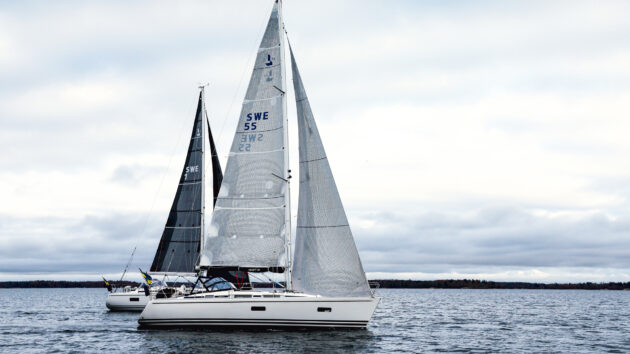
The 34 enjoying sailing in company with her big sister, the new Linjett 36. Photos: Paul Wyeth
The switch panel and electrical distribution is neatly executed and easily accessible, while all the lamps (with USB charging), lights and hidden LED strips are top quality. The hull windows are optional, but add light and views down below, though the coachroof windows are large, and made from toughened glass. If you don’t have the hull windows, the main lockers behind the settees move aft.
Powered up
Two cabins offer comfortable berths. The aft double isn’t far off rectangular at 200cm long and 165cm wide, with a couple of overhead lockers outboard, a drawer below the berth, a large seat-cum-shoe locker and a large shelved locker. Light comes from two hatches inboard and in the coachroof, both of which open, though there’s no hull window.
The forward cabin has more space, with hanging and shelved full-height lockers either side, a full- length shelf above the hull window to port and overhead lockers to starboard (though as it’s hand-built this can be customised).
The mattresses sit on slatted bases for comfort and ventilation, with drawers under the central part of the berth and bin stowage outboard and ahead of these.
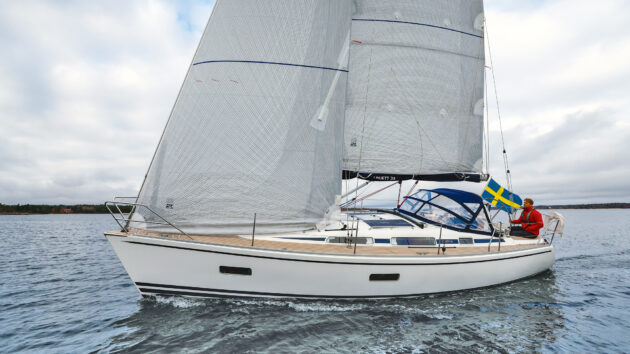
Photos: Paul Wyeth
Headroom is unsurprisingly lower than on newer boats, a reasonable compromise for such a slow and sleek boat; the deckhead decreases from 188cm in the galley to 182cm by the mast, and 175cm in the forecabin.
Finally, the 30hp Yanmar engine is accommodated in a box under the companionway, with the top step and front panel lifting off separately, rather than hinged steps, for excellent all-round access.
The only system that wasn’t easily accessed was the water strainer, for which you’ll need to lift the mattress in the aft cabin. You could opt for electric propulsion, and you could just about squeeze in a 4kW generator, or go for a diesel engine with a high output alternator to power enough batteries for induction cooking. With a saildrive and two bladed Flexofold prop, we hit 7.4 knots at max, and cruising comfortably at 6.8 knots.
Linjett 34 specifications
LOA: 10.66m/35ft 0in
LWL: 9.30m/30ft 6in
Beam: 3.45m/11ft 4in
Draught: 1.84m/6ft 0in
Displacement: 5,500kg/12,125 lbs
Ballast: 2,200kg/4850 lbs
Sail area: (107% genoa) 63.4m2/682 sq ft
Ballast/disp ratio: 40%
Disp/length: 190.2
SA/D Ratio: 20.7
Engine: Yanmar 30hp
Transmission: Saildrive SD25
Water: 260L (+40L hot water)
Fuel: 110L
RCD: Category A
Designer: Linjett Design Team
Builder: Rosättra Båtvarv
Website: linjett.se
Enjoyed reading this?
A subscription to Yachting Monthly magazine costs around 40% less than the cover price, so you can save money compared to buying single issues.
Print and digital editions are available through Magazines Direct – where you can also find the latest deals.
YM is packed with information to help you get the most from your time on the water.
-
-
- Take your seamanship to the next level with tips, advice and skills from our experts
- Impartial in-depth reviews of the latest yachts and equipment
- Cruising guides to help you reach those dream destinations
-
Follow us on Facebook, Twitter and Instagram.
Note: We may earn a commission when you buy through links on our site, at no extra cost to you. This doesn’t affect our editorial independence.
Verdict
If you look at modern yachts and protest that they don’t build them like they used to, then I urge you to look at Linjett. It has sustained a business that has weathered the economic storms of the last century and a half by resisting the urge to expand and churn out hulls in high numbers, preferring to refine what they do and build beautiful boats to the highest standard for a small and discerning group of customers. The fact that 200 boats flock back to their nesting ground every winter for storage and servicing attests to the loyalty that these owners have for their boat and the yard. The Linjett 34 proves that designs with slippery hulls that avoid fashion, highly refined handling and systems, and exquisite craftsmanship still have significant appeal. These are boats that in 50 years will still be being sailed and enjoyed, just as the first ever Linjett 30 continues to sail and return to the yard every year.