


Anchoring is different for every boat, but having a process that everyone is happy with is key to feeling secure on the hook, says Lars Hellman
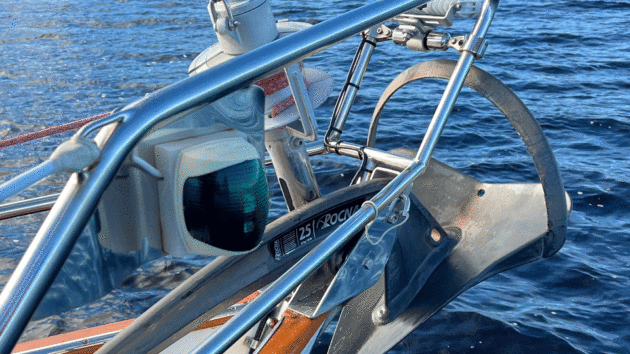
Anchoring is like a religion. There are a number of beliefs and within every belief there are varieties and interpretations. Anyhow, when you start sailing and living on the hook for an extended period of time you start developing your own experiences that eventually become tools in your box of skills.
I’ve been anchoring on and off since the late 1970s and now my wife Susanne and I have basically been living on the hook for the last 10 years. Doing so, your skills evolve and what was an absolute law ten years ago is maybe less strict now. Instead, you develop a routine that becomes refined and makes you feel safer as time goes by. What follows is what works for us.

Anchoring in remote places requires a well-proven method and set-up for peace of mind
Ground tackle
Good anchoring of course starts with the anchor itself. Finding the right one for you is the holy grail in this subject, so I will not recommend any particular model. There are several good anchors on the market today.
Our only recommendation is not to buy any cheap and inferior copies. Your life may depend on it one day. When choosing an anchor size, weight, material, whether it fits your boat, the bow roller, locker or any other specific arrangements will all need to be taken into consideration.
If you plan to anchor regularly nothing beats a good chain. For unlimited cruising a full chain is far superior to rope. The only real benefit of a rope is that it’s lighter both to carry and to handle and is easier to retrieve manually. Chain is much heavier and requires a good quality windlass to be able to handle in all conditions.
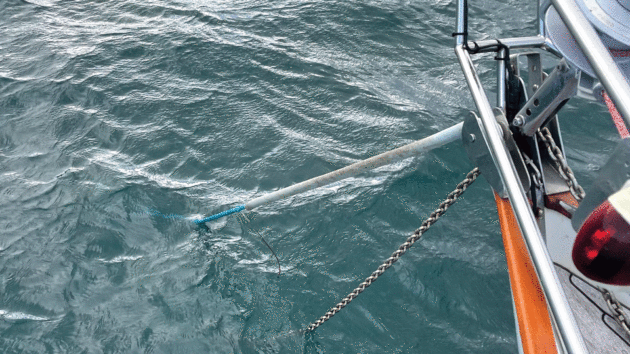
With the anchor down and the short snubber on, gradually go astern to dig in, before attaching the long snubber
Scope
We have developed a dynamic scope range that we have found to work very well. This is: Chain required = 3 x max depth + 20 metres
Only slightly more complicated than a straightforward ratio of depth to chain, this formula gives you more scope when it’s shallow and you need more catenary, and less scope as it gets deeper and the weight of chain deployed increases. This ratio gives you 1:7 at 5 metres depth, 1:5 scope at 10m and 1:4 at 20m. It can be adjusted of course if necessary, due to local conditions such as wind strength, holding and swinging room.
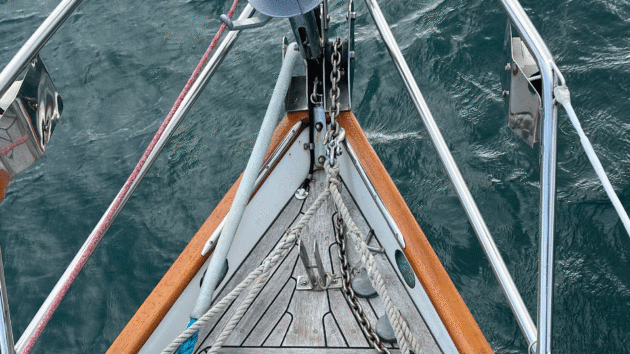
Use chain for anchoring wherever possible, along with a short snubber to take the anchor loads
Snubber line
We work with two snubber lines. The first one we use is a short bridle with a chain hook in the middle. This one is secured to the two cleats on the foredeck and the hook is set just aft of the bow roller.
We use this primarily when we dig in the anchor to take unnecessary load off the windlass, but also to prevent the chain running out if the windlass or brake failed. We also use it if we need to break loose the anchor under power. Again, this takes the load off the windlass.
Our primary snubber line is a 4m long three-strand polypropylene rope, 25mm in diameter. It has a spliced eye in one end and a chain hook in the other. It is covered with a 1.5m plastic tube starting at the spliced eye for chafe protection. This line is equal to or stronger than the chain, which is important.
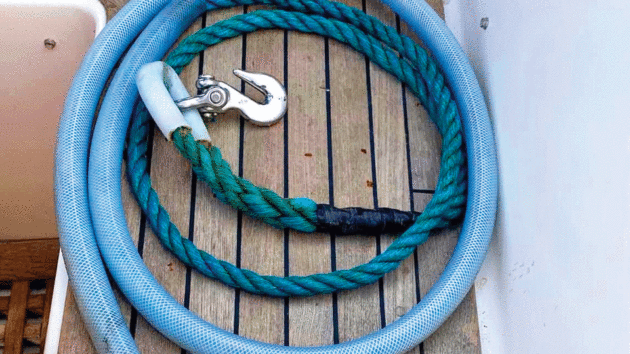
A long 25mm polypropylene snubber takes the loads and adds elasticity
You don’t want the snubber to break in a gale or storm and suddenly have the full force of a yank directly on the chain and windlass. That can take your windlass off the deck before you know it.
The typical three-strand polypropylene rope is very elastic and doesn’t break until it’s extended 20%. That’s 80cm of flex on a 4-metre length. That flexibility, plus the catenary and durability of the chain, will give you a good night’s sleep.
Article continues below…

Anchoring a boat near shore: how close can I get?
Do you know how close you can get when anchoring a boat near shore? James Stevens answers your Questions of…

What to do if someone anchors too close to your boat?
Clara, Fi and Ahmed are cruising north Brittany on Clara’s Rival 34, Grace. Clara is a recently-qualified Coastal Skipper, and…
Procedure
We choose our spot based on the information available. If the anchorage is poorly charted, we take a slow sweep around what would be our swing radius, while reading the depth finder, to make sure we have enough depth everywhere. If there’s a lot of weed or kelp and we have enough visibility we try to pick a spot with minimal growth.
Then we drop the anchor and set the anchor alarm before paying out chain to the desired length so the plotter knows exactly where the anchor is on the seabed. We then set the short snubber while letting the wind (if any) drift the boat back slowly as the anchor sinks in to the bottom substrate.
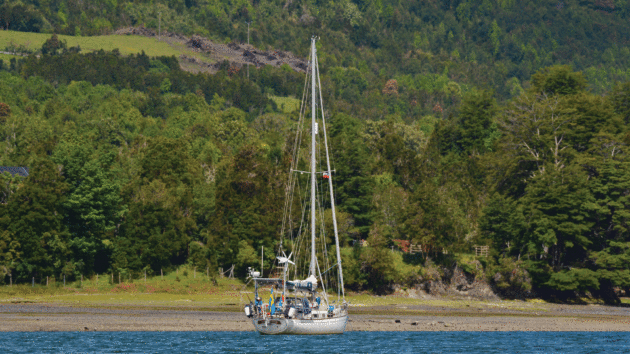
With the anchor well dug in, anchor alarm on and snubbers in place, you can rest easy
When the boat stops, we reverse slowly on the engine, increasing the revs incrementally to 2,000-2,500rpm. If we both feel happy and the boat is not moving, we set the primary snubber. It’s important not to shock load the anchor by going astern quickly on a slack chain, as this could break the anchor out or prevent it catching before it’s had a chance to dig in.
If any of us have doubts we weigh the anchor and repeat the procedure. Consensus is the key. You don’t want an ‘I told you so’ comment in the middle of the night.
Now it’s time for a wee dram.
Enjoyed reading this?
A subscription to Yachting Monthly magazine costs around 40% less than the cover price, so you can save money compared to buying single issues.
Print and digital editions are available through Magazines Direct – where you can also find the latest deals.
YM is packed with information to help you get the most from your time on the water.
-
-
- Take your seamanship to the next level with tips, advice and skills from our experts
- Impartial in-depth reviews of the latest yachts and equipment
- Cruising guides to help you reach those dream destinations
-
Follow us on Facebook, Twitter and Instagram.
Note: We may earn a commission when you buy through links on our site, at no extra cost to you. This doesn’t affect our editorial independence.