



Monty Halls takes on the clans in the World Pilot Gig Championships. Here's how it went.
A great gathering of the coastal clans, a spectacle that is un-matched anywhere in Britain, in Europe, and dare I say the entire world. In the early days of May a strange tribe of sea dwellers, those with horny palms and hawsers for sinews, are drawn to an archipelago off the tip of Cornwall.
Like some mis-shapen migratory species they converge on the islands from all four points of the compass, from as far afield as the Americas, and as close to home as your local slipway. Throughout the year you’ll have seen them, you may have even heard their distinctive mating calls, the shrill cry rending the dawn asunder – ‘Up the rate, up the rate, up the rate.’
It’s spring, it’s the Scillies, and the gig rowers have turned up en masse for the world championships. Or at least most of them have. I happened to still be in Falmouth, effing and jeffing with my head down in the engine compartment, trying to get my Yanmar to cough into life.
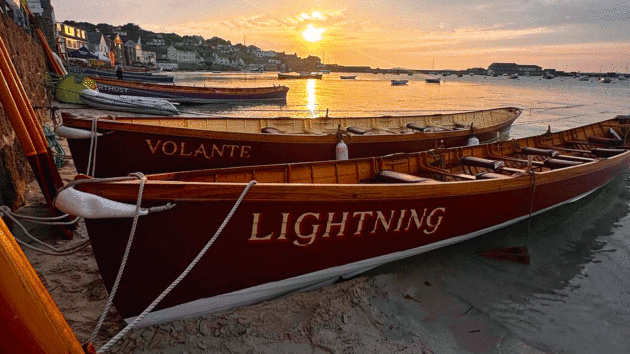
Photo: Monty Halls
Each year I try to sail down for the championships. This is a terrible idea on a number of levels. The first is that, with the inconvenience of work, I invariably have a limited window to actually make the trip, so end up thrashing through whatever the weather happens to provide during that week.
The second is that I turn up absolutely cream crackered. We all have fancy fitbits and smart watches nowadays it seems, and when I got there last year mine was telling me very stridently that my body battery was at three percent. That’s virtually dead, and is less than ideal when you’re about to jump in a gig to repeatedly race snorting Cornishmen over thrashing Atlantic seas.
And finally it does rely on my dear old ketch Sobek co-operating throughout. It was the latter that was absorbing my attention in Falmouth.
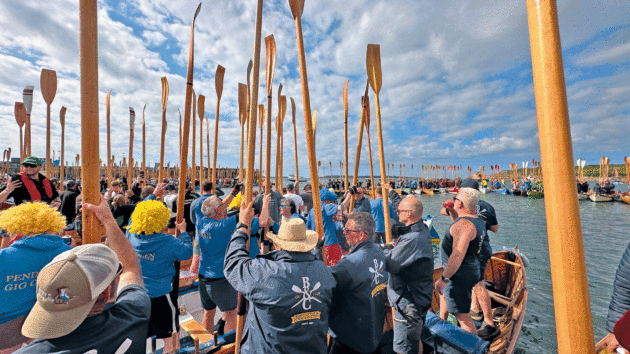
A pagan forest of oars greet the world champions after the final race. Photo: Monty Halls
Getting her up and running
When one gets into sailing for the first time – and I’m still a relative newbie – you don’t foresee turning into an absolute grease monkey in your first 12 months. Reading the wind like a Polynesian? Oh yes. Slipping your hand into the water to assess tidal flow and the proximity of land? Perfect.
Repeatedly hitting your engine with a hammer whilst shouting ‘Just start you moron’? Less so. But that did seem to dominate my early sailing career. Now it seemed the engine needed bleeding, which was a co-incidence as by this stage it was me that was oozing platelets, what with skinned knuckles and scuffed elbows and all. A tweak of a bolt here, and vigorous bit of fuel pumping there, and the old girl roused herself to roar into life.
With howling revs that unequivocally stated ‘What are you lot staring at, let’s race some dolphins’ all 29 horses were harnessed to drive Sobek out into the channel, and then a sharp right turn took us towards gig heaven.
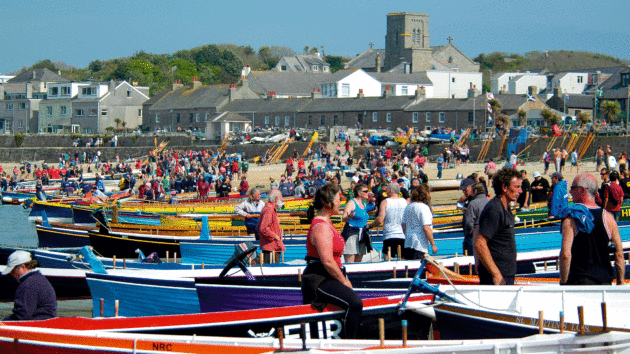
Colourful crews gather in Hughtown, St Mary’s, Isles of Scilly. Photo: Monty Halls
Awkward anchorage
The trip from Dartmouth is about 120 miles as the crow flies. But any crow that followed our route would have to be absolutely demented. I was sailing with Mark, an old mate from the Marines, and we had set out in good order with a vague notion that we’d do it in one fell swoop.
A combination of wind and swell directly on the stern saw us skid and slew our way west, until we both got cheesed off and decided to duck into the Yealm for the night. We dropped anchor in distressingly close proximity to a chap wearing plum-coloured trousers, who had plainly been to Eton, Oxford, the Guards, then became a banker. He informed us from the flying bridge of his cruiser that we ‘can’t bloody anchor there, you’re in the channel’.
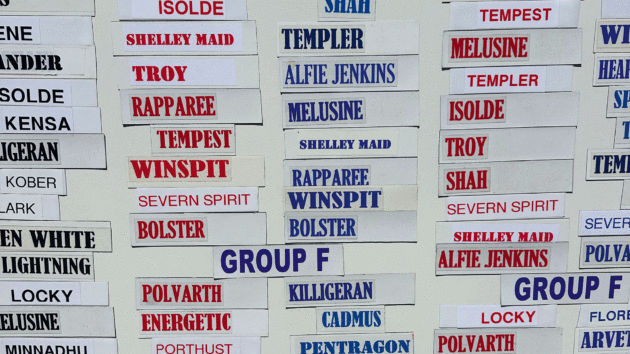
The leaderboard is everyone’s focal point. Photo: Monty Halls
We flagrantly weren’t, and I briefly considered Mark’s suggestion that we ‘pay him a visit’ before discounting it as impractical, much as it would have harked back to our amphibious boarding days. But actually our problems were slightly more tidally imminent, although it took some time and several bits of paper for my addled brain to fully hoist that in.
By now it was dark. Our anchorage might have appeared utterly perfect – braying dimwits aside – but we were on Springs, and some subsequent scribbling, a few muttered calculations, and a bit of texting Justin (wise guru, and available at all hours of the day and night to offer me advice even though he’s unaware that’s his primary role in life) revealed that we were 30cms out.
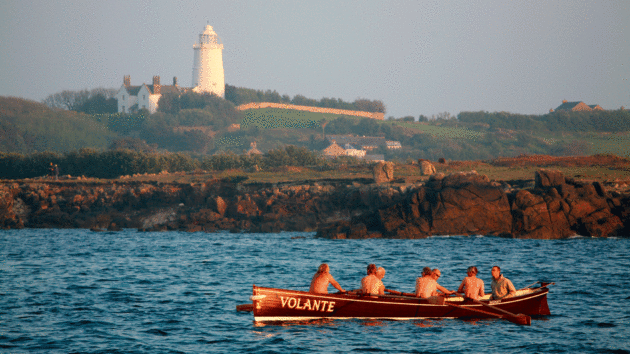
The Dartmouth crew passing the lighthouse at St Agnes in former times. Photo: Monty Halls
As that 30cm would have manifested itself in our keel cheese-grating itself to oblivion on the rocks beneath us at about 0300, we decided to move.
Making an effort
It always amazes me how knackering sailing is, and our red-eyed progress up the Yealm saw Mark crouched on the bow, Gollum-like, sweeping a torch from side to side desperately seeking a ring. One duly appeared, we clumsily tied on with every line available, and then crashed out like dynamited lighthouses.
Dawn the next day saw us creep away furtively, to fish tail our way to Falmouth with wind and swell still firmly on the stern. Several gybes later, we decided this was level two fun, and pulled into Falmouth. It was here, the very next morning, that myself and the engine had our domestic.
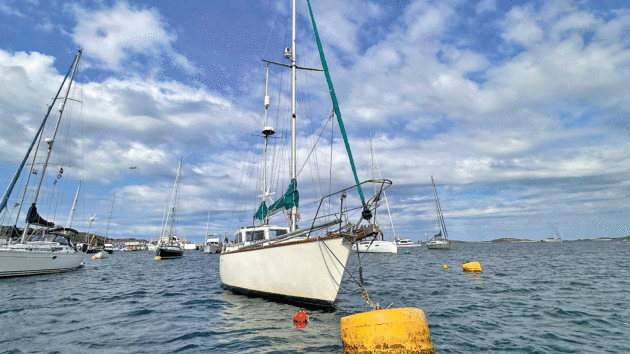
Sobek rocks quietly on the mooring, a haven from the bedlam ashore. Photo: Monty Halls
And so, after another 10 hours of surfing, sailing, chugging, and chuntering we made our triumphant entrance into Hugh Town in a festival of flapping sails. But here’s the rub – once we’d stemmed a buoy, said hello to the neighbours, and puttered ashore in the tender for supplies, the realisation dawned
that we had the best seat in the house.
Over the next four days we watched a glorious parade of gigs pass within metres of our stern, each a vivid manifestation of local pride and identity. And we rowed our own races as well of course, me in the glorious claret of Dartmouth, Mark in the proud blue of Salcombe (I think it was blue, they were behind us most of the time).
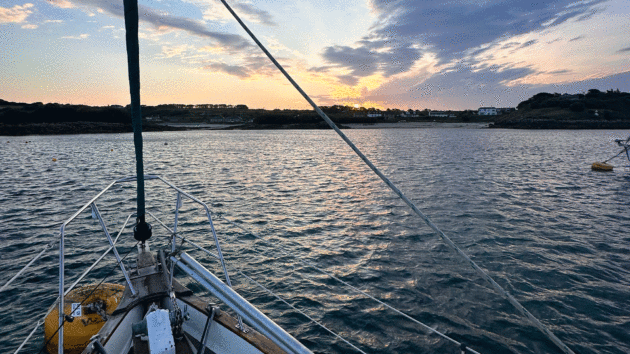
Photo: Monty Halls
The great thing about being there, in the very midst of it all, is the chance to soak up the atmosphere, to cheer the crews on as they heave away, might and main combining with technique and verve, women and men of all ages absolutely emptying the tank for their community.
And then – this is the brilliant bit – you can go below and have tea and battenburg and get ten hours sleep. This is whilst everyone else does shots on the beach out of each other’s belly buttons, and wakes up in a skip with a seagull pecking at their face. A yacht in the harbour is THE way to watch the world gig championships.
Article continues below…

Cawsand Bay, Cornwall: the anchorage with it all
Beaches, coastal walks and historic Plymouth near by – the Cornish anchorage of Cawsand Bay has it all, says Jane

Day sailing to the Isles of Scilly: Dodging a 35,000-tonne cargo ship
Quaker Girl is waiting patiently at the end of steep granite steps for her third skipper. Not that she needs…
Unforgettable finale
There’s a lovely finale to it all, when the gigs, gathered on the finish line like a flock of parakeets, welcome in the world champions after the final race. For the aficionados amongst you, these are exquisite vessels, with each identical except for their livery, and every one a monument to artisanal boat building.
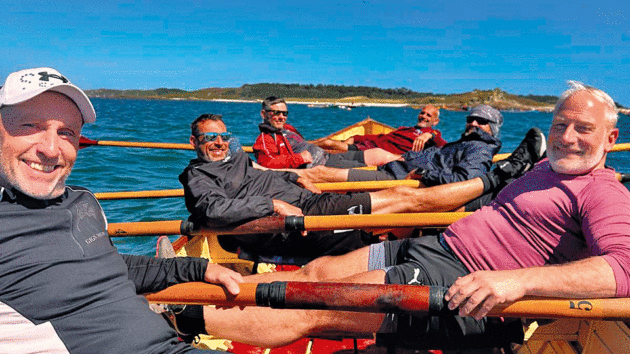
The Dart Super Veterans looking stressed before their race. Photo: Monty Halls
To see 150 of them in a tight fleet, to see the oars raised aloft to create a pagan forest through which the exhausted winners scull their own vessel, and to experience the swelling tide of the roar of acclaim that greets them is an unparalleled sensation. Admittedly that’s through the distorted lens of several shots of rum and four days of dehydration, but I still think it’s worth the journey.
See you there next year. Leave a buoy for me as I’ll be late…
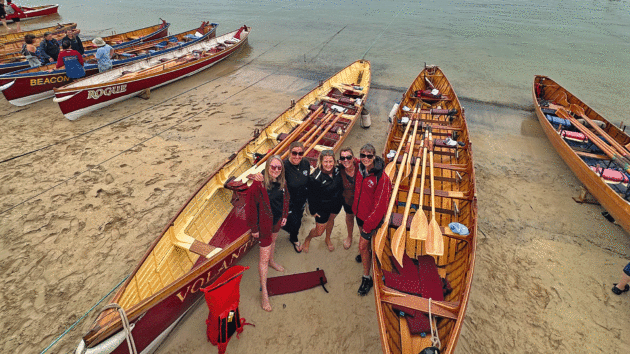
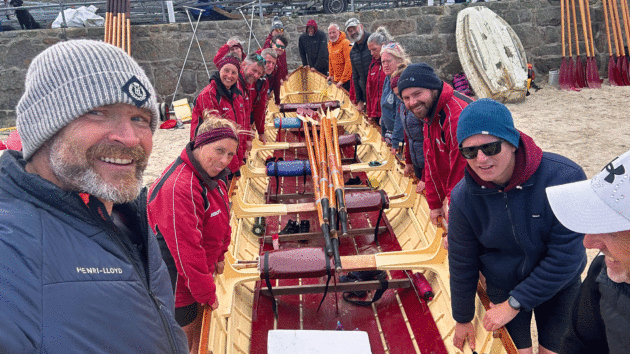
Gigs on the beach, ready for the contest. Photo: Monty Halls
World Pilot Gig Championships
The World Pilot Gig Championships is an annual event held on the Isles of Scilly in early May. WPGC was first held in 1990, only attracting a few crews from Cornwall, but in the intervening years the amount of pilot gigs attending has increased with crews coming from all over the South West and further afield.
The pilot gigs are 9.8m, six-oared rowing boats built from Cornish narrow leaf elm wood. The pilot gig is recognised as one of the first shore-based lifeboats that went to help vessels in distress, as far back as the late 17th century.
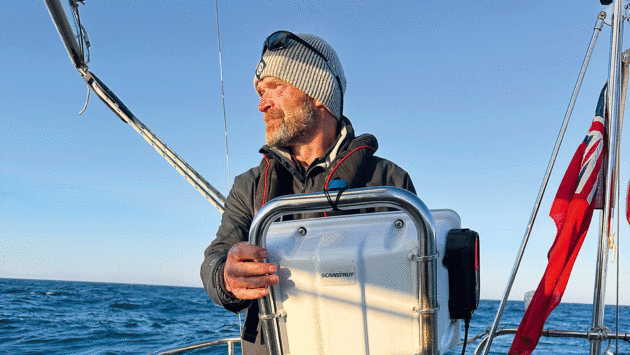
Monty Halls is a regular YM contributor, former Royal Marine, TV broadcaster and marine biologist well known for several high-profile documentaries, notably his BBC Great Escape series. Photo: Monty Halls
The original purpose of the Cornish pilot gig was as a general work boat, and the craft were used for taking pilots out to incoming vessels from the
Atlantic. At the time, the gigs would race to get their pilot on board a vessel first in order to get the job and hence the payment.
All modern racing gigs are based on the Treffry, built in 1838 by William Peters of St. Mawes, and still owned and raced by the Newquay Rowing Club. There are currently over 200 gigs on the CPGA register. The 200th was built for Sidmouth Gig club and was launched in 2018. Check out their website for more
information on www.wpgc.uk.
Enjoyed reading this?
A subscription to Yachting Monthly magazine costs around 40% less than the cover price, so you can save money compared to buying single issues.
Print and digital editions are available through Magazines Direct – where you can also find the latest deals.
YM is packed with information to help you get the most from your time on the water.
-
-
- Take your seamanship to the next level with tips, advice and skills from our experts
- Impartial in-depth reviews of the latest yachts and equipment
- Cruising guides to help you reach those dream destinations
-
Follow us on Facebook, Twitter and Instagram.
Note: We may earn a commission when you buy through links on our site, at no extra cost to you. This doesn’t affect our editorial independence.