



The ARC Baltic rally returns after a seven-year gap. The fleet sailed through many beautiful destinations, visiting Germany, Denmark, Sweden, Estonia and the stunning Finnish archipelago
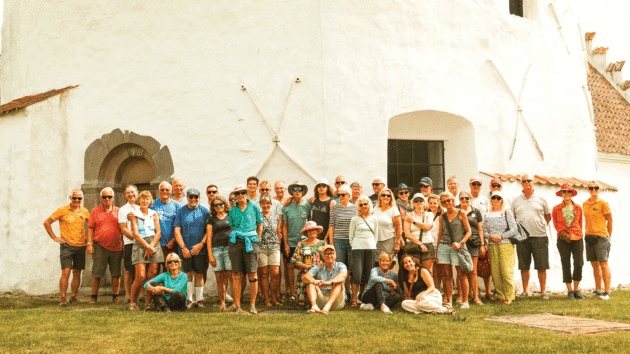
The ARC Baltic has been reintroduced by the World Cruising Club after a seven-year hiatus. With a newly shortened and redesigned route, Saint Petersburg has been axed and is now replaced with more time in the Swedish and Finnish archipelagos.
The new format of ‘four weeks, five countries, 1,000 miles’ appeals to those who want to spend a bit more time cruising the smaller islands, which for many people is ‘the point’ of sailing in the region. The wild harbours, mooring bows to the rocks, saunas, barbecues and being off grid sums up what the joy of Scandinavian sailing is all about.
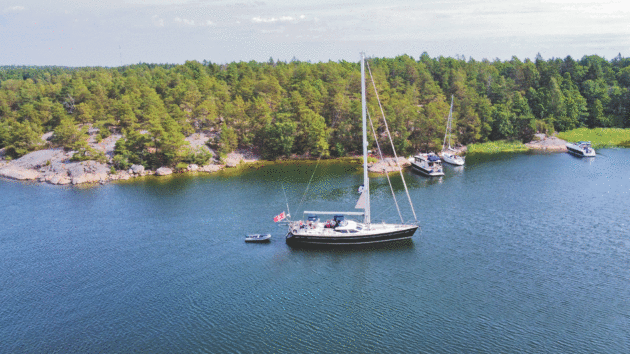
Skyelark 2 lies to anchor while smaller boats tie up bows to the rocks. Photo: Dan and Emily Bower
On the way to the archipelagos the itinerary takes in some beautiful and characterful cities. It’s an area I’ve always wanted to explore and so when the rally launched we signed straight up.
The route takes us from Kiel, on a tour to Stralsund in the former East Germany, Bornholm (Denmark), Visby, Gotska Sandon (Sweden), Tallinn (Estonia), Helsinki (Finland), the Åland Islands and Stockholm. The end point allows more time to explore the islands, or for the smaller boats to take the Gota canal to Gothenburg.
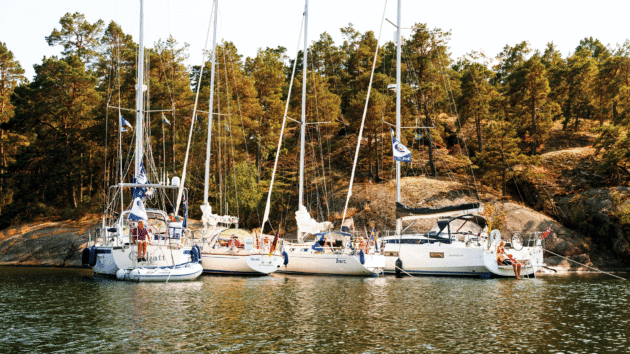
Wild mooring tests skills but adds thrills. Photo: Danielle Lavoi Photography
Hanseatic towns
The first stage of the rally is really a cultural tour of the medieval world. Whilst we hopped between the different countries and changed the courtesy flags, the one constant was the beautiful old towns from the Hanseatic League, a defensive and trading alliance from the 13th to the 17th century whose strength and power generated incredible wealth and produced magnificent architecture.
The Gothic style of soaring churches, tall merchant houses and walled and gated towns are beautifully preserved.
Our first introduction was Lübeck, the powerhouse of the period, and whilst technically not on the rally, it’s a short journey from our starting point in Kiel. We also visited Stralsund in the former GDR, Visby with its storybook perimeter walls and Tallinn with its striking skyline. When visiting by boat you can imagine arriving as a trader of the day, directly into the centre of the action, a stone’s throw from the old squares, town halls and taverns.
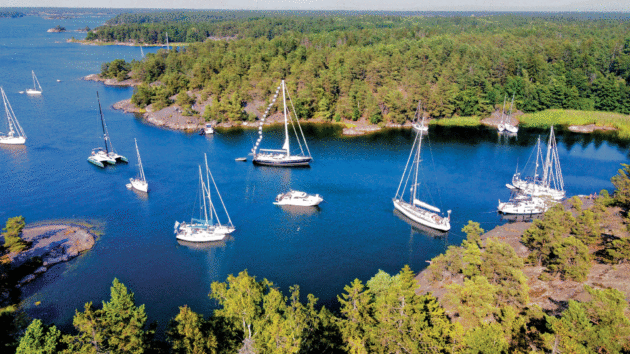
The fleet prepares for a sunset barbecue. Photo: Dan and Emily Bower
Indeed Stralsund boasts the ‘oldest harbour pub’ in Europe – from 1332!
The exception was Tallinn. We were moored away from town in the marina complex that was built as the sailing venue for the 1980 Moscow Olympics (boycotted by the RYA).The choice of location had mixed opinions from the fleet, but for me it was interesting to see the Soviet brutalist architecture left almost untouched – and in decline – and then look across the bay to the stunning medieval skyline.
Somewhere in amongst is the modern, vibrant newer city which is also worth exploring. There is a plan to regenerate the marina area, but much of its history will be preserved as a heritage monument.
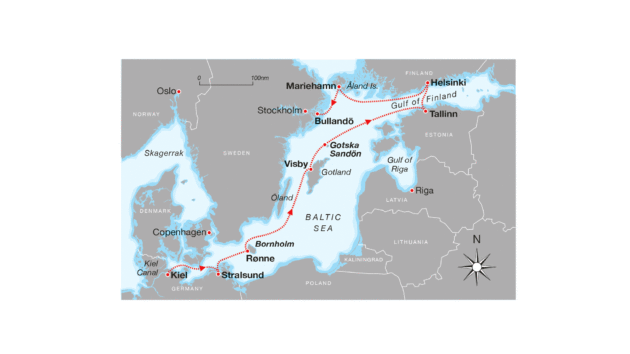
Photo: Dan and Emily Bower
The format of the rally for the first two weeks had a familiar pattern: a challenging passage, with a warm welcome into a new town where we would spend a day or two structured around a welcome drink to get the party started, a cultural guided tour and a fine feast in a well chosen restaurant. All of this was very nicely done and considerably higher budget than most sailing events.
Were the passages challenging? We had unusual weather, as did most of Europe this summer. The Scandinavian high pressure which usually brings extended periods of calm winds, sunshine and warmth to the Baltic in the summer did not materialise and instead the jet stream sent a series of low pressures into the Baltic Sea, meaning both windier and more changeable conditions.
It’s an old joke in sailing that the wind is always on the nose. For this cruise, it certainly seemed to be true. Our longest passage was 200 miles, another three were 100 miles or more, and often the balance of dodging the lows and trying to keep to schedule did mean some less than perfect days, be it more upwind or more motoring than we would choose.
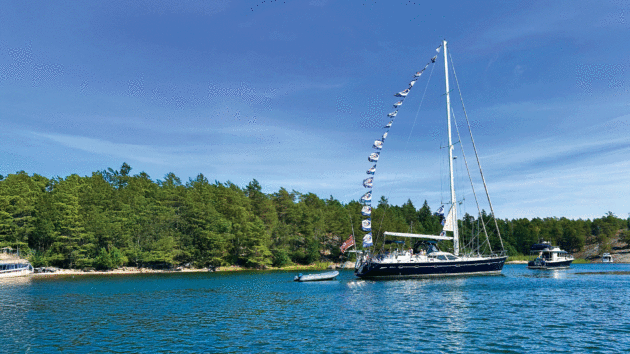
Photo: Dan and Emily Bower
This challenge was amplified for the smaller boats and smaller crews, although it wasn’t all bad and the glorious days more than made up for it.
In between the old town stops we visited Bornholm and Gotska Sandon. Bornholm is home to the Hammerhus – the largest medieval castle ruin in northern Europe, but it’s also known as an island of artists. You can find potters, jewellers and glassmakers’ galleries dotted around pretty former fishing villages. Gotska Sandon is uninhabited and a national park.
Formerly it had a small village for the two lighthouse keepers’ families, and now it’s a quiet camping retreat with the old lighthouse, school house and village renovated and turned into a very quaint and tasteful museum. Even the campers have to land on the beach, there is no shop – just an endless beach, seal colony and pretty forest trails. It’s a weather dependent stop and on the route from Gotland to Estonia.
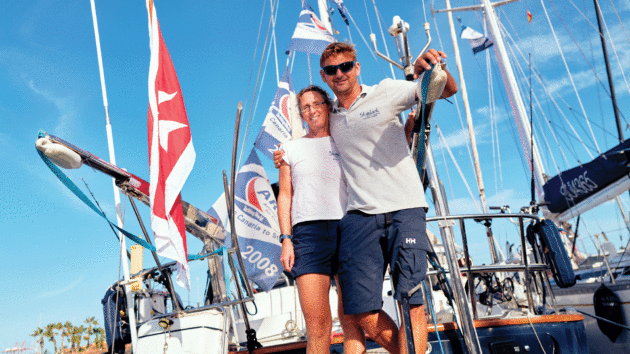
Dan and Emily Bower met while working as sailing instructors and are now full-time cruising sailors living aboard their Oyster 62, Skyelark 2. Photo: Dan and Emily Bower
Swedish and Finnish Archipelago
The second half was less structured with more time to cruise in the archipelagos and enjoy some more isolated stops and a move from sightseeing to cruising. For this we were supported by an excellent presentation by some local sailors, helping us get to up to speed with the rather daunting task of navigating the archipelagos.
Sailing here comes with its own challenges. Planning how to navigate the hundreds of thousands of islands that make up the Finnish archipelagos is a daunting proposition, particularly with digital navigation. Zoom out far enough to see where you may want to go and it’s a blur of rocks, hazards, buoys and dangers.
Zoom in and you have no idea where on the route you are or how you possibly get to from A to B – at some point it seems just easier to get straight out to deeper water and take the long way around. This would be a mistake!
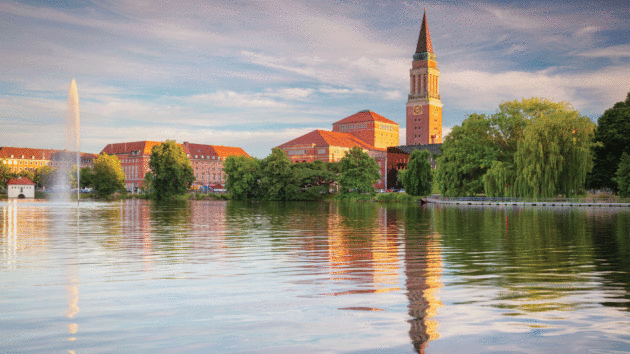
Kiel, Germany, with the town hall, and opera house shimmering in
the sunset, marks the start of many sailors’ Baltic exploration. Photo: Dan and Emily Bower
Spending a bit of time with the paper publications and pilot books show clear routes through the islands, which are incredibly well marked with uncommonly prolific aids to navigation albeit through what feel like some very narrow gaps, until you see a ferry coming through.
The reward is one of the prettiest cruising grounds I’ve had the pleasure to sail; you’re mostly navigating narrow channels through wooded islands dotted with summer houses and little jetties. The more open water passages are punctuated with bare granite rocks and a rawer form of beauty.
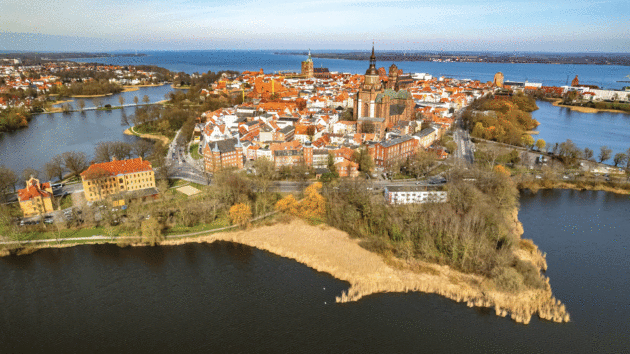
Stralsund’s cityscape with St Mary’s Church, the tallest building in the world from 1525 to 1647. Photo: Peter Schickert / Alamy Stock Photo
Where to stop
There are natural harbours everywhere. By this I mean protected bays where you can nose up and tie to the rocks, possibly tying to pre-laid rings, or if you’re really hardy your own pitons. The bays are often small – in many cases too small to swing on your anchor and there is (delightfully) nothing ashore.
Next up are the guest harbours, usually just open in the summer time and are generally a small pontoon often bows to with buoys or a stern anchor, and occasionally alongside is possible. These will usually have a small shop, café, toilets and showers and nearly always a sauna! They are frequent and generally well protected so you are able to sail without needing a fixed plan on where you end up for the night.
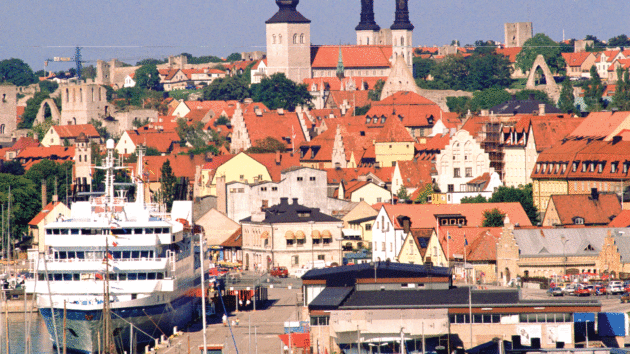
More sightseeing within the ancient walls of Visby in Sweden. Photo: Robert Harding / Alamy Stock Photo
Small boats don’t require reservation but it becomes tricky for larger yachts or deeper draughts. Traditional marinas are much rarer, and will only have a few berths for a 50-foot yacht and will always require some advanced booking, which puts you on a schedule and takes all the joy out of the day!
For the larger yacht, anchorages are your friend! However, they very rarely feature in publications and not at all on the well known apps or websites,
and this concerned me. Surely there must be hundreds of places to stop amongst the many islands and channels – you’re never far from a protected shore, and herein lies the answer.
No one marks good anchorages because there is no need to. With a bit of common sense and an eye to the weather you can almost stop anywhere you find protection, and the right to do so is also enshrined in the national laws.
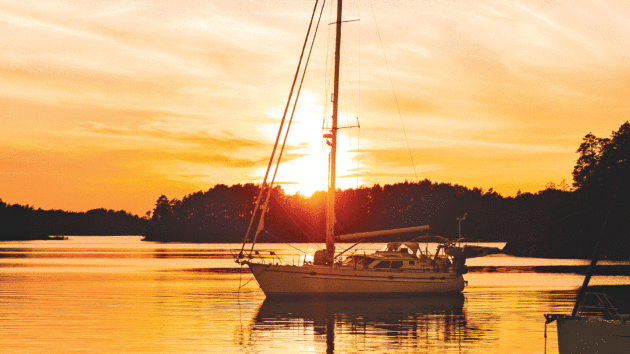
Sea Hayes sits silhouetted by a breathtaking sunset in Sweden. Photo: Danielle Lavoi Photography
As long as you are not right outside someone’s home or you risk seeing more than you wish as a naked Scandinavian runs out of the sauna and
into the sea…
The pretty islands and anchorages made a tremendous backdrop, and the rally gives a great introduction as to where you may want to spend more time. Whilst I felt we could ‘tick off’ the city stops, we barely scratched the surface of the archipelagos. With a smaller boat you could explore here over several years and that’s what some of our fleet now intend to do.
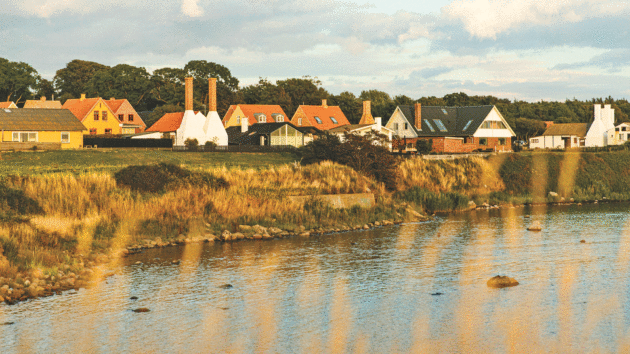
Bornholm is a Danish island but closer to Sweden and Poland than mainland Denmark. Photo: Dan and Emily Bower
Sociable sailing
In total there were 17 events that got the crew together and many more informal ones as the groups gelled. Plenty of boat parties, World Cup watching and singalong sessions brought the crews together. No one needed much encouragement to make friends and have a good time, which is not surprising given most of the boats I spoke to had said the social aspect was one of the main reasons for joining the rally.
The other reasons were the organisation of the stopovers and the booking of marinas, which is more important for the bigger boats, where space for these is very limited.
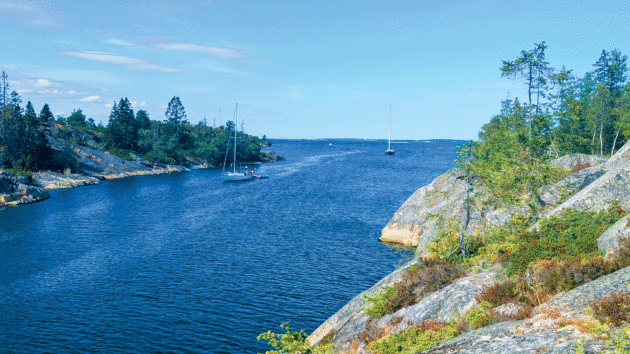
Skyelark 2 anchored in Sweden. Photo: Dan and Emily Bower
To this end we were superbly assisted by our ‘yellow shirts’ Andrew and Traci (previous World ARC participants) who travelled the route by camper van. From organising the marinas and social programmes, to catching lines and generally helping out in every way, this shoreside support and advance information took the unknown out of our arrivals and really helped keep things going smoothly.
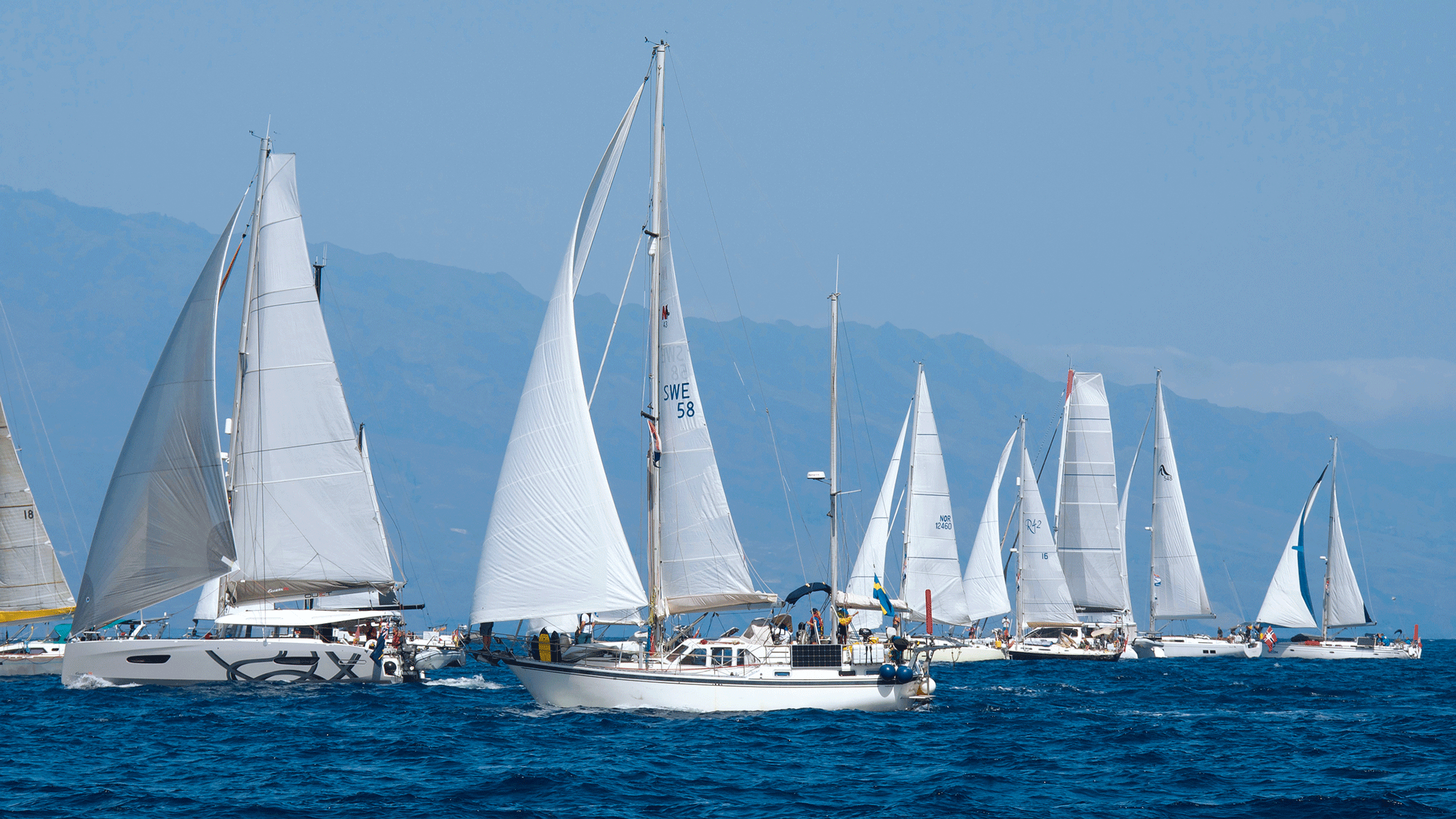
The fleet was certainly varied, from the classic Hornet 32 Dania to Oyster 62 Skyelark 2. Some colour was added with a bright yellow catamaran, Skipper Zipper, and a very green performance Dragonfly 40 Trimaran, Orizuru, both new and fresh out of the box, as was the ‘Monomaran’ Moody 41 DS, Makani Olu, unwrapped weeks before the start.
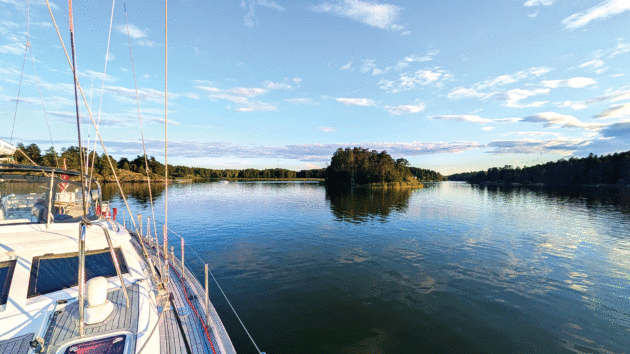
Skyelark 2 in the Finnish Archipelago. Photo: Dan and Emily Bower
We also had some rally veterans amongst us – a Moody 419 Summerwinds of Cuan, Malo 43 Gilliat, and the Rustler 44 Sea Hayes, who had previously done the ARC. Champagne, a Cavalier 45, made the diversion to the Baltic on his circumnavigation from New Zealand, and the family boat Fuzzy Duck and double handers on board Clemency and Coyote joined the rally from the UK and USA. The crews and the characters made for a great event and lots of fun.
Of course as in any fleet we had a few small and not so small issues – two boats required outside assistance of a tow – one who drifted off a narrow channel and got firmly stuck in the mud and an engine failure. More seriously a collision and a fuel leak saw two boats drop by the wayside.
Surprisingly no one hit a rock – as the saying goes ‘there are two types of sailors in the Baltic, those who have hit a rock and those that are going to! Chatting to the participants there were some common themes about the reasons to sign up and the overall experience.
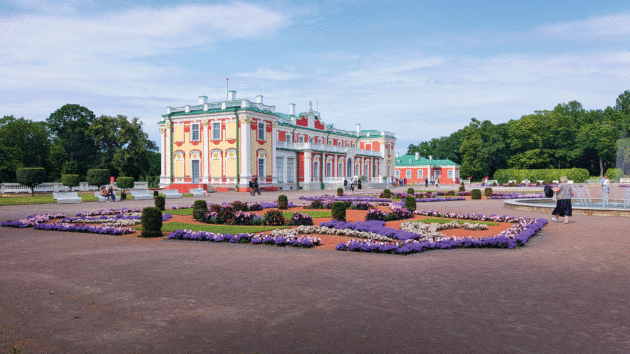
Tallinn Palace is a rally highlight. Photo: Dan and Emily Bower
Ben Eastwood, sailing Orizuru, wanted ‘to add some structure and camaraderie to what would otherwise be just free cruising’. For him, the rally was ‘not so much about the passages, and more about the destinations’, with Stralsund, Visby, Helsinki and the Finnish archipelago among the highlights.
For Bill and Heather Whidden aboard Makani Olu, the Storö barbecue, Visby and Utö were unforgettable, but ‘the best part was the new friends we made and the support we all gave each other’ – a sentiment shared by crews across the fleet.
Article continues below…
ARC vs ARC+: Which Atlantic Rally is Right for Your Ocean Crossing?
Crossing the Atlantic in sailing yachts has been done for decades by those of an independent mindset; they just needed…

Sailing Sweden: dodging the rocks
Phil Woollam and his family weave their way through the islands of Sweden’s east coast on their Cornish Shrimper
Things to know: Anchoring in the Archipelagos
Wild mooring is the classic Scandinavian technique of tying the bow directly on to the rocks and using a stern anchor to hold the yacht in position. It is much safer to approach bow to as in some cases you may do some serious damage to the rudder on underwater rocks if you were to try the Mediterranean style stern-to method. A key part of the set-up is a stern anchor and nearly all the local boats have this permanently rigged on a launch system.
The other key requirement is to be able to get off easily at the bows, usually with a bow ladder as one person is going to need to take the line ashore. Fenders are no help here and a certain amount of dexterity is required from the crew to get ashore before the bow makes contact with some rather firm granite. Once ashore, the mooring lines are secured to pre-rigged rings or made fast with pitons.
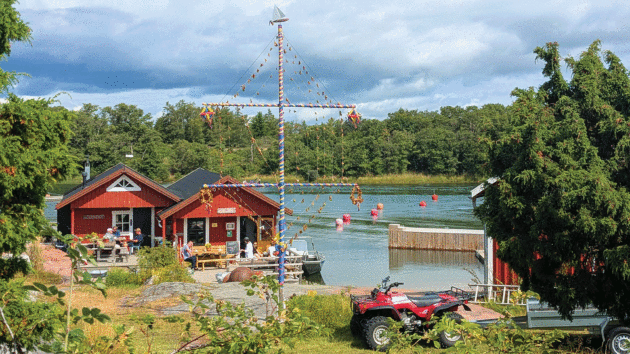
Typical small harbour with a café in Rodhamn, Finland. Photo: Dan and Emily Bower
For choosing the perfect spot, the local cruising guides will give locations as often the water is not clear enough to see the shape of the rocks underwater. Regardless, the standard method is to make a slow test approach, before heading back out, dropping the stern anchor and going for it. Like in any anchorage where one boat starts the rest congregate and it’s not at all unusual to be fender close to your neighbour.
It’s partly the natural friendly way, but also once the first boat is in, it makes it easier for the rest! In some places the rocks are sheer enough to lay alongside, or stern to but this would require local knowledge or carefully sounding it out first with a stick designed for the purpose.
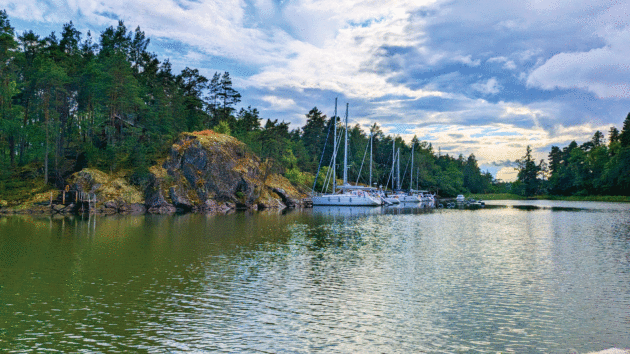
When in the Baltic… a wild Scandinavian mooring spot. Photo: Dan and Emily Bower
Practically most of the boats that do this regularly are less than 40 feet. It really needs to be light enough that someone on the shore can stop and hold the yacht in position, and therefore 30-35 foot boats appeared to be the most common for cruising the archipelagos.
Enjoyed reading this?
A subscription to Yachting Monthly magazine costs around 40% less than the cover price, so you can save money compared to buying single issues.
Print and digital editions are available through Magazines Direct – where you can also find the latest deals.
YM is packed with information to help you get the most from your time on the water.
-
-
- Take your seamanship to the next level with tips, advice and skills from our experts
- Impartial in-depth reviews of the latest yachts and equipment
- Cruising guides to help you reach those dream destinations
-
Follow us on Facebook, Twitter and Instagram.
Note: We may earn a commission when you buy through links on our site, at no extra cost to you. This doesn’t affect our editorial independence.