


Dutch couple Janneke and Wietze sail over 400 miles north in a midsummer circuit in the Gulf of Bothnia
The massive structure of Svartklubben lighthouse looms on the horizon. Standing on the small Swedish island of Singö, it guards the entrance to the Gulf of Bothnia. Passing it feels like we’re opening the pages of a new book.
That morning, we’d hauled our anchor out of the mud in the beautiful Arholma anchorage, the northernmost island of the Stockholm archipelago. Sweden has so many excellent cruising grounds, each of which can keep you busy for a lifetime.
We’d spent a month on the south-east coast of Sweden, meandering between the thousands of islands. But now we were going to where even Swedes rarely sail: the Gulf of Bothnia.
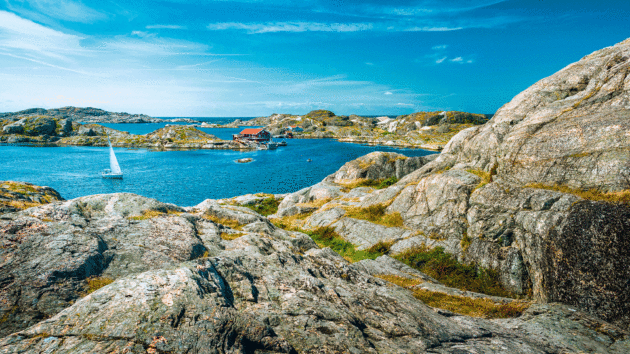
Photo: Shutterstock / Light-Studio
From the Stockholm archipelago to the northernmost point of the Gulf it’s roughly 400 miles in a straight line. But we will be sailing a circuitous route, and there are many distractions along the way.
The first thing to decide is whether we’re going to loop around the Gulf of Bothnia clockwise or anticlockwise. The prevailing winds are south-westerly, but when we were there they tended to blow from the south-south-east. To avoid having to sail dead downwind, we decide to sail north up the Swedish coast and south along the Finnish coast.
Back in time
Our first stop is the quaint village of Öregrund, where we find a good spot in the small guest harbour. Öregrund is one of those little towns where it seems as if time has stood still. Wooden houses are painted in the typical red or yellow, trimmed with white. You can tell that it gets very cold here in winter: each dwelling has small windows and big chimneys.
There are sturdy churches, each with a neighbouring bell tower, and fishing boats in the harbour. Tourists stroll around and we join the throngs for an alfresco dinner at one of the many terrace restaurants.
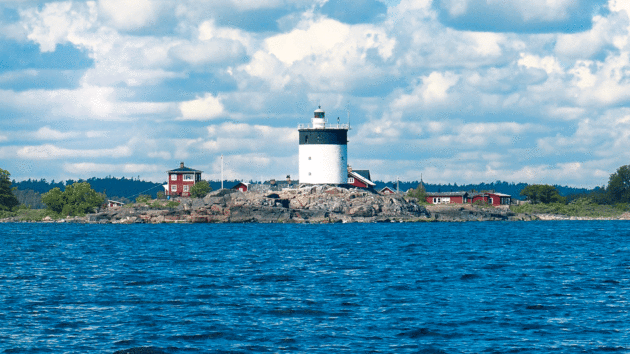
Svartklubben lighthouse at the entrance to the Gulf of Bothnia signals the start of Wietze and Janneke’s journey. Photo: Janneke Kuysters
When you ask Swedes about the northern Swedish coast, they invariably talk about Höga Kusten, the High Coast. This is an area in the middle of the Gulf, just south of the island Kvarken.
Between Stockholm and the High Coast, the land is flat and forested. Many islands dot the coast, so there are lots of options to anchor or tie to a rock ‘Scandinavian style’ with a stern anchor to keep the bow away from the hard stuff. In many places along the Swedish and Finnish coast, you have the choice to head ‘outside’, where there is more sea room, or ‘inside’ between the islands where you find more shelter.
We moor Anna Caroline in a club harbour on the island Granskär. These club harbours are quite common in Nordic countries. Basically, it’s a harbour at a lovely island that has been owned or leased by a club for decades and members come from their different home ports to spend the summer vacation there.
Visitors are often very welcome. A clubhouse, including the inevitable sauna, is standard, but sometimes the harbour has a restaurant or café as well. At Granskär, they rarely see a foreign boat, so we receive a warm welcome and are spoiled with all sorts of useful advice for our journey further north.
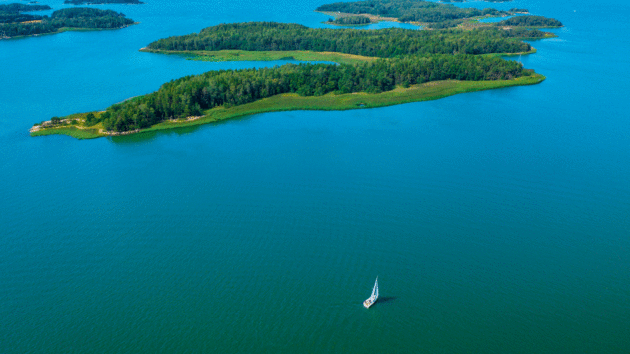
There are thousands of islands at the crossing of the Gulf of Finland and the Gulf of Bothnia. Photo: Andia / Alamy Stock Photo
Cherry picking
To decide on our next stops, we look at the map and at the time we have available to sail here; summers are short in this part of the world. ‘Why don’t we cherry pick?’ Wietze muses. We choose to sail overnight to the High Coast to maximise our time there.
When we cast off it’s midsummer: we sail through a night in which the sun doesn’t set and the skies keep amazing us with their hues of yellow, orange and red. In the early hours of the next morning the wind drops and we motor into the Lustholmen club harbour. There’s not a soul to be seen on the moored yachts; only fresh leaves rustling in the wind.
After tying up, we put the kettle on and wonder what midsummer partying went on the night before as the island slowly comes back to life. Again we receive kind hospitality and lots of information about great places on the High Coast.
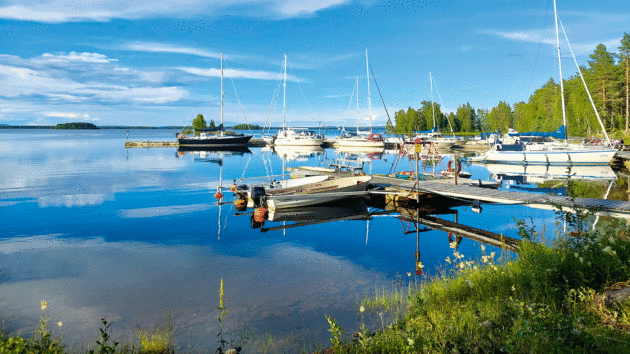
Swedish Cruising Club harbour on Bergön at the northern end of the Gulf. Photo: Janneke Kuysters
‘Ulvön and Trysunda are well-known and beautiful islands,’ fellow cruiser Stig comments, ‘but come to my village Häggvik. We have a harbour that can accommodate your boat.’
It’s a wonderful sail to Häggvik: the high cliffs create sudden wind shifts and keep us on our toes. It feels like dinghy sailing again. When the channel narrows we drop the sails and look for the narrow passage to Häggvik – it’s much narrower than we thought.
After some nail-biting moments, with the depth sounder screaming at us, the fairway widens again and we arrive at the loveliest little marina. For provisioning we can borrow bikes to cycle to the nearest town with a supermarket.
We spot reindeer on the shore of an island on the other side of the Ratan anchorage, after a brisk sail from the High Coast to Ratan, a beautiful secluded bay. This is close to the narrowest part of the Gulf of Bothnia; the part where the landrise is most visible.
Once the last Ice Age retreated, the land of the Nordic countries started to bounce back. And it’s still going on, albeit at different rates. In the northern part of the Gulf, it’s roughly 9mm per year. Rocks that were marked at sea level hundreds of years ago are now metres higher.
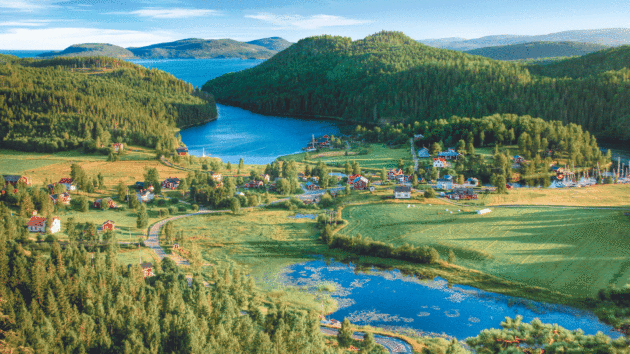
View over a village in the High Coast region in central Sweden. Photo: Frida Gruffman/Getty Images
The far North
From Ratan we make use of a steady, 20-knot south-easterly. We’re enjoying such a great sail, with hardly any waves, that we decide to keep going and do an overnighter to Luleå, one of the bigger cities of northern Sweden.
There’s a nasty low approaching, so we tie up in the large marina. While we wait for the weather to pass, we visit the site where Luleå was first built; due to the landrise they had to move the town 7km further east to keep the harbour at sufficient depth.
There’s a beautiful old town built of 404 tiny wooden cottages around a 15th century stone church. Sailing through the Luleå archipelago is at times challenging with our 2.15m draught, but we enjoy the solitude of this relatively unknown cruising ground. We see fishermen working trout and salmon nets, and a handful of sailing yachts. But mostly it is us, the birds, wooded islands and the high summer sun.
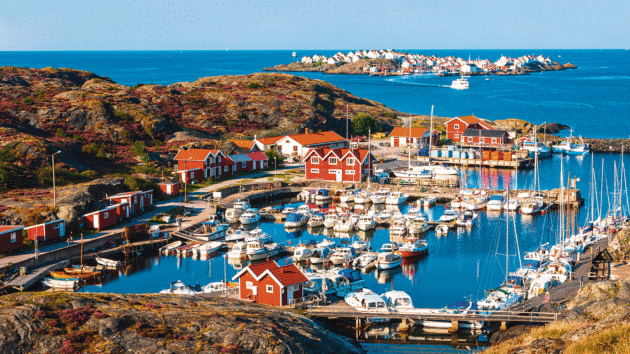
Marina at the Island of Dyrön, Bohuslän, Sweden. Photo: Shutterstock / Kedardome
Endless days
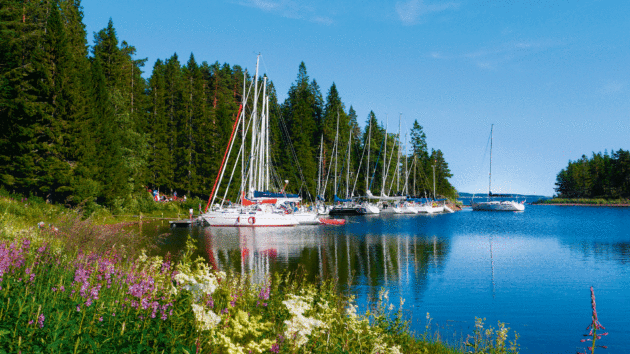
The club harbour on the island Bergön is a particularly magical place. Members have built a clubhouse, a wood-burning sauna and a fireplace under a circular roof. On long tables on the jetty, members and cruisers meet and share tales on endless summer days.
From Bergön we motor eight miles to Töre, the northernmost navigable point on the Gulf of Bothnia, a literal high point, and turning mark of our voyage in the Gulf. A big yellow buoy marks the spot. Together with two Finnish boats, we round the mark, then tie up to a wall and walk to the nearby campsite.
Just 30 miles south of the Arctic Circle, we’re in shorts and T-shirts, enjoying bright sunshine and 25°C temperatures. Töre has only 1,100 inhabitants, but is a significant stopover for yachts because of the iconic yellow buoy.
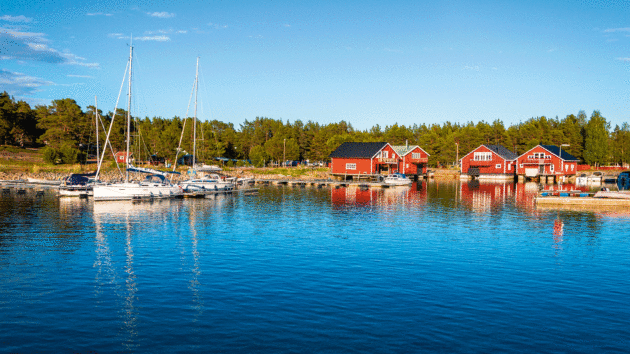
View on Hölick, a little village in the nature preserve Hornslandet a peninsula in East Sweden. Photo: Getty Images/iStockphoto
At the local campsite we even get a certificate for rounding it. Bergön is popular with Finnish cruisers, so we take the opportunity to gather up-to-date information. We meet Niklas and Johanna sailing their Grand Soleil 40 Zeieten around the Gulf anticlockwise, and discuss the best strategy for the Finnish coast.
For miles and miles offshore it’s very shallow. Rocks are everywhere, and tend to move with the ice in winter. So, there are dredged and marked channels to the bigger cities and the main ports.
Article continues below…

Cruising in the beautiful Baltic
When I was a young boy, barely having learnt how to swim, I would stand by the sea in my…
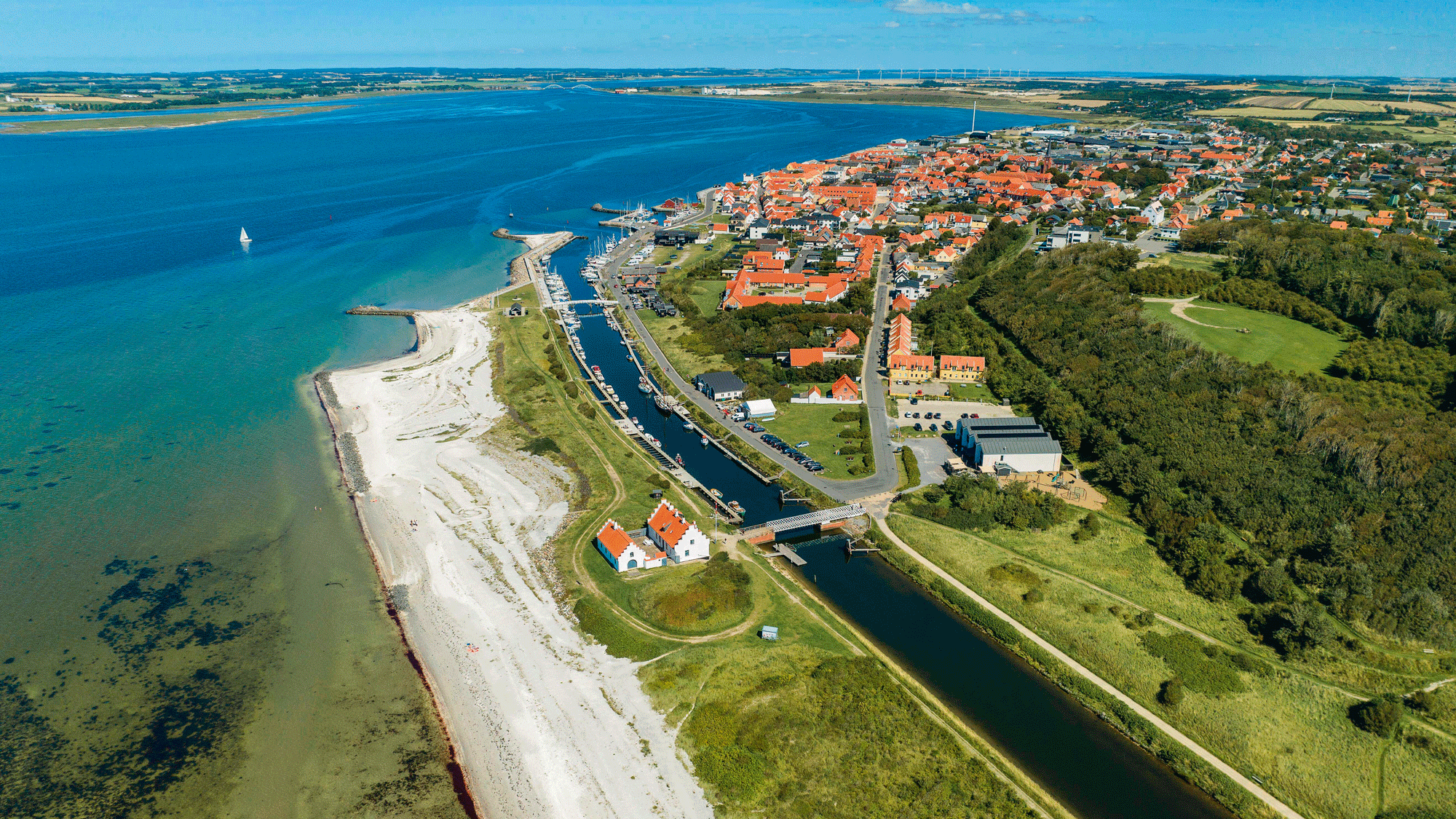
Cruising the Limfjord: A guide to Denmark’s island-hopping paradise
The wind is blowing hard from the west, as so often happens here. The widest part of the Limfjord, Livø…
Lighthouse route
To get in, you often have to sail up to 20 miles through a channel, and the same distance out again, which deters most people from sailing along this coast. ‘Go for the lighthouses,’ Niklas says. ‘When Finland was part of Russia, the government wanted the cargo ships to travel along the Finnish and not the Swedish coast.
So, they built a whole series of lighthouses with small harbours on islands all along the westernmost rim of the shallow part of the coast. These harbours can accommodate government vessels, so they are deep enough for a yacht. Pick the destinations on the mainland where you want to go and for the rest stay “outside” and use the lighthouses.’
It’s a splendid idea. We’d sailed into Bergön as strangers and we leave as friends; it’s that kind of place. Unexpectedly, the wind turns to the north. We rush south, to make good use of it.
A quick visit to university town Vaasa, then on in more northerly winds to historic Rauma, a UNESCO World Heritage Site. Both marinas in Rauma are too shallow for us, so we end up in the fishing harbour, where we find a warm welcome.
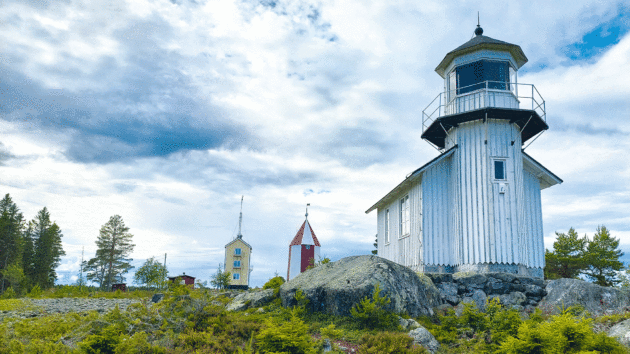
Pilot buildings in the bay at Ratan. Photo: Janneke Kuysters
Coastal meanderings
Our first lighthouse harbour is Kylmäpihlaja, a tight fit for our boat, with a stiff breeze blowing across the basin. With the help of Ari, a Finnish fellow cruiser, we got our lines ashore and safely tied up. But it was worth it: the island is a gem.
It takes about 20 minutes to walk around it and we make several laps to enjoy the ever-changing light. Ari also offers excellent tips for anchorages
in the famous Turku archipelago, further south. ‘It’s the best cruising ground in Finland,’ he promises.
We take a week to meander through more beautiful islands: another lighthouse landmark, and yet more cute anchorages or villages where we can tie up. The archipelago can get quite crowded in July, but by August things are slowing down, and slowly the nights get darker. It is sufficiently quiet that as we approach Turku through a winding, shallow channel, an elk swims across our bow.
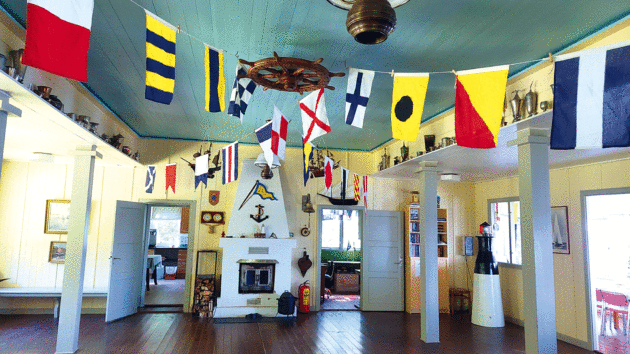
Yacht club clubhouse on the island of Granskär. Photo: Janneke Kuysters
The city of Turku feels very cosmopolitan after the small villages we’ve visited. We sail right into the centre of town, where a marina is situated on the banks of the Aura river. It’s a popular place for crew changes, restocking and sightseeing.
But after a few days we head back into the archipelago. The narrow, winding, and in places, shallow track makes for challenging sailing in the shifts and calms. Our last stop in the Turku archipelago is the small island Kumlinge, where the name of the tiny harbour and adjacent restaurant is Glada Laxen: the
Laughing Salmon.
When we ask manager Markku what their speciality is, he replies: ‘Perch.’ We now know why the salmon is laughing. The next archipelago is nestled between Finland and Sweden. Åland is officially Finnish, but Swedish is spoken.
Again, you can opt for the wider channels that are used by the big ferries that ply the route between Helsinki, Turku, Mariehamn and Stockholm. Or you choose one of many narrower fairways between the smaller islands.
In a steady south-westerly breeze we sail from island to island before we reach Åland’s capital, Mariehamn, and finally complete our Gulf of Bothnia loop. But I’m not sure this chapter of our cruising is completely closed.
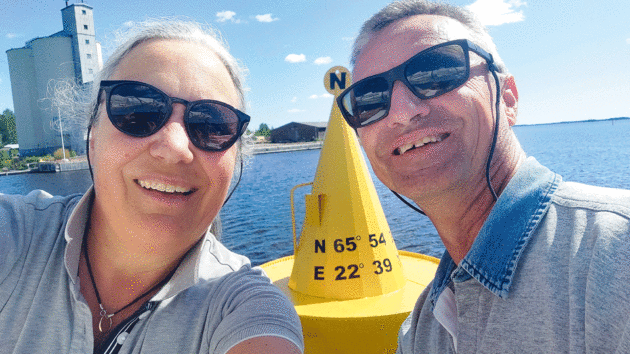
The yellow buoy off Töre marks the northernmost point of the Gulf of Bothnia, and the start of the southward leg. Photo: Janneke Kuysters
Cruising notes
Coasts and rivers
The west coast has beautiful islands, skerries, and a busy sailing community around Marstrand. The east coast, especially the Stockholm archipelago, is considered one of Europe’s best cruising grounds, with thousands of islands, nature, and old fishing villages. You can sail around the south coast to visit both archipelagos.
You can use the Götakanal (rivers, lakes, and almost 60 locks) to cross Sweden from Gothenburg in the west to Mem on the east coast. Cruising up north to the Gulf of Bothnia is challenging but rewarding, with solitude and historical locations like the Höga Kusten (High Coast).
Charts
Charts are available through several publishers for the Swedish coast, but for the Finnish coast there is only one publisher.
Imray and Adlard Coles have published cruising guides in English for the Baltic. These are useful, but lack some detailed information for the Gulf of Bothnia.
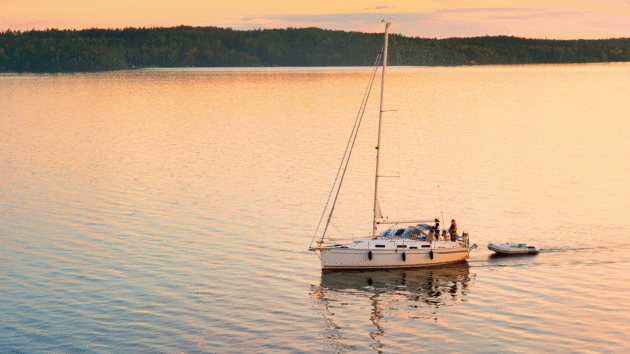
Photo: Janneke Kuysters
For the Swedish coast as far as the High Coast the Harbour Guides are very useful (No 10). There is also an online HarbourGuide app version. Further north, the only cruising guide is made by the Svenska Kryssarklubben (www.sxk.se), available in Swedish only.
The Finnish coast is covered by the Great Harbour Book series. ce guide, published in Finnish. Apps like Navily and Harbourmaps are of limited use, especially in the north of the Gulf, because there is hardly any input by yachtsmen in this area. We used a combination of Navionics, OpenCPN, the Harbourguide app and Google Earth to find information about anchorages, harbours and marinas.
Swedish permit
Sweden has a special residence permit from the Migration Agency (Migrationsverket) that lets visitors stay for up to six months extra on top of the standard 90 Schengen days.
How to apply for a Swedish permit
Start the application online. You’ll need an interview at a Swedish embassy/consulate if applying from your home country, or while you are already in Sweden.
You need a detailed cruising itinerary.
You must have sufficient funds (SEK450 per person per day).
You must have travel insurance that covers all medical emergencies, including repatriation. It’s recommended to apply at least three months before sailing to Sweden because the process can take time. The permit length varies, but for tourism, it’s a maximum of six months.
Enjoyed reading this?
A subscription to Yachting Monthly magazine costs around 40% less than the cover price, so you can save money compared to buying single issues.
Print and digital editions are available through Magazines Direct – where you can also find the latest deals.
YM is packed with information to help you get the most from your time on the water.
-
-
- Take your seamanship to the next level with tips, advice and skills from our experts
- Impartial in-depth reviews of the latest yachts and equipment
- Cruising guides to help you reach those dream destinations
-
Follow us on Facebook, Twitter and Instagram.
Note: We may earn a commission when you buy through links on our site, at no extra cost to you. This doesn’t affect our editorial independence.